
The Trust was a resistance movement that existed mainly on paper in the Lubyanka. From about 1921 to 1927 the Soviet secret police presented the Russian emigration in Europe with a disciplined monarchist underground inside the USSR, complete with a central committee, couriers, safe crossing points on the frontier and contacts high in the Soviet government. Émigré generals, foreign intelligence services and two of the regime's most dangerous enemies believed in it1,3.
Reviewing the history for CIA's Studies in Intelligence in 1970, an Agency officer called the real contest of those years "a ruthless campaign by the Soviet services to destroy the Russian emigré groups abroad"1. The Trust was its centerpiece.
The legend
The cover organization was the Monarchist Organization of Central Russia, known by its Russian initials MOTsR. Its business front was the Moscow Municipal Credit Association, and in letters abroad the conspirators used commercial code: the organization was the "trust," the communists were "competitors"3,4. The operation was managed by Artur Artuzov of the Cheka's counterintelligence department, under Felix Dzerzhinsky3,4.
Its main performer was Alexander Yakushev, a former senior official of the imperial civil service who held a post in the Soviet trade bureaucracy and could travel abroad. In 1921 he called on an old acquaintance in Reval (Tallinn), a former tsarist officer working for the British, and spoke of an anti-Bolshevik organization among officials who served the new regime only outwardly3. Later trips took him to the Supreme Monarchist Council in Berlin and eventually to the pretender, Grand Duke Nikolai Nikolayevich. A former tsarist general serving the Red Army, N. M. Potapov, went abroad with the same story1,3.
The line Yakushev carried was tailored to keep the émigrés quiet. The Bolshevik regime was decaying and would fall on its own, he said; terrorism and foreign intervention would only damage the underground, which needed money and patience1,4. Through émigré channels the Polish, French and British services received intelligence that the OGPU had written1.
Savinkov, Reilly and Shulgin
The Trust's most famous catches came through it and its sister operation. Boris Savinkov, the former terrorist and wartime deputy minister, was drawn into Soviet territory in August 1924 by a parallel OGPU legend, Sindikat-2, tried in Moscow and died in the Lubyanka in May 19251,3.
Sidney Reilly, under a Soviet death sentence since the 1918 plot against Lenin, was approached in 1925 through Maria Zakharchenko-Schultz, a niece by some accounts of General Alexander Kutepov, who believed in the Trust and carried its messages1,3,4. On 25 September 1925 Reilly met Yakushev near the Finnish border and agreed to a short trip to meet the organization's "political council." He crossed that night and never returned. Soviet sources at first said he had been killed at the border; he was executed near Moscow in November 19251,3.
Reilly's disappearance damaged the Trust in London, so the OGPU staged a recovery. Vasily Shulgin, a former Duma deputy who had accepted the abdication of Nicholas II, was invited in late 1925 to search for a missing son. The Trust moved him through Kiev, Moscow and Leningrad and let him leave safely. His book Three Capitals, which he sent to his Trust "friends" for editing before publication, appeared in early 1927 and reported that Russia was reviving1,3,4.
Collapse
On 13 April 1927 Eduard Opperput, the Trust's financial manager and an OGPU agent, crossed into Finland with Maria Zakharchenko-Schultz and told Finnish interrogators that the Soviet secret police had controlled the organization from the beginning. His statements appeared in the Latvian and Finnish press, and intelligence officers of several countries questioned him; Shulgin had to admit he had been duped1,3.
Kutepov's people then sent Opperput and Zakharchenko back into the USSR on a sabotage raid in late May 1927. The CIA reviewer wrote that Opperput was killed near Smolensk and that Zakharchenko died of wounds after a gunfight with cavalry; Soviet announcements said the Moscow team had been caught and shot1,4.
What the record shows, and what it does not
The Trust left a long legacy in Western counterintelligence. CIA compiled an unclassified study of it in March 19692,4. In 1993 the Western author John Costello, writing with former KGB spokesman Oleg Tsarev, reported that the file ran to 37 volumes, so tangled that Russian service historians struggled to separate fact from invention5.
That is the central problem. Much of what is known comes from Opperput, from Soviet popular histories written with selective access to OGPU files, and from émigrés who never understood what had happened to them. Dates and names vary between accounts, and the scope of the OGPU's control at any given moment cannot be fixed from the open record1,4.
The documents
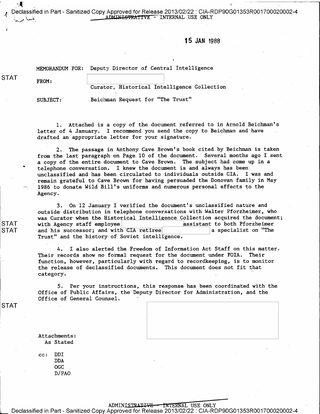
Declassified records of this operation, with the scans and their full text hosted here.
Checking the record
Dates and outcome compared in two independent sources: they agree.
- CIA
- Directed against the emigration from 1922 to 1927; collapsed in 1927 after Opperput's apparent defection. Savinkov lured into Russia in 1924 and died in prison; Reilly lured to Moscow in 1925 and executed; Trust lay in shambles after Opperput's revelations.
- Wikipedia
- Ran from 1921 to 1927. Lured Savinkov and Reilly into the Soviet Union, where they were captured; Shulgin's monitored trip; operation ended 1927.
The sources agree on the course and end of the operation but differ on its start: Wikipedia and the Harris thesis date the first contacts to 1921, the CIA reviewer dates the campaign from 1922. This page uses 1921 for the earliest contacts. The CIA reviewer also rejects the Soviet line, which Wikipedia partly repeats, that the OGPU took over a pre-existing monarchist group.
Sources
- CIA Book review of The Secret Road to World War Two: Soviet Versus Western Intelligence, 1921–1939, by Paul W. Blackstock (Studies in Intelligence, vol. 14, no. 1), Central Intelligence Agency, Center for the Study of Intelligence (1970).
- CIA The Trust (CIA-RDP90G01353R001700020002-4), Central Intelligence Agency, FOIA Reading Room (1969-03).
- Official history The Trust: The Classic Example of Soviet Manipulation (thesis, Stephen A. Harris), Naval Postgraduate School, Monterey (via Internet Archive) (1985-09).
- Other The Trust (Intelligencer: Journal of U.S. Intelligence Studies, vol. 30, no. 1), Association of Former Intelligence Officers (2025).
- Wikipedia Operation Trust, Wikipedia.
- Wikipedia English Wikipedia article (used for cross-checking).
Elsewhere in the files
Read next
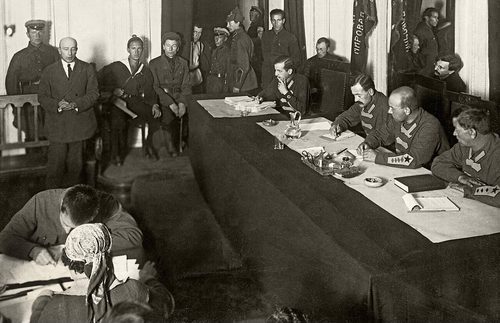 12 May 1922 – 29 August 1924
Operation Sindikat-2
An OGPU deception of 1922–1924 that invented an underground party inside Soviet Russia to draw the old terrorist Boris Savinkov home. He crossed the border in August 1924 and walked into a trap.
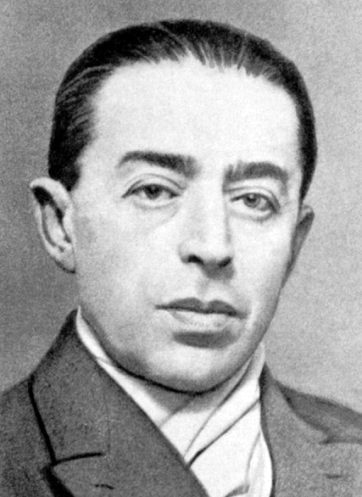 1874–1925
Sidney Reilly
Russian-born British agent whose 1918 plot against Lenin made him famous and whose 1925 return to Soviet Russia, lured by the OGPU's Trust, ended in his execution. Much of his legend is invention.
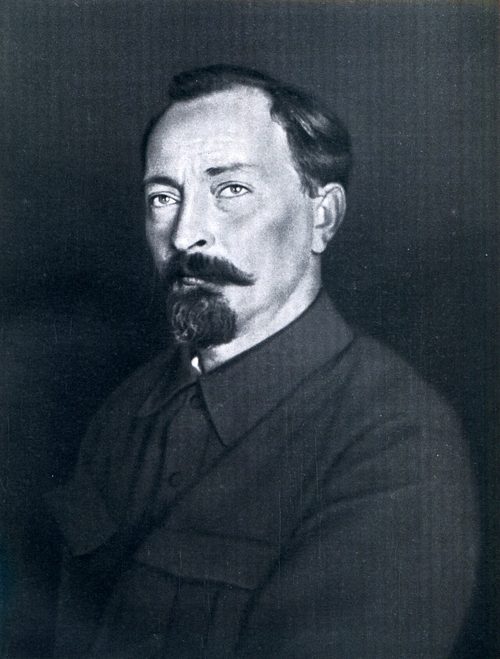 1877–1926
Felix Dzerzhinsky
Polish-born revolutionary who founded and ran the Cheka and its successors, the GPU and OGPU, from 1917 until his death in 1926, presiding over the Red Terror and the Trust deception.
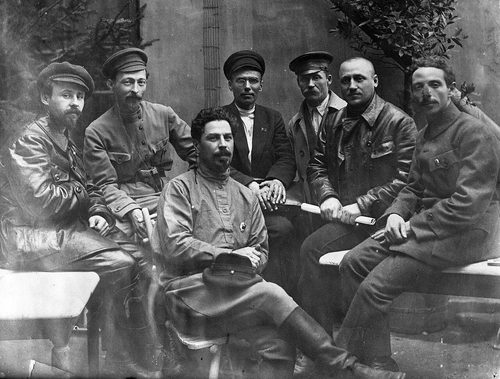 Soviet Union · 1917–1946
Cheka, OGPU and NKVD
The Soviet political police from 1917 to 1946 under its successive names: Cheka, GPU, OGPU and NKVD. It ran the Red Terror, the Trust deception, the Great Terror, Katyn and Stalin's killings abroad.
1920s–1990s
Double agents
Agents who seem to serve one service while controlled by another. From the OGPU's Trust to MI5's Double Cross system and the FBI's Duquesne case, the best of them turned an enemy network into a channel for deception.
July 1941 – August 1944
Operation Monastery
An NKVD radio game of 1941–1944 in which the agent Alexander Demyanov, 'Heine', posed as the Abwehr's man in Moscow, fed German intelligence disinformation and drew its couriers into arrest.