
 Page 1 of 86
From the document
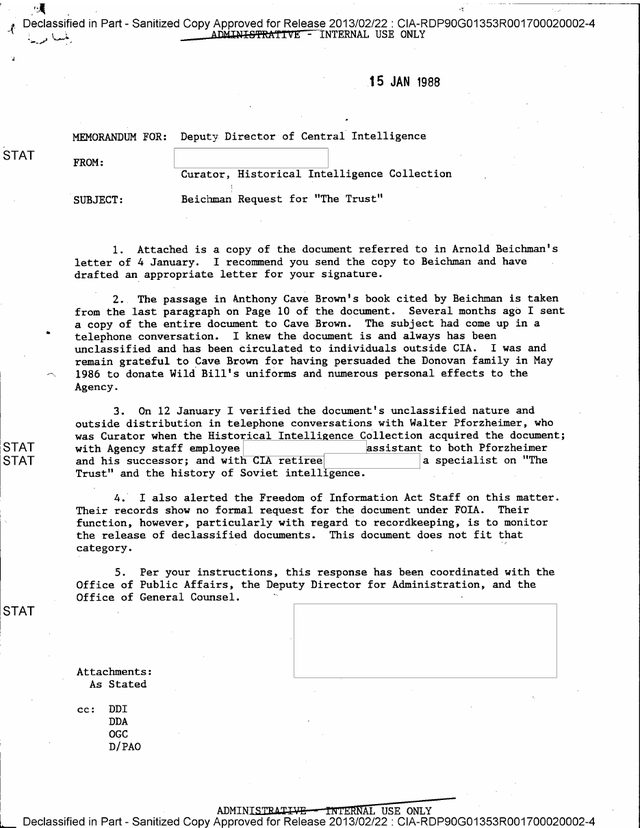
I knew the document is and always has been unclassified and has been circulated to individuals outside CIA.
Thus, communists were to be referred to as "competitors", the MOTSR Central Comittee as "The Board Management of the Trust", etc.
Whether his defection was genuine or just another ingenious maneuver of the GPU may never be known.
It must be noted however, that the Trust operation succeeded not because of its inherent merits, but rather because of the inherent weakness of elements it was targeted against.
Excerpts are passages from a US government work (public domain), quoted exactly as they read in the scan, and checked against the full text on every rebuild.
Someone in the CIA wrote this account of the Trust in the late 1960s, and someone else later wrote across its first page, by hand: "Internal CIA study, completed ca. March 1969, never published." It has no author's name, no classification marking and no footnotes to agency files; its sources, listed at the end, are published Soviet and émigré books1. It survives because of a 1988 request from outside, explained in the covering memorandum that opens this extract1.
How it got out
On 15 January 1988 the curator of the CIA's Historical Intelligence Collection wrote to the Deputy Director. The writer Arnold Beichman had asked for "The Trust" after seeing it quoted in a book by Anthony Cave Brown. The curator explained that he had sent Cave Brown the whole study some months earlier; that it was and always had been unclassified and had circulated outside the agency; and that he had checked this with Walter Pforzheimer, who had been curator when the collection acquired the study, among others. He recommended sending Beichman a copy, and noted that public affairs, administration and the general counsel had been consulted1. His own name and those of two people he consulted are blacked out.
What the study says
The narrative follows the operation in order. It sets the scene with Lenin's December 1921 call for vigilance and the Cheka's earlier penetrations of émigré groups, then turns to A. A. Yakushev, a senior official of the waterways administration, arrested after an indiscreet visit to an émigré in Tallinn and turned by Artur Artuzov and Roman Pillar. The study weighs Opperput's later version of the recruitment against the Soviet writer Lev Nikulin's1. It explains the cover: a monarchist organization, MOTsR, posing abroad as a "Trust" and using business language as code1.
Then come the operations the Trust made possible: Yakushev's trips to Berlin and Paris and his meeting with Grand Duke Nikolai Nikolayevich; the separate, parallel deception that lured Boris Savinkov across the Polish border in August 1924 (Operation Sindikat-2); the Estonian channel and the strange case of the Estonian minister Ado Birk; and the capture of Sidney Reilly in September 1925 after a meeting in Moscow, covered by a staged shooting on the Finnish border1. The end comes with Eduard Opperput's flight to Finland in April 1927 with Maria Schultz, his newspaper revelations, and their fatal return to Moscow as saboteurs that June1.
Appendices give notes on the people involved, sorted into genuine anti-Bolsheviks, GPU officers and agents, and foreign officials, and assess the published literature1.
How to read it
This is not an operational history drawn from secret files. It is an analyst's synthesis of published sources, several of them Soviet works written to glorify the security services, and it says so, repeatedly weighing Nikulin against Opperput, Richard Wraga and others and calling some stories implausible1. Its verdict is that the Trust worked less because of its own brilliance than because the émigrés and the small Baltic and Polish services believed what they wanted to believe; and it leaves Opperput's motives open1.
The CIA's journal Studies in Intelligence reviewed a book covering the same ground, Paul Blackstock's The Secret Road to World War Two, in its 1970 volume, soon after this study was finished2.
Sources
- CIA The Trust (CIA-RDP90G01353R001700020002-4), Central Intelligence Agency, CREST (1969-03).
- CIA Book review of The Secret Road to World War Two: Soviet Versus Western Intelligence, 1921–1939, by Paul W. Blackstock (Studies in Intelligence, vol. 14, no. 1), Central Intelligence Agency, Center for the Study of Intelligence.
- Wikipedia Operation Trust, Wikipedia.