
Portrait: Sidney Reilly, in a photograph released by Russia's FSB. Unknown. Likely an anonymous state intelligence agent working for either the Russian Em…. Wikimedia Commons, Public domain.

The man known as Sidney Reilly told so many stories about himself that the first fact in doubt is his name. An OGPU dossier compiled after his capture in 1925 recorded him as Zigmund Rozenblum, born on 24 March 1874 in Odessa; biographers have offered other first names, other years and other provinces7. He reached London in the mid-1890s as Sigmund Rosenblum, and by 1899 was using the name Sidney George Reilly, apparently with official help7.
Agent of Special Branch and SIS
Biographers place him in the 1890s as a paid informant on Russian émigré circles for William Melville of Scotland Yard's Special Branch, who later ran a section of the new Secret Service Bureau. Before the Russo-Japanese War he was in business at Port Arthur in Manchuria7. Tales that he stole the harbor's defense plans for Japan, or later spied inside the Kaiser's Germany, come from memoirs and early biographies and are not supported by the documentary record7.
From 1914 he was in New York selling munitions. In 1917 he sought intelligence work from the British station there, and on 19 October 1917 he was commissioned a temporary second lieutenant on probation, as the London Gazette recorded in January 19181,7. Early in 1918 Mansfield Cumming's Secret Intelligence Service sent him to Soviet Russia7.
The 1918 plot
In Moscow and Petrograd, Reilly worked with the British diplomatic agent Robert Bruce Lockhart and with French and American contacts on a plan to overthrow the Bolsheviks with the help of the Latvian Rifle regiments that guarded the Kremlin. The Latvian commander they approached, Eduard Berzin, reported the approach to Felix Dzerzhinsky's Cheka7.
After the shooting of Lenin on 30 August 1918 the Cheka struck: the British mission in Petrograd was raided and the naval attaché Francis Cromie killed, and Lockhart was arrested. The American consul in Moscow, DeWitt Clinton Poole, cabled on 9 September that Lockhart was held in the Kremlin on charges of plotting, and judged that there was "some foundation of fact for charges respecting Lettish troops"3,7. Reilly escaped by way of Kronstadt, Helsinki and Stockholm and reached London on 8 November 1918. A Soviet tribunal sentenced him and Lockhart to death in absentia7.
He went next to South Russia with George Hill to report on the White forces. On 12 February 1919 the Gazette listed "2nd Lieut. Sidney George Reilly, R.A.F." among officers awarded the Military Cross "for distinguished services rendered in connection with Military operations in the Field"2,7.
The Trust
In the 1920s Reilly raised money for anti-Bolshevik causes and backed Boris Savinkov, who was lured into the USSR by the OGPU's Sindikat-2 in 19245,6. A year later the Trust, a fake monarchist underground, invited Reilly to meet its leaders. On 25 September 1925 he met the Trust's emissary Alexander Yakushev near the Finnish border and crossed into the USSR that night6. The Soviets first put it about that he had been killed at the frontier. He was interrogated in the Lubyanka and shot near Moscow; the usual date, 5 November 1925, comes from Soviet sources5,6,7.
The legend
Fame came after death. Lockhart's Memoirs of a British Agent (1932) and newspaper serials made Reilly the "master spy," and Ian Fleming is said to have drawn on him for James Bond7. The historian Christopher Andrew judged his career "remarkable, though largely ineffective," and the skeptical biographer Andrew Cook argues his formal SIS employment ran only from March 1918 to 19217.
MI5's personal file on him, covering 1916 to 1944, was opened at the National Archives on 1 May 2002 as KV 2/8274.
Key dates
- 19 October 1917 Commissioned temporary second lieutenant on probation, General List.
- September 1918 Allied plot to use Latvian Riflemen against the Bolsheviks collapses; Reilly flees Russia.
- December 1918 Sentenced to death in absentia by the Supreme Revolutionary Tribunal in Moscow.
- 12 February 1919 Award of the Military Cross gazetted.
- 25 September 1925 Crosses from Finland into the USSR to meet the Trust; arrested by the OGPU.
- 5 November 1925 Executed near Moscow, by the usual account.
- 1 May 2002 His MI5 personal file is opened at the National Archives, Kew.
Sources
- Other Supplement to the London Gazette, 28 January 1918, p. 1363 (temporary commission, General List), The Gazette (UK official public record) (1918-01-28).
- Other Supplement to the London Gazette, 12 February 1919, p. 2238 (award of the Military Cross), The Gazette (UK official public record) (1919-02-12).
- FRUS Foreign Relations of the United States, 1918, Russia, Volume I, Document 611 (Consul Poole to the Secretary of State, 9 September 1918), US Department of State, Office of the Historian (1918-09-09).
- Other Security Service file on Sidney George Reilly (KV 2/827), catalogue description, The National Archives (UK).
- CIA Book review of The Secret Road to World War Two, by Paul W. Blackstock (Studies in Intelligence, vol. 14, no. 1), Central Intelligence Agency, Center for the Study of Intelligence (1970).
- Official history The Trust: The Classic Example of Soviet Manipulation (thesis, Stephen A. Harris), Naval Postgraduate School, Monterey (via Internet Archive) (1985-09).
- Wikipedia Sidney Reilly, Wikipedia.
- Wikipedia English Wikipedia article (used for cross-checking).
Elsewhere in the files
Read next
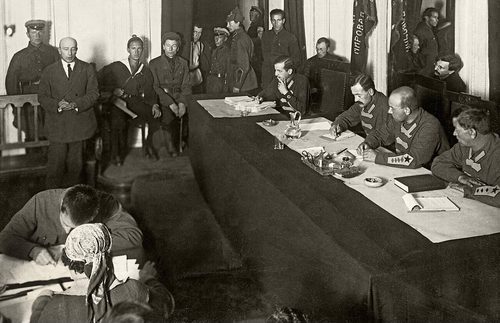 12 May 1922 – 29 August 1924
Operation Sindikat-2
An OGPU deception of 1922–1924 that invented an underground party inside Soviet Russia to draw the old terrorist Boris Savinkov home. He crossed the border in August 1924 and walked into a trap.
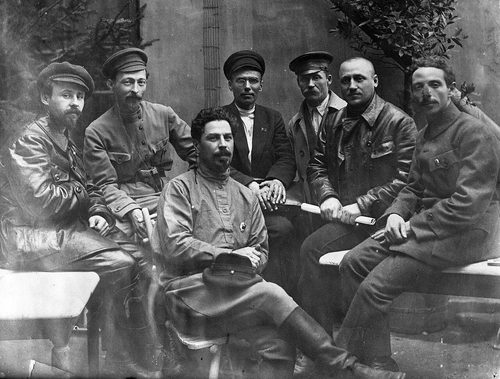 Soviet Union · 1917–1946
Cheka, OGPU and NKVD
The Soviet political police from 1917 to 1946 under its successive names: Cheka, GPU, OGPU and NKVD. It ran the Red Terror, the Trust deception, the Great Terror, Katyn and Stalin's killings abroad.
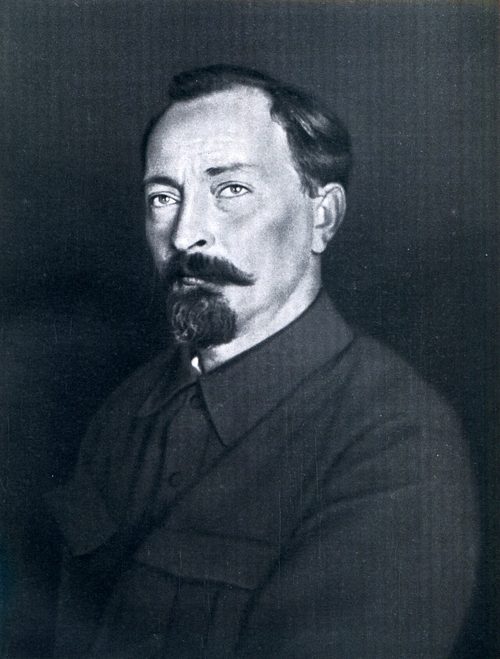 1877–1926
Felix Dzerzhinsky
Polish-born revolutionary who founded and ran the Cheka and its successors, the GPU and OGPU, from 1917 until his death in 1926, presiding over the Red Terror and the Trust deception.
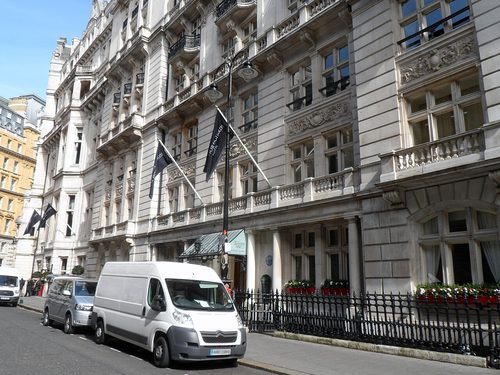 United Kingdom · 1909
Secret Intelligence Service (MI6)
Britain's foreign intelligence service, founded in 1909 as the foreign section of the Secret Service Bureau, run by a chief known as 'C', and not placed on a statutory footing until the Intelligence Services Act 1994.