
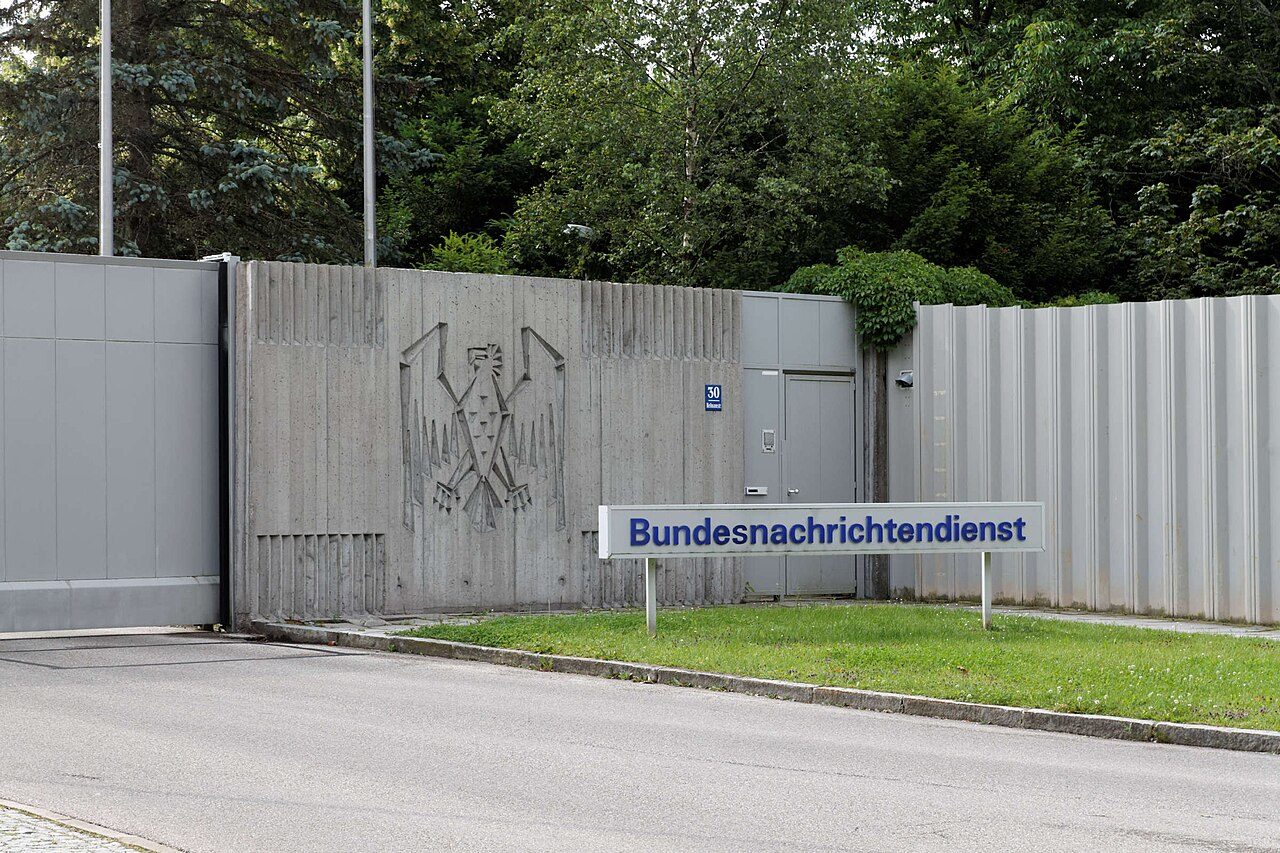
In 1999, to mark fifty years of cooperation, the CIA's head of operations presented the West German intelligence service with a two-volume secret history of how it had been born. Forging an Intelligence Partnership, compiled by the CIA historian Kevin Ruffner, was declassified in 2002 under the Nazi War Crimes Disclosure Act. Its introduction called the Gehlen Organization a "double edged sword": it had given the Americans eyes in the East, but it "boosted the Warsaw Pact's propaganda efforts" and "suffered devastating penetrations by the KGB"1,4,7.
From Foreign Armies East to Pullach
Reinhard Gehlen had headed Foreign Armies East, the German army staff section that assessed the Red Army, from 1942 until the last weeks of the war. He planned to keep his staff and files together and hand them to the Americans. As Germany collapsed he surrendered to the US Army, and in the summer of 1945 he offered to continue the same work for the United States2,4.
The Strategic Services Unit, the CIA's predecessor, searched the prisoner-of-war camps for his officers and interrogated them. As the Cold War began in 1946, American officers who lacked recent knowledge of Soviet forces decided to use German experts, "even though some may have been war criminals," as the National Archives put it in 2000. The organization began work in June 1946 under US Army sponsorship and was soon based in a guarded compound at Pullach, south of Munich3,6,7,2.
The CIA was reluctant to take it on. Evaluations in October 1946 advised against it; by 1949, after an inspection of the operation code-named RUSTY, the agency accepted responsibility, and it sponsored the organization until 1956. Chancellor Konrad Adenauer learned of it in the summer of 19491,4,6.
What it did
Every German prisoner of war returning from Soviet captivity between 1947 and 1955 was questioned by the organization, giving the West an up-to-date picture of Soviet industry and military installations. It watched Soviet rail traffic, airfields and ports in East Germany7.
A CIA officer who knew the service well reviewed Gehlen's memoirs for the agency's classified journal in 1972. He credited the organization with a good record on military and economic intelligence about East Germany and Soviet forces there, but noted that this "came from observation and not from clandestine penetration." As far as the CIA knew, the reviewer wrote, the Germans "never had a good political penetration in East Germany or anywhere else in the Soviet Bloc"2.
Former Nazis and Soviet moles
The organization recruited heavily among former officers of the Wehrmacht, the SS and the SD. Records released under the Disclosure Act show that at least 100 of its officers had been in the SD or Gestapo. The historians on the government's review panel concluded that such men were a security risk as well as a moral liability: their pasts could be used to blackmail them1,5.
That risk was realized. Heinz Felfe, a former SS officer who joined the organization in the early 1950s, rose to a senior counterintelligence post while working for the KGB. He and two associates were uncovered in 1961 and convicted in 1963. The CIA reviewer of 1972 wrote that the BND's "very real and crushing defeat" had come at the hands of the KGB and was "best personified by the Felfe case." The historian Timothy Naftali, reviewing the CIA files for the government panel, concluded that the Gehlen Organization had been "the back door by which the Soviets penetrated the Western alliance"5,7,2,1.
The BND
The federal cabinet decided on 11 July 1955 to take over the organization, and on 1 April 1956 it became the Bundesnachrichtendienst, attached to the Federal Chancellery, with Gehlen as president. It was West Germany's only foreign intelligence service. Gehlen led it until he retired in April 1968; his successor, Gerhard Wessel, began a reorganization6,2,8.
For more than twenty years the BND had no statutory basis and no parliamentary oversight. A 1978 law brought the intelligence services under the scrutiny of a parliamentary control committee, and a BND Act followed in 19906.
The American record opens
The CIA did not acknowledge its relationship with Gehlen until 20 September 2000, in a court filing in a Freedom of Information case brought by the researcher Carl Oglesby. It then released the Gehlen files and Ruffner's history through the National Archives3,4.
Key dates
- 22 May 1945 Reinhard Gehlen surrenders to the US Army in Bavaria and offers his files and staff.
- June 1946 The Gehlen Organization begins work under US Army sponsorship in the American zone.
- July 1949 The CIA takes over sponsorship from the Army.
- 11 July 1955 The federal cabinet decides to take the organization over as a state service.
- 1 April 1956 The Bundesnachrichtendienst is founded, attached to the Federal Chancellery, with Gehlen as president.
- 6 November 1961 Heinz Felfe, head of the BND's Soviet counterintelligence section, is arrested as a KGB agent.
- April 1968 Gehlen retires; Gerhard Wessel succeeds him.
- 1978 A federal law places the intelligence services under parliamentary oversight.
- 20 September 2000 The CIA acknowledges its relationship with Gehlen in a court filing under the Nazi War Crimes Disclosure Act.
Operations against the BND

People
Sources
- National Security Archive The CIA and Nazi War Criminals (Electronic Briefing Book No. 146), posting Forging an Intelligence Partnership: CIA and the Origins of the BND, 1945–49, National Security Archive (2005-02-04).
- CIA Book review: The Service: The Memoirs of General Reinhard Gehlen (Studies in Intelligence 16, no. 3), archived, Central Intelligence Agency, Center for the Study of Intelligence (1972).
- National Archives CIA acknowledges intelligence relationship with General Reinhard Gehlen (press release), National Archives and Records Administration (2000-09-20).
- National Archives Disclosure: Newsletter of the Nazi War Crimes and Japanese Imperial Government Records Interagency Working Group, November 2002, National Archives and Records Administration (2002-11).
- National Archives Historical Analysis of 20 Name Files from CIA Records (Richard Breitman), National Archives and Records Administration, Nazi War Crimes Interagency Working Group (2001).
- Other Vor 60 Jahren: Gründung des BND, Bundeszentrale für politische Bildung (2016-03).
- Wikipedia Gehlen Organization, Wikipedia.
- Wikipedia Federal Intelligence Service, Wikipedia.
- Wikipedia English Wikipedia article (used for cross-checking).
Elsewhere in the files
- Agency Stasi (Ministry for State Security)
- Document Kissinger to Nixon on Brandt's fall: the blackmail reports (May 1974)
- Document What the CIA told the State Department about Eichmann (July 1960)
- Operation Operation Neptune (1964)
- Operation The Guillaume affair
- Operation The capture of Adolf Eichmann
- Person Reinhard Gehlen
- Tradecraft Cipher machines