
 Page 1 of 5
From the document
When an opportunity is apparent to disrupt or neutralize black nationalist, hate-type organizations through the cooperation of established local news media contacts or through such contact with sources available to the Seat of Government, in every instance careful attention must be given to the proposal to insure the targeted group is disrupted, ridiculed, or discredited through the publicity and not merely publicized.
Be alert to determine evidence of misappropriation of funds or other types of personal misconduct on the part of militant nationalist leaders so any practical or warranted counterintelligence may be instituted.
Intensified attention under this program should be afforded to the activities of such groups as the Student Nonviolent Coordinating Committee, the Southern Christian Leadership Conference, Revolutionary Action Movement, the Deacons for Defense and Justice, Congress of Racial Equality, and the Nation of Islam.
Excerpts are passages from a US government work (public domain), quoted exactly as they read in the scan, and checked against the full text on every rebuild.
The Church Committee later wrote that the "long, hot summer of 1967" put intense pressure on the FBI to do something about urban unrest. On 25 August headquarters answered with this letter. It went to the Special Agent in Charge at Albany, with copies to 22 more field offices from Atlanta to the Washington Field Office, and set up the fourth of the Bureau's secret counterintelligence programs, known by its file caption "Counterintelligence Program, Black Nationalist – Hate Groups"1,2.
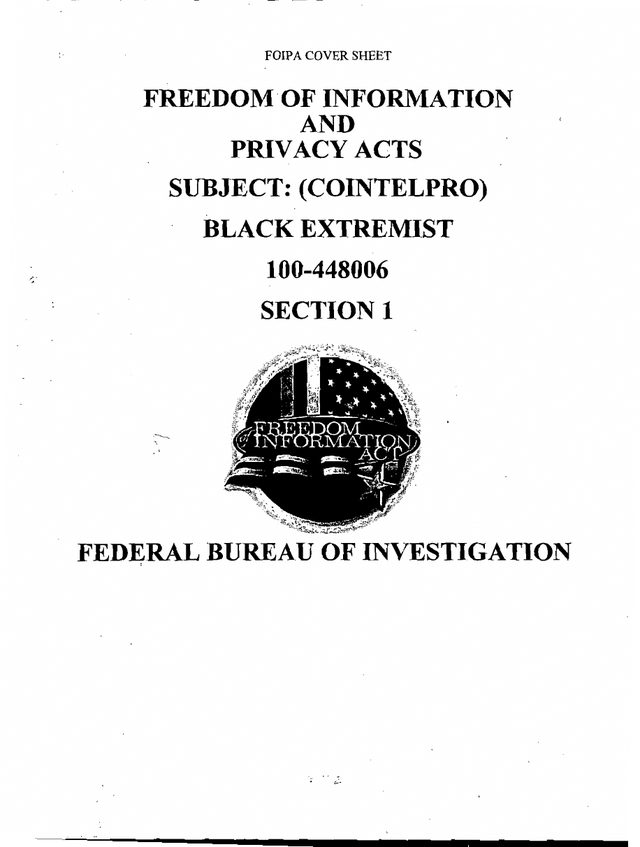
The copy hosted here is the first item in the FBI's released file 100-448006. The first two pages are FOIA administration: a cover sheet and a notice that the "best copy obtainable" is reproduced. The letter itself is the following three pages1.
What the letter orders
The first page tells each office to open a control file and to assign the work to "an experienced and imaginative Special Agent." It then states the purpose in the words the Church Committee later made famous: "to expose, disrupt, misdirect, discredit, or otherwise neutralize" black nationalist organizations, "their leadership, spokesmen, membership, and supporters"1,2.
The second page lists methods. Agents were to exploit organizational and personal conflicts between and within groups; to use friendly news media contacts so that targets were "ridiculed, or discredited" and not merely publicized; to keep "rabble-rouser" leaders from spreading their views; and to dig up evidence of immorality, criminal records or misuse of funds. It names six organizations for "intensified attention," including the nonviolent Southern Christian Leadership Conference, and four leaders by name, among them Stokely Carmichael and Elijah Muhammad1.
The third page separates the program from the existing ones against the Communist Party and against the Klan and other white "hate groups." It forbids any action "without specific prior Bureau authorization," and warns that "under no circumstances should the existence of the program be made known outside the Bureau." It closes by urging an "enthusiastic and imaginative approach"1.
What happened next
In March 1968 the program was widened from 23 to 41 field offices. The expanding letter set long-range goals, among them preventing the rise of a black "messiah" who could unify the movement, and named Martin Luther King Jr. in that context. The SCLC was kept as a "primary target," and King's name was added to the list of persons targeted2.
COINTELPRO ended in April 1971 after files stolen from the FBI office in Media, Pennsylvania, reached the press. The Church Committee's staff report of April 1976 quoted this originating letter at length2,4.
How to read it
The letter is a headquarters directive, not a record of what agents did; the actions it set in motion appear in the field-office replies and later case files, which are not hosted here because they name private individuals and informants1. Its language, including "hate-type" for groups such as the SCLC, is the Bureau's own. The Church Committee's verdict was that COINTELPRO went beyond collecting intelligence to secret action against First Amendment activity2. The rest of the series is on the FBI's Vault3.
Sources
- FBI COINTELPRO Black Extremist, Part 01 (FBI file 100-448006, section 1), archived copy of the FBI Vault PDF, Federal Bureau of Investigation, FBI Records: The Vault (Wayback Machine capture) (1967-08-25).
- Congress Final Report of the Select Committee to Study Governmental Operations with Respect to Intelligence Activities, Book III (S. Rep. 94-755), US Senate, digitized by the Internet Archive (1976-04).
- FBI COINTELPRO (FBI Records: The Vault), Federal Bureau of Investigation.
- Wikipedia COINTELPRO, Wikipedia.