

From the document
Time is running against us. The Cuban people feel helpless and are losing hope fast.
Americans once ran a successful revolution. It was run from within, and succeeded because there was timely and strong political, economic, and military help by nations outside who supported our cause.
It aims for a revolt which can take place in Cuba by October 1962. It is a series of target actions and dates, not a rigid time-table.
A vital decision, still to be made, is on the use of open U.S. force to aid the Cuban people in winning their liberty.
Excerpts are passages from a US government work (public domain), quoted exactly and checked against the text on history.state.gov on every rebuild.
Ten months after the The Bay of Pigs invasion, the Kennedy administration tried again to remove Fidel Castro, this time by trying to build a revolt inside Cuba. A memorandum from the President dated 30 November 1961 put the effort under Brigadier General Edward Lansdale of the Air Force as "Chief of Operations." He was to work through the regular departments, and knowledge of the program was limited to a handful of officials2. The FRUS editors note that an earlier draft had put Attorney General Robert Kennedy in charge, with Lansdale under him2. The program became known as Operation Mongoose.
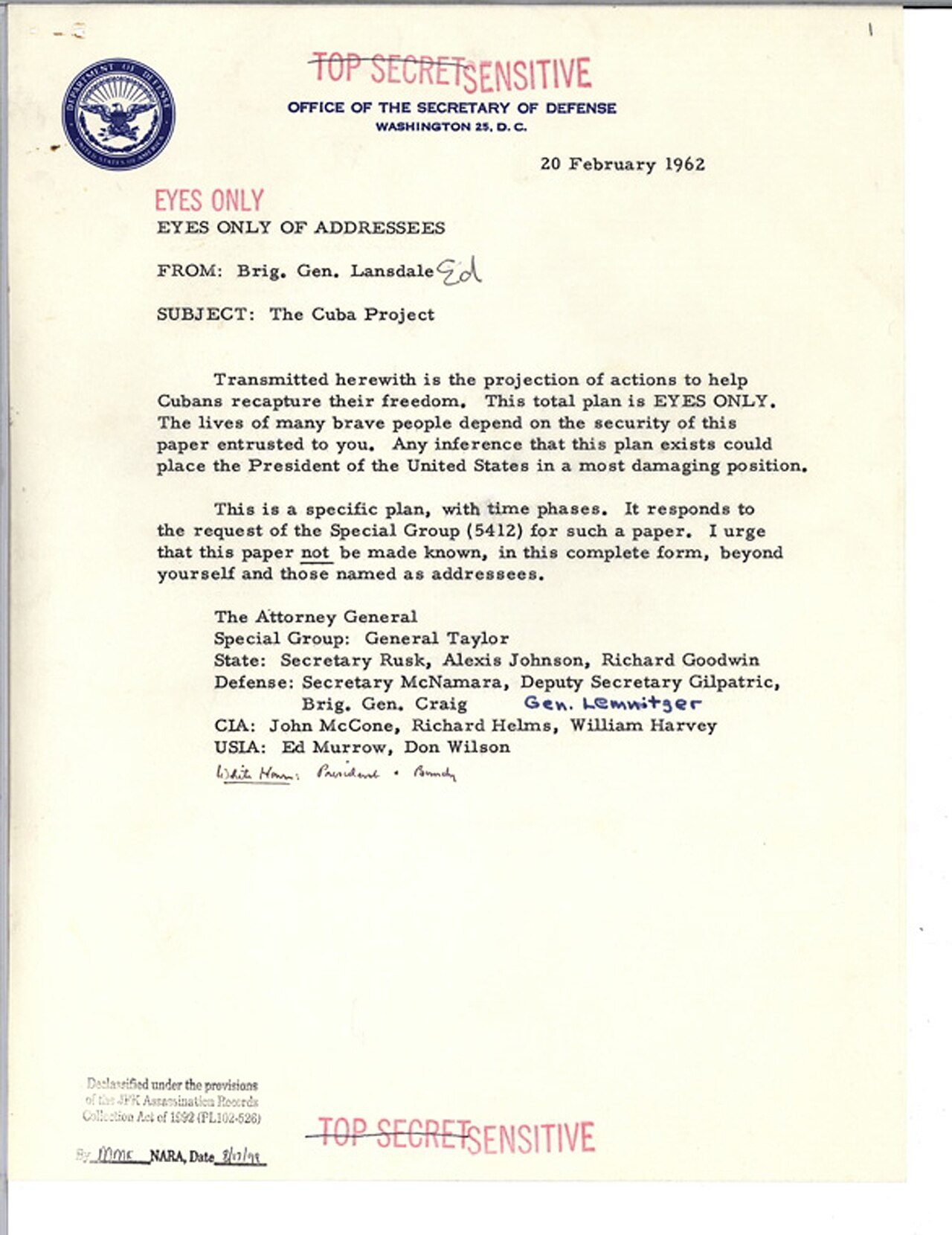
The document printed here is Lansdale's second statement of the plan. FRUS prints the program review of 20 February 1962. The 39-page operational plan attached to it is not printed in the book and appears only in the volume's microfiche supplement1.
The January version
Lansdale's first paper under the title "The Cuba Project" was dated 18 January 1962. It set out the objective of helping "the Cubans overthrow the Communist regime from within Cuba." Under it, Lansdale assigned 32 tasks to the State and Defense Departments, the CIA and other agencies, asking each what it could actually do1,3. The status notes show how thin the base was: the CIA hoped to have eight to ten Cuban political action agents spotted and assessed by mid-February3. The paper was blunt about the political damage of April 1961. The failure of the American-backed landing, it said, had so shaken Cuban patriots' faith in the United States that any new effort needed visible support from Latin American governments3.
What the February review says
The answers came back on 15 February, and five days later Lansdale circulated the program review. The distribution list shows 12 copies: the President through McGeorge Bundy, Robert Kennedy, General Maxwell Taylor, Secretary Rusk, Secretary McNamara, Director of Central Intelligence John McCone, Murrow of the US Information Agency, a representative of the Joint Chiefs and William Harvey of the CIA, among others1.
The review restates the goal in the language of Kennedy's November memorandum. It admits that "we still know too little about the real situation inside Cuba"1. It frames the project with an analogy to the American Revolution, a revolt "run from within" with outside help1. Then it gives a timetable, which FRUS prints as a list1:
- Phase I, Action, March 1962: "Start moving in."
- Phase II, Build-up, April–July 1962: operations inside Cuba together with outside political, economic and military support.
- Phase III, Readiness, 1 August 1962: a check for a final policy decision.
- Phase IV, Resistance, August–September 1962: guerrilla operations.
- Phase V, Revolt, first two weeks of October 1962: "open revolt and overthrow of the Communist regime."
- Phase VI, Final, during October 1962: establishment of a new government.
The attachment contained a basic action plan for inside Cuba and six support plans: political, economic, psychological, military, sabotage and intelligence. The review leaves operational decisions with the Chief of Operations1. It ends with the question the plan could not answer by itself: whether the United States would send in its own forces if a revolt began and needed help to survive. Lansdale asked for an early decision "prior to deep involvement of the Cubans in this program"1.
What happened next
The answer was cautious. On 14 March 1962 the Special Group (Augmented) issued guidelines that put the acquisition of "hard intelligence" first. The guidelines ruled out, for the time being, actions "reasonably calculated to inspire a revolt." They also accepted that "final success will require decisive U.S. military intervention"4. A note in State Department files records that when the guidelines were discussed with the President on 16 March, he was skeptical that circumstances would arise to justify using American forces, and no such decision was taken4.
The October target date came and went in a way no one had planned for. Soviet missiles were found in Cuba in mid-October; the Intelligence in the Cuban Missile Crisis page covers that discovery5. Planning in the same months for a pretext to intervene produced the Joint Chiefs' The Northwoods memorandum (1962)5. The CIA's side of Mongoose was run by William Harvey, who also handled the agency's contacts in the The plots against Fidel Castro5.
Why it matters
The program review is the clearest statement in the official record of what Mongoose was supposed to achieve and when1. It does not mention assassination; the Senate's 1975 inquiry into plots against Castro is a separate story, told on the Alleged Assassination Plots Involving Foreign Leaders (1975) page5. The review appeared in the Cuba volume of Foreign Relations in 1997 alongside the Special Group records that show the plan being cut back1,4.
Sources
- FRUS Foreign Relations of the United States, 1961–1963, Volume X, Cuba, January 1961–September 1962, Document 304, US Department of State, Office of the Historian (1997).
- FRUS Foreign Relations of the United States, 1961–1963, Volume X, Document 278 (Memorandum From President Kennedy, 30 November 1961), US Department of State, Office of the Historian (1997).
- FRUS Foreign Relations of the United States, 1961–1963, Volume X, Document 291 (Program Review, 18 January 1962), US Department of State, Office of the Historian (1997).
- FRUS Foreign Relations of the United States, 1961–1963, Volume X, Document 314 (Guidelines for Operation Mongoose, 14 March 1962), US Department of State, Office of the Historian (1997).
- Wikipedia Operation Mongoose, Wikipedia.
Elsewhere in the files
- Document 16 October 1962: the first White House meeting on the missile sites
- Document Lansdale's first Cuba Project program review (18 January 1962)
- Document The CIA Inspector General's report on plots to kill Castro (1967)
- Document The CIA historian's case against the Taylor Committee (1984)
- Document The Northwoods memorandum (1962)
- Operation Operation Mongoose