
 Page 1 of 15

From the document
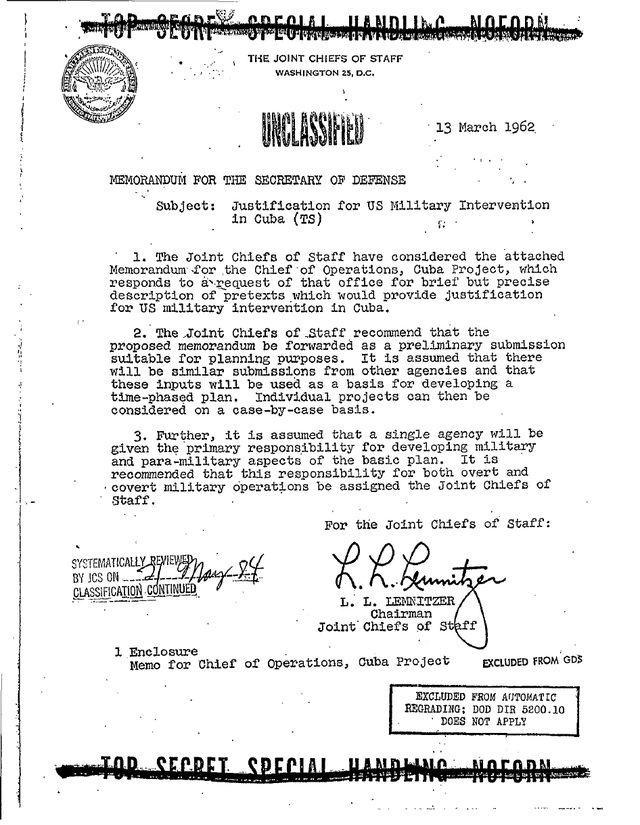
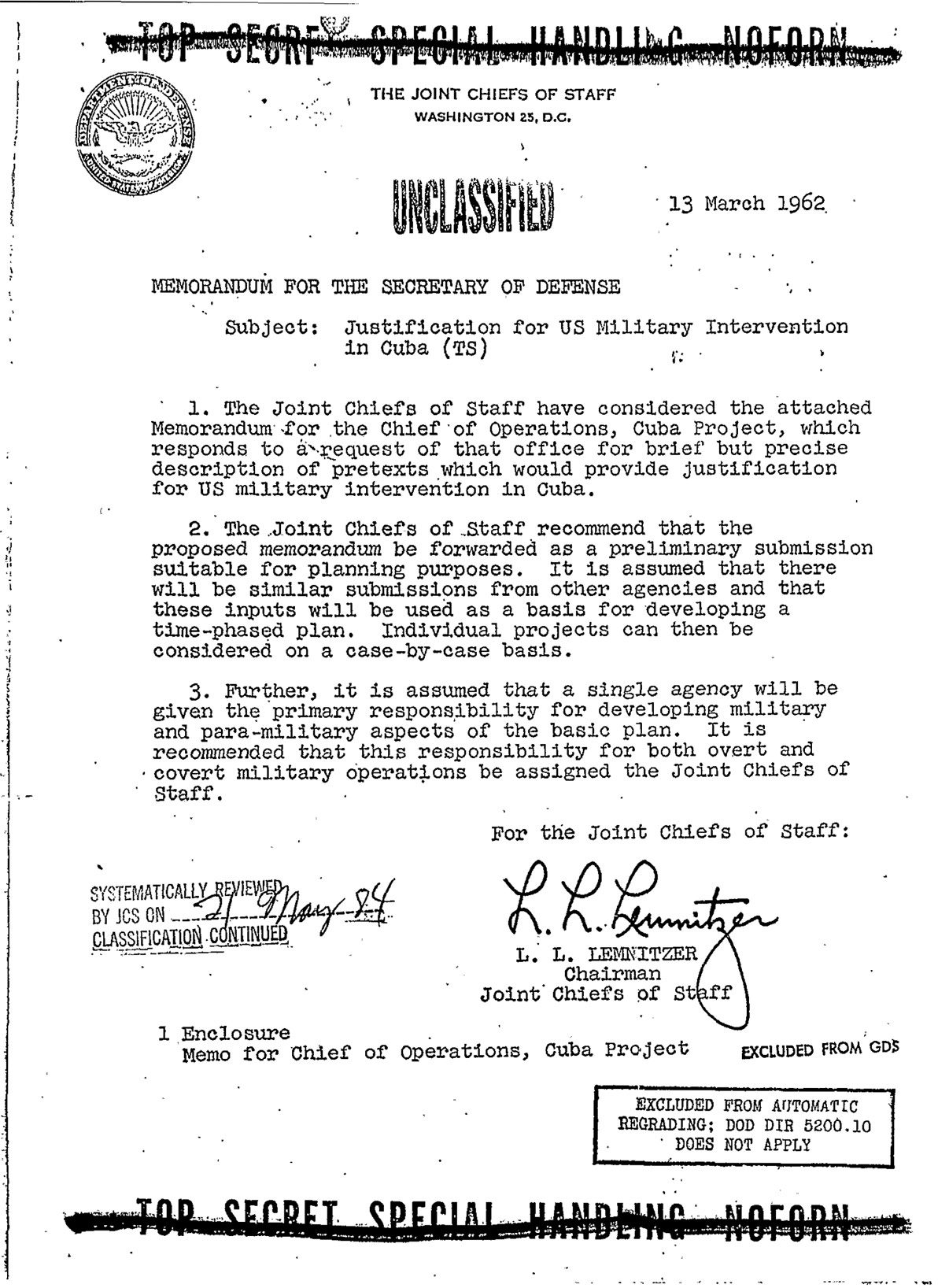
The Joint Chiefs of Staff have considered the attached Memorandum for the Chief of Operations, Cuba Project, which responds to a request of that office for brief but precise description of pretexts which would provide justification for US military intervention in Cuba.
The desired resultant from the execution of this plan would be to place the United States in the apparent position of suffering defensible grievances from a rash and irresponsible government of Cuba and to develop an international image of a Cuban threat to peace in the Western Hemisphere.
We could develop a Communist Cuban terror campaign in the Miami area, in other Florida cities and even in Washington.
determination that a credible internal revolt is impossible of attainment during the next 9-10 months will require a decision by the United States to develop a Cuban "provocation" as justification for positive US military action.
Excerpts are passages from a US government work (public domain), quoted exactly as they read in the scan, and checked against the full text on every rebuild.
The memorandum was an answer to a homework assignment. In early 1962 the Kennedy administration's covert campaign against Fidel Castro, Operation Mongoose, was run by Edward Lansdale as Chief of Operations of the Cuba Project. On 5 March he asked the Joint Chiefs of Staff for a "brief but precise description" of pretexts that could justify American military intervention in Cuba, and wanted their views by 13 March1. The work went to the Pentagon officer who represented the Joint Chiefs on the Cuba Project's Caribbean Survey Group. His report, dated 9 March, was circulated to the Chiefs on 12 March as JCS 1969/321, under the heading NORTHWOODS1.
The Chiefs approved it, and on 13 March 1962 their chairman, General Lyman Lemnitzer, sent it to Secretary of Defense Robert McNamara1.
How the document is built
The surviving file is fifteen pages, stamped TOP SECRET and, after review, UNCLASSIFIED1. It has four layers.
The cover memorandum is three short paragraphs over Lemnitzer's signature. The Chiefs recommended that the paper go forward as a "preliminary submission suitable for planning purposes." They expected other agencies to send similar ideas and asked that the Joint Chiefs be given responsibility for both overt and covert military operations1.
The staff study sets out "the problem," "facts bearing on the problem" and a discussion. Its premise was that intervention would follow a period of rising tension that left the United States looking like the injured party. Because the Soviet Union had not yet tied itself to Cuba's defense, it said, all projects should be ready "within the time frame of the next few months"1. It recommended that the paper not be sent to unified commanders, to American officers at NATO or to the US delegation on the United Nations Military Staff Committee1.
The draft memorandum to Lansdale asked for a single, time-phased plan in which incidents would be combined with "seemingly unrelated events to camouflage the ultimate objective"1.
The annex lists the pretexts themselves. They include faked attacks and sabotage in and around the Guantanamo naval base, a "Remember the Maine" incident involving a US ship, a staged terror campaign against Cuban refugees in Florida, fake Cuban raids on neighboring states, and staged incidents involving civilian and military aircraft over or near Cuba1. Enclosure B quotes the Chiefs' own view, recorded on 7 March, that if an internal revolt proved impossible within nine or ten months, the United States would have to decide to develop a Cuban "provocation"1.
What happened to it
None of the pretexts was carried out. On 14 March 1962 the administration approved guidelines for Mongoose. They said final success would require "decisive U.S. military intervention," but in the coming months they confined the program to intelligence gathering and actions short of a revolt3. A note by U. Alexis Johnson records a meeting with Kennedy on 16 March at which Lemnitzer was present. The President "expressed skepticism" that circumstances would arise to justify overt military action, and "no decision was expressed or implied" approving the use of American forces, although contingency planning would go on3.
Declassification
The memorandum came out through the Kennedy assassination records program. On 18 November 1997 the National Archives opened about 1,500 pages of Joint Chiefs of Staff records on Cuba policy for 1962–64, reviewed by the Assassination Records Review Board, including files of Lemnitzer and his successors4. Parts of the annex appeared online in 1998. The full document drew wide attention only after Bamford featured it in 2001, when the National Security Archive posted the fifteen pages2,6.
How historians use it
Northwoods shows how far Pentagon planners were willing to go on paper in the months after the The Bay of Pigs invasion, and how keen the Chiefs were to take over the Cuba problem from the CIA. It is often quoted out of that context. It was a planning menu sent up for approval, not an operation. It belongs with the other Mongoose papers, including Lansdale's program review, and with the record of how the Cuba problem changed later that year (see Intelligence in the Cuban Missile Crisis). The operation page is Operation Northwoods.
Sources
- National Archives Justification for US Military Intervention in Cuba (TS), Memorandum for the Secretary of Defense, 13 March 1962, with enclosures (JCS 1969/321), Joint Chiefs of Staff, via the National Security Archive (1962-03-13).
- National Security Archive Pentagon Proposed Pretexts for Cuba Invasion in 1962, National Security Archive (2001-04-30).
- FRUS Foreign Relations of the United States, 1961–1963, Volume X, Cuba, 1961–1962, Document 314: Guidelines for Operation Mongoose, 14 March 1962, US Department of State, Office of the Historian (1962-03-14).
- National Archives National Archives Releases Additional Materials Reviewed by the Assassination Records Review Board (media advisory, 17 November 1997), National Archives and Records Administration (1997-11-17).
- Other Operation Northwoods document, "Justification for U.S. Military Intervention in Cuba" memorandum (PDF), Wikimedia Commons (public-domain copy).
- Wikipedia Operation Northwoods, Wikipedia.