

From the document
Now, um, I do think we have to set in motion a chain of events that will eliminate this base. I don't think we [can?] sit still.
if we are to conduct an air strike against these installations, or against any part of Cuba, we must agree now that we will schedule that prior to the time these missile sites become operational.
We set up a, uh, new security classification governing precisely the field of offensive capability in Cuba just five days ago, four days ago, under General Carter.
We're certainly going to do number one; we're going to take out these, uh, missiles.
Excerpts are passages from a US government work (public domain), quoted exactly and checked against the text on history.state.gov on every rebuild.
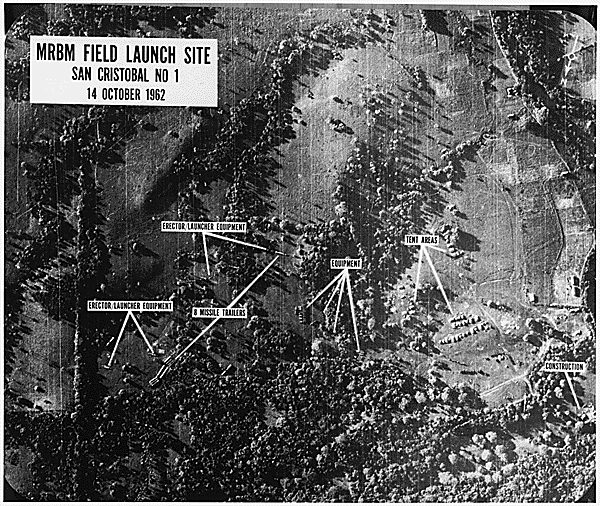
On the morning of Sunday 14 October 1962, an Air Force U-2 flown by Major Richard D. Heyser crossed western Cuba from south to north. The flight over the island lasted about six minutes and produced 928 photographs2. At the National Photographic Interpretation Center, analysts found three medium-range ballistic missile (MRBM) sites under construction near San Cristóbal in Pinar del Río province. They counted eight large missile transporters and four erector-launchers in what looked like firing positions2. Two more flights on 15 October found a fourth MRBM site and two sites at Guanajay for longer-range missiles2.
The CIA's deputy director, General Carter, gave McGeorge Bundy the hard evidence at 8:30 p.m. on 15 October. Bundy decided not to tell the President until morning. In March 1963 he wrote Kennedy an explanation, which FRUS quotes: the evidence needed proper presentation, and a "quiet evening and a night of sleep" was the best preparation for what was coming2. Bundy told Kennedy at 8:45 a.m. on 16 October. Kennedy called his senior advisers to the White House for late morning1.
The document
What survives of that meeting is a recording. Kennedy had a taping system in the White House, and the 11:50 a.m. meeting was taped. FRUS prints a transcript of audiotape 28.1, which is 35 pages in the original. The bracketed question marks and "[words unintelligible]" are in the source text, and the transcribers kept the speakers' hesitations1.
FRUS does not print the whole transcript. It omits the first 7½ pages, in which the photographs were presented and analyzed, and the last 6 pages, on who should be told and when to meet next. Two short passages also remain classified1. The intelligence briefing itself is therefore missing from this document. General Taylor's draft account of the meeting and General Carter's memorandum for the record are in the volume's microfiche supplement1.
What was said
The printed part begins when the President turns to Secretary of State Dean Rusk. Rusk set out the two paths the administration would argue over for the next week. One was a sudden strike. The other was to build pressure through the Organization of American States, the allies and a private warning to Castro, while mobilizing forces1. Secretary of Defense Robert McNamara set out the military premise: any air strike had to come before the missiles were operational, and had to hit the airfields and aircraft as well as the launch sites1. General Maxwell Taylor stressed surprise and warned that the timing of readiness would be hard to judge1.
Kennedy asked why the Soviets would do this. He asked how many weapons the United States had in Turkey, and whether a strike could be effective. He also asked whether submarines could simply bring more missiles in1. Bundy noted that a new security classification for intelligence on Soviet offensive capability in Cuba had been set up only days earlier. He also raised Senator Keating's public claim of 10 October that missile sites were being built1.
Kennedy summed up the military choices as a strike on the missile sites alone, a wider strike on airfields and air defenses, or either of those plus a blockade. Robert Kennedy added invasion as a further option and warned how many people a wide air strike would kill1. Closing the meeting, the President said the first course was certain. A general air strike and an invasion were still open, and he called a second meeting for that evening1,3.
What came after
At the evening session, Carter reported that the additional film showed nothing new, but that a better reading of the first photographs gave good evidence of back-up missiles for each launcher3. At 8:30 the next morning Director of Central Intelligence John McCone joined a meeting in Ball's conference room at the State Department and wrote it up himself. There McNamara listed what was known and what was not. Three MRBM sites could be ready in two weeks. Where the warheads were, and whether they were nuclear, was unknown4. The group that met that week became the Executive Committee of the National Security Council, the ExComm5. The intelligence side of the crisis, including the U-2 coverage that followed, is told on the Intelligence in the Cuban Missile Crisis page.
The tapes were declassified with some excisions in the mid-1990s and published as transcripts, and FRUS printed this one in 19965,1. For historians the 16 October transcript is unusual: an unrehearsed record of senior officials meeting a surprise.
Sources
- FRUS Foreign Relations of the United States, 1961–1963, Volume XI, Cuban Missile Crisis and Aftermath, Document 18, US Department of State, Office of the Historian (1996).
- FRUS Foreign Relations of the United States, 1961–1963, Volume XI, Document 16 (Editorial Note on the U-2 discovery), US Department of State, Office of the Historian (1996).
- FRUS Foreign Relations of the United States, 1961–1963, Volume XI, Document 21 (Off the Record Meeting on Cuba, 16 October 1962, 6:30 p.m.), US Department of State, Office of the Historian (1996).
- FRUS Foreign Relations of the United States, 1961–1963, Volume XI, Document 22 (McCone, Memorandum of Meeting, 17 October 1962), US Department of State, Office of the Historian (1996).
- Wikipedia EXCOMM, Wikipedia.