
 Page 1 of 4
From the document
To assess the strategic and political significance of the recent military buildup in Cuba and of the possible future development of additional military capabilities there.
We believe that the USSR values its position in Cuba primarily for the political advantages to be derived from it, and consequently that the main purpose of the present military buildup in Cuba is to strengthen the Communist regime there against what the Cubans and the Soviets conceive to be a danger that the US may attempt by one means or another to overthrow it.
The USSR could derive considerable military advantage from the establishment of Soviet medium and intermediate range ballistic missiles in Cuba, or from the establishment of a Soviet submarine base there. As between these two, the establishment of a submarine base would be the more likely. Either development, however, would be incompatible with Soviet practice to date and with Soviet policy as we presently estimate it.
If it became clear that the USSR was establishing an "offensive" base in Cuba, most Latin American governments would expect the US to eliminate it, by whatever means were necessary, but many of them would still seek to avoid direct involvement.
Excerpts are passages from a US government work (public domain), quoted exactly as they read in the scan, and checked against the full text on every rebuild.
Special National Intelligence Estimates were the fast form of the intelligence community's formal judgments: written by the CIA's Office of National Estimates, argued over by the agencies, and approved by the United States Intelligence Board. This one, dated 19 September 1962, was drafted by the CIA with the intelligence organizations of State, Defense, the three services and the NSA. Every board member concurred except the Atomic Energy Commission's, who abstained because the subject was outside his remit2.
It is the best-known wrong estimate of the Cold War. Twenty-five days later, on 14 October, a U-2 flown by Major Richard D. Heyser photographed three medium-range ballistic missile sites under construction near San Cristóbal3.
What the hosted pages contain
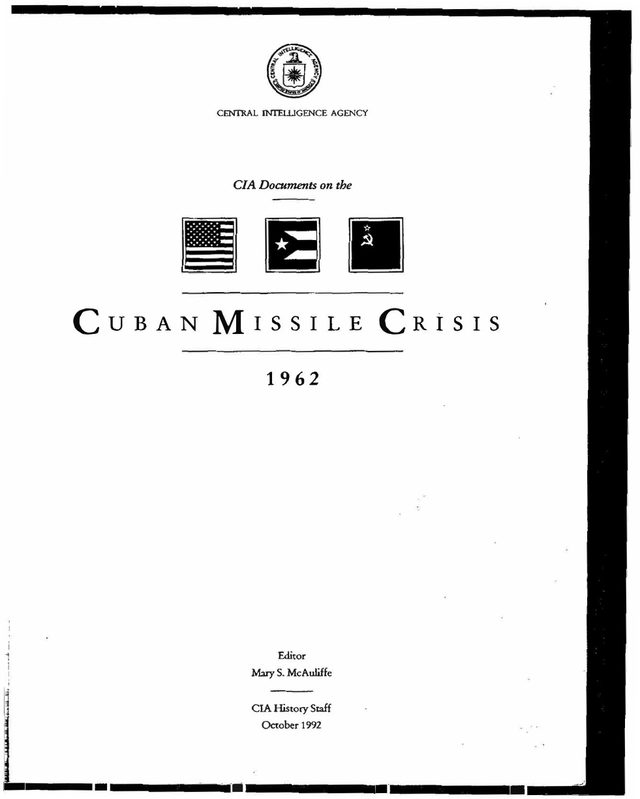
The pages here are not the original typescript. They come from a 1992 compilation, CIA Documents on the Cuban Missile Crisis 1962, edited by Mary S. McAuliffe of the CIA History Staff, which printed the estimate's cover, its statement of the problem, and its five conclusions as document 33, marked "Excerpt"1. The 37 numbered paragraphs of discussion behind those conclusions are not in this extract; they were printed, with one footnote still withheld, in the Foreign Relations volume on Cuba in 19972.
The conclusions run in order. A: the USSR valued Cuba mainly for political advantage, and the buildup was meant to protect Castro's regime from an American attempt to overthrow it. B: the new deliveries were "substantially improving" Cuba's air and coastal defenses, and together with the Soviet statement of 11 September would discourage Castro's opponents. C: the Soviets might be tempted to add weapons of a more "offensive" character, such as light bombers, submarines or short-range missiles. D: Soviet medium- or intermediate-range missiles in Cuba would bring real military advantage, but would be incompatible with Soviet practice and policy; a submarine base was the likelier of the two. E: Latin American governments would leave the problem to the United States1.
The discussion, in the full text, explains what the board was looking at: about 70 ships unloaded military cargo between mid-July and early September, and 12 SA-2 surface-to-air missile sites had been installed in the western half of the island2. In the hosted copy, conclusion D has been underlined by hand1.
What went wrong
The CIA's director, John McCone, did not share the board's view. According to the National Security Archive, he was on his honeymoon in France and sent his deputy, General Marshall Carter, a series of cables in September warning about missiles, the last of them, on 20 September, a rebuttal of the estimate itself1.
How to read it
Read conclusion D beside the transcript of 16 October, when the photographs were on the table. The estimate's reading of Soviet motives, that Moscow feared an American invasion of Cuba, has worn better than its forecast1,4. One small trap: the FRUS transcription of conclusion E reads "steps of direct military action"; the printed estimate says "steps short of direct military action"1,2.
Sources
- CIA Special National Intelligence Estimate 85-3-62, 'The Military Buildup in Cuba', 19 September 1962 (excerpt), in CIA Documents on the Cuban Missile Crisis 1962, ed. Mary S. McAuliffe (CIA History Staff, 1992), document 33, as posted by the National Security Archive, Central Intelligence Agency, via the National Security Archive (1962-09-19).
- FRUS Foreign Relations of the United States, 1961–1963, Volume X, Cuba, 1961–1962, Document 433: Special National Intelligence Estimate 85-3-62, US Department of State, Office of the Historian (1997).
- FRUS Foreign Relations of the United States, 1961–1963, Volume XI, Document 16: Editorial Note (the U-2 discovery of 14 October 1962), US Department of State, Office of the Historian (1996).
- CIA A Crucial Estimate Relived (Sherman Kent, Studies in Intelligence, spring 1964; 1992 reprint), Central Intelligence Agency, Center for the Study of Intelligence (1964).
- CIA Cuban Missile Crisis: Revisiting Sherman Kent's Defense of SNIE 85-3-62 (Michael Douglas Smith, Studies in Intelligence 51, no. 3), Central Intelligence Agency, Center for the Study of Intelligence (2007).