
 Page 1 of 153
From the document
The concept and execution of the venture clearly indicate that the Soviet authorities made no appreciable effort to prevent or delay US detection by aerial reconnaissance of the offensive weapons during the deployment phase. It is believed that the most likely explanation is that they judged the risk of a US military reaction to be very slight.
the evidence on this aspect of the buildup is so ambiguous and inconclusive that it is not possible to reach a judgment based on factual information.
For example, more than 200 reports contain references to the presence in Cuba of missiles before January 1962.
Finally, the only aggressive act ever committed by the Soviet Forces in Cuba occurred on 27 October, when a U-2 aircraft was shot down near the Port of Banes, probably by the surface-to-air missile unit located north of the port.
Excerpts are passages from a US government work (public domain), quoted exactly as they read in the scan, and checked against the full text on every rebuild.
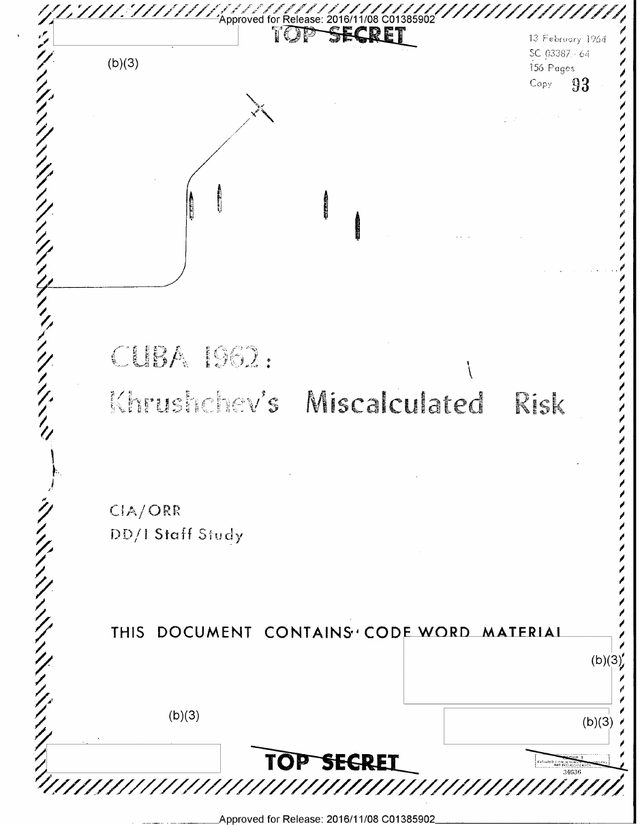
A year after the crisis, the CIA's Office of Research and Reports tried to answer a question the October drama had left open: how, and with what intent, had the Soviet Union built its base in Cuba? Its answer, dated 13 February 1964, runs to 156 pages and was issued under the code-word controls of the intelligence it drew on1. The foreword credits help from the Office of Scientific Intelligence, the Office of Current Intelligence and the National Photographic Interpretation Center, and points readers to a companion study by the DD/I Research Staff, The Soviet Missile Base Venture in Cuba, which looked at the political side1.
The evidence
Part One rests on aerial photography, which the authors treat as conclusive, and on photographs of Soviet ships at sea. Reports from agents, refugees and diplomats were used only where photography could check them, because so many had proved false1. It counts about 150 Soviet dry-cargo voyages to Cuba between late July 1962 and the start of the quarantine on 24 October, all but about 25 of them carrying military cargo, and notes that Moscow had put all seven of its ships able to carry missiles below deck onto the Cuba run1.
System by system it traces the build-up: surface-to-air missile sites from August, MiG-21 fighters, coastal cruise missiles, Komar patrol boats, four armored groups, 24 MRBM launch positions at six sites near San Cristobal and Sagua la Grande, and three IRBM sites, two near Guanajay and one near Remedios, none finished1. It puts Soviet personnel at about 22,000, a figure it calls only the most common estimate1. The 42 Il-28 bombers, it argues, were meant for the Cubans from the start1. Of the withdrawal it records that all 42 MRBMs were at sea by 10 November, carried as deck cargo, and that the bombers left only in early December after Khrushchev's announcement of 20 November1.
The argument
Part Two draws the inference in the title. The integrated air defense system did not begin operating until 27 October, more than a month after missiles reached the sites, and nothing was hidden from overhead cameras until low-level flights began. The Soviets had known what American photography could do since they recovered the U-2 downed near Sverdlovsk in May 1960, and the officer who had commanded their air defenses then, Marshal Biryuzov, had taken over the Strategic Rocket Forces in April 19621. The authors conclude that Moscow must have expected the United States to accept the missiles, or at least not to remove them by force1. They place the final decision in the spring of 1962, perhaps April or May, and judge that Khrushchev wanted a quick cut in the strategic imbalance, an increase of more than 50 percent in Soviet missile strike capacity against the United States, and leverage over Berlin1.
How to read it now
The study is a careful reading of American evidence, and its limits are those of that evidence. Later Soviet and Russian disclosures put the force at about 43,000 men, not 22,000, and in 1992 it was confirmed that tactical nuclear warheads had already reached Cuba, the point on which this study could reach no judgment3. Its account of the settlement says the United States rejected Khrushchev's offer of 27 October to trade Cuban bases for Turkish ones; it says nothing of the private undertaking to remove the Jupiter missiles from Turkey1,3. It sits between the September 1962 estimate that judged missiles unlikely and the photographic discoveries described under Intelligence in the Cuban Missile Crisis. The CIA released it, with some passages, figures and photographs blacked out, in November 20162.
Sources
- CIA Cuba 1962: Khrushchev's Miscalculated Risk, DD/I Staff Study, 13 February 1964 (C01385902), archived copy of the CIA reading-room PDF, Central Intelligence Agency (Wayback Machine capture, February 2025) (1964-02-13).
- CIA CIA FOIA reading room record for document 01385902 (archived copy), Central Intelligence Agency (Wayback Machine capture, February 2025) (2016-11-18).
- Wikipedia Cuban Missile Crisis, Wikipedia.