
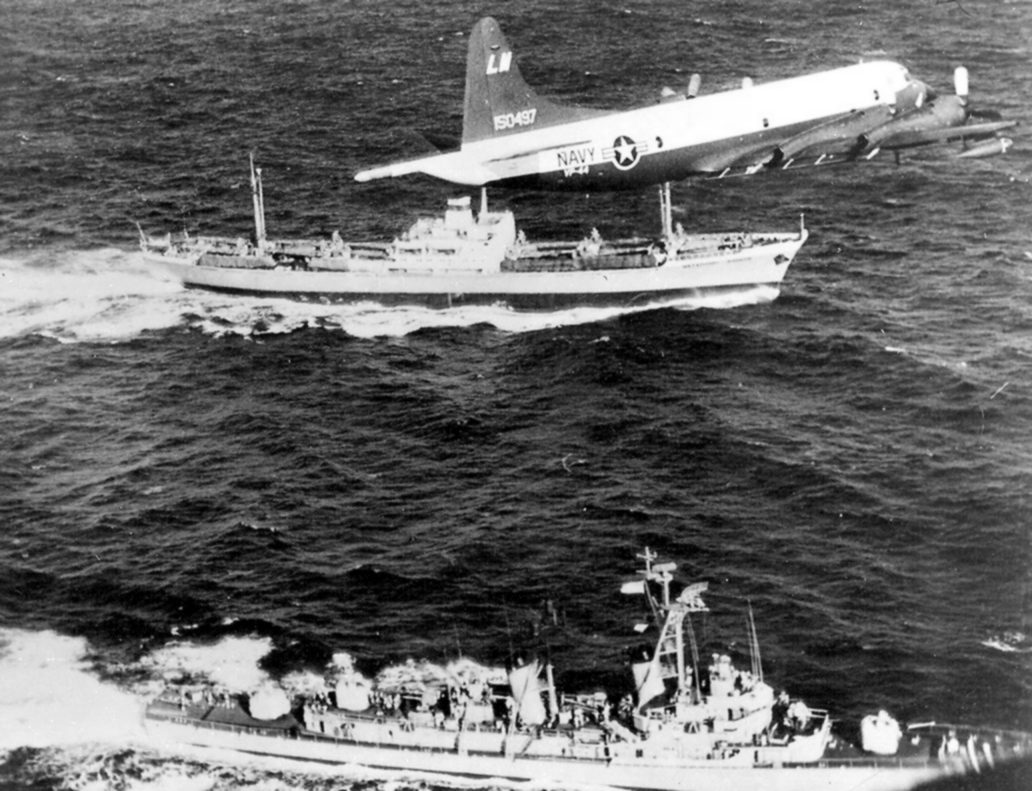

Anadyr is a river that runs into the Bering Sea, the name of a remote town in Chukotka and of a bomber base nearby. The Soviet General Staff chose it as the codename for sending nuclear missiles to Cuba because it pointed the other way. Junior commanders, Soviet soldiers and any Western agent who heard it would assume an exercise in the far north.1
Planning in longhand
The idea was Nikita Khrushchev's, and it was approved in principle at a Defense Council meeting in late May 1962.6 A handful of senior officers drew up the plan. The CIA's study of the operation, drawing on the account of its Soviet planner General Anatoli Gribkov, records that no secretaries were used: a colonel with good handwriting wrote out the proposal, and the finished plan, still handwritten, was approved by Defense Minister Rodion Malinovsky on 4 July and by Khrushchev on 7 July. From May to October nothing about the deployment was sent by radio or cipher; everything was hand-carried.1
The plan called for 50,874 men: missile regiments with medium-range SS-4 and intermediate-range SS-5 missiles, plus air-defense, ground, air and naval forces with field hospitals, bakeries and three months of food and fuel.1 A Soviet delegation disguised as agricultural experts reached Havana on 29 May; Marshal Sergei Biryuzov of the Strategic Rocket Forces traveled as "Engineer Petrov." Fidel Castro and the Cuban leadership agreed in principle.1
Hiding a missile force at sea
Troops were told only that they were going somewhere cold, and many units were issued skis, felt boots and fleece-lined parkas. Missile engineers were told they were taking ICBMs to Novaya Zemlya.1 Ships loaded at eight closed ports, four in the north and four on the Black Sea; captains opened sealed envelopes naming their destination only once at sea. On board, men stayed below decks for voyages of 18 to 20 days, allowed up only at night in small groups, while temperatures in the holds passed 120°F. Rations were issued in darkness.1
In Cuba the force came ashore at 11 ports. At Mariel the Soviets built a cinder-block wall around the docks and moved local residents away from the waterfront. Weapons were unloaded only at night and moved inland in convoys, the soldiers in civilian clothes and their escorts in Cuban uniforms giving orders in Spanish. Radio Moscow, meanwhile, described Soviet shipments as machine tools, wheat, farm machinery and fertilizer.1 The first SS-4 missiles reached Mariel aboard the Omsk on 8 September, and the first nuclear warheads arrived aboard the Indigirka on 4 October.1
Part of the plan, codenamed Kama, sent four diesel attack submarines toward Cuba in October. All four were detected by US forces during the quarantine, and three were forced to surface.6
Diplomatic cover
The deception extended to the White House. On 4 September Ambassador Anatoly Dobrynin assured Robert Kennedy that no surface-to-surface missiles or offensive weapons would be placed in Cuba, and on 11 September TASS said the USSR had no need to put offensive weapons there. On 17 October the GRU officer Georgi Bolshakov brought Robert Kennedy a personal message from Khrushchev that missiles would "under no circumstances" be sent. By then they were already on the island.1
Hansen also describes a counter-intuitive tactic: accurate reports of missiles were allowed to reach the United States through Cuban exiles in Miami, whom the CIA regarded as unreliable, and some 17,000 intercepted Cuban letters mentioning Soviet troops and missiles were released to the mails in late September, in the expectation that Washington would ignore them. His source for this is a former Cuban intelligence officer.1
Discovery
On 14 October a U-2 flown by Major Richard Heyser photographed the San Cristóbal area for six minutes; the 928 frames gave the first verified evidence of medium-range missile sites.2 Analysts read the photographs against Soviet missile manuals supplied by the GRU colonel Oleg Penkovsky, and on 18 October the CIA reported at least one regiment of SS-4s in western Cuba that could fire within 18 hours, with sites for longer-range SS-5s being built near Havana.3 (See IRONBARK: the Penkovsky case and Intelligence in the Cuban Missile Crisis.)
The Killian board's postmortem of 4 February 1963 called the deployment a "near-total intelligence surprise," Hansen notes, without once mentioning Soviet deception.1
Withdrawal and the numbers
On 28 October Khrushchev wrote to Kennedy that the Soviet government had "given a new order to dismantle the arms which you described as offensive, and to crate and return them to the Soviet Union."4 In January 1963 the Director of Central Intelligence, John McCone, told congressional leaders that the Soviets had withdrawn 42 strategic missiles and 42 jet bombers with four or five thousand men, leaving about 17,000 Soviet troops in Cuba.5 Gribkov's later figures, accepted by Hansen, put the force at its peak at about 41,900, roughly four times what US intelligence had estimated during the crisis.1
The documents
Declassified records of this operation, with the scans and their full text hosted here.
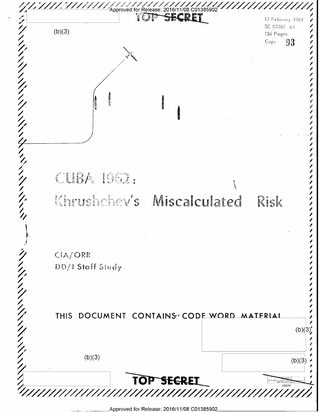 13 February 1964 · 153 p.Cuba 1962: Khrushchev's Miscalculated Risk (CIA staff study, 1964)CIA Directorate of Intelligence, Office of Research and Reports (DD/I Staff Study, SC 03387/64)A CIA staff study of February 1964 that rebuilt the Soviet missile deployment in Cuba from photography and reports, and argued that Moscow had judged the risk of an American military response to be slight.
- 16 October 196216 October 1962: the first White House meeting on the missile sitesWhite House taping system (transcript of audiotape 28.1, President's Office Files, Kennedy Library)The transcript of the meeting at which President Kennedy and his advisers first discussed U-2 photographs of Soviet medium-range missile sites in Cuba, and began weighing an air strike against a blockade.
Checking the record
Dates and outcome compared in two independent sources: they agree.
- CIA
- Plan approved by Malinovsky 4 July and Khrushchev 7 July 1962; first SS-4s at Mariel 8 September; first warheads 4 October; U-2 discovery 14 October; Khrushchev agrees to withdraw 28 October. About 41,900 Soviet personnel in Cuba by late October; missile bases dismantled after Khrushchev's agreement.
- Wikipedia
- Defense Council meeting 21 May 1962; plan approved 4 and 7 July; U-2 photographs 14 October; Kennedy informed 16 October. Planned force of about 50,874 personnel (infobox: 47,000); the deployment was discovered and led to the Cuban Missile Crisis.
Dates agree. Troop figures differ because they measure different things: 50,874 was the July plan, 41,900 the strength actually reached by late October (Hansen, citing Gribkov). This page uses the CIA study's figure for the force in Cuba.
Sources
- CIA Soviet Deception in the Cuban Missile Crisis (Studies in Intelligence 46, no. 1), by James H. Hansen, Central Intelligence Agency, Center for the Study of Intelligence (2002).
- FRUS Foreign Relations of the United States, 1961–1963, Volume XI, Document 16 (Editorial Note), US Department of State, Office of the Historian (1996).
- FRUS Foreign Relations of the United States, 1961–1963, Volume XI, Document 30 (Editorial Note), US Department of State, Office of the Historian (1996).
- FRUS Foreign Relations of the United States, 1961–1963, Volume XI, Document 102: Message From Chairman Khrushchev to President Kennedy, 28 October 1962, US Department of State, Office of the Historian (1962-10-28).
- FRUS Foreign Relations of the United States, 1961–1963, Volume XI, Document 265 (Editorial Note on McCone's briefing of 8 January 1963), US Department of State, Office of the Historian.
- Wikipedia Operation Anadyr, Wikipedia.
- Wikipedia English Wikipedia article (used for cross-checking).
Elsewhere in the files
- Document 16 October 1962: the first White House meeting on the missile sites
- Document Cuba 1962: Khrushchev's Miscalculated Risk (CIA staff study, 1964)
- Document SNIE 85-3-62: the estimate that ruled out missiles in Cuba (1962)
- Operation IRONBARK: the Penkovsky case
- Operation Intelligence in the Cuban Missile Crisis
- Person Oleg Penkovsky
Read next
 10 August – 20 November 1962
Intelligence in the Cuban Missile Crisis
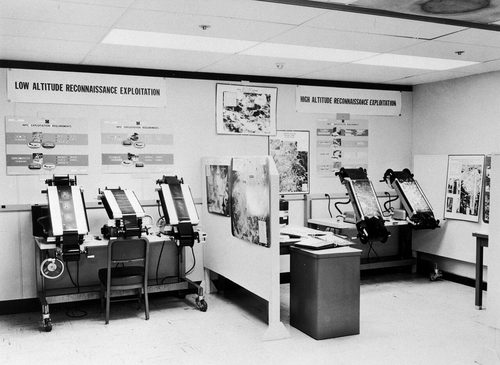
How US intelligence missed, then found, Soviet missiles in Cuba in 1962: a wrong estimate, a five-week gap in U-2 coverage, the 14 October flight over San Cristóbal, and what the photographs never showed.
 20 April 1961 – 22 October 1962
IRONBARK: the Penkovsky case
How a disaffected GRU colonel, Oleg Penkovsky, fed the CIA and MI6 Soviet missile manuals in 1961–62, and how his IRONBARK material shaped US judgments in the Cuban Missile Crisis.
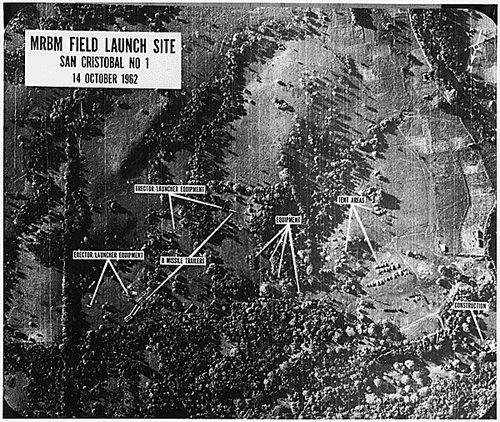 16 October 1962
: the first White House meeting on the missile sites
The transcript of the meeting at which President Kennedy and his advisers first discussed U-2 photographs of Soviet medium-range missile sites in Cuba, and began weighing an air strike against a blockade.
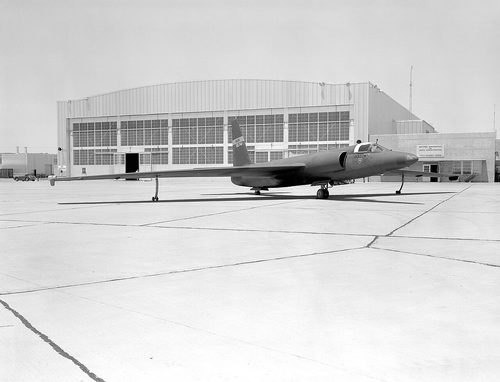 24 November 1954 – 16 May 1960
The U-2 program and the 1960 shoot-down
From 1956 the CIA's U-2 photographed the Soviet Union from 70,000 feet. On 1 May 1960 a missile brought down Francis Gary Powers near Sverdlovsk, the cover story collapsed and the Paris summit failed.
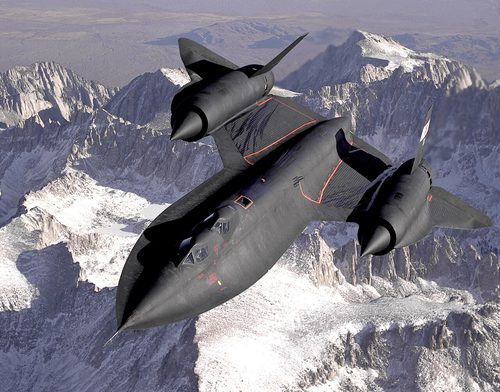 1956–1990s
Overhead reconnaissance
Balloons, the U-2, the A-12 and the CORONA satellites gave the United States its first reliable picture of Soviet military power. The programs were secret for decades; the NRO itself was not acknowledged until 1992.
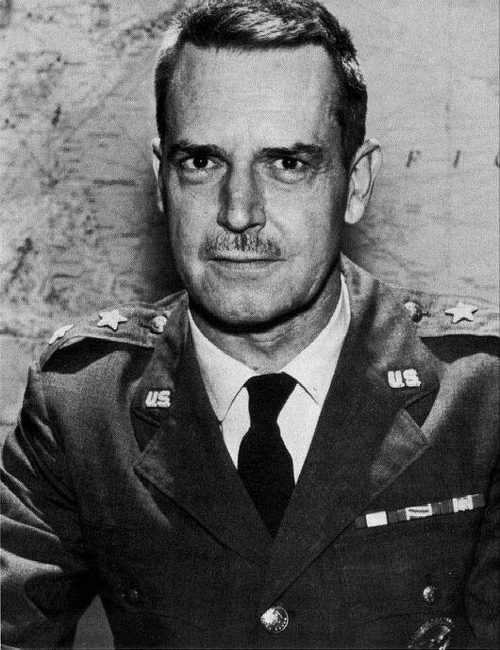 30 November 1961 – October 1962
Operation Mongoose
The Kennedy administration's 1961–62 covert program to overthrow Fidel Castro, run by Edward Lansdale under Robert Kennedy's eye, which aimed at a revolt in Cuba by October 1962.