
 Page 1 of 9
From the document
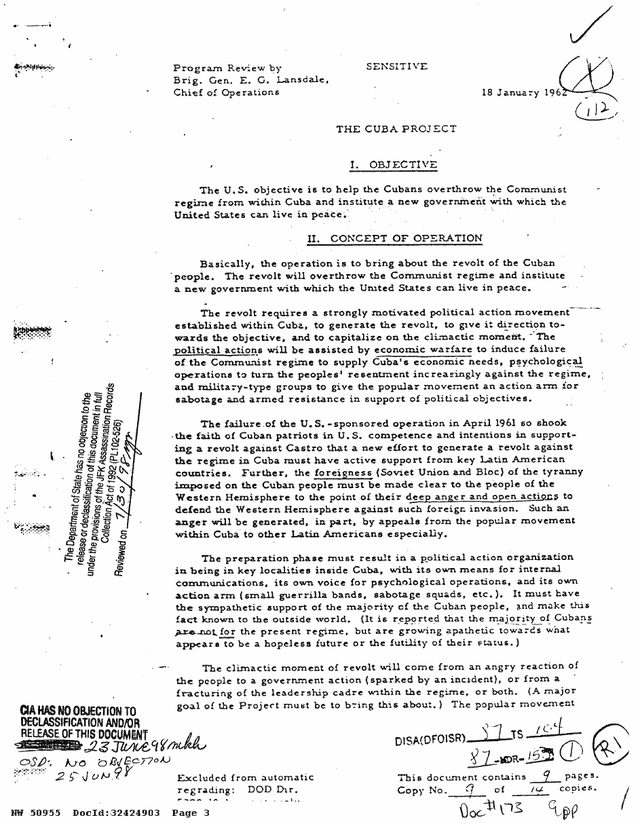
The U.S. objective is to help the Cubans overthrow the Communist regime from within Cuba and institute a new government with which the United States can live in peace.
After this second look, CIA has concluded that its realistic role should be to create at least the illusion of a popular movement, to win external support for it, to improve CIA operational capability, and to help create a climate which will permit provocative actions in support of a shift to overt action.
This effort must be imaginative and bold enough to consider a "name" defector to be worth at least a million U.S. dollars.
This is not in conformity with the Presidential directive now governing Project tasking.
Excerpts are passages from a US government work (public domain), quoted exactly as they read in the scan, and checked against the full text on every rebuild.
On 30 November 1961 President Kennedy put Brig. Gen. Edward Lansdale in charge of a new effort "to help Cuba overthrow the communist regime," to be run through the regular departments and kept to a small circle of officials3. This nine-page review, dated 18 January 1962, is Lansdale's first written account of where that effort, soon known as Operation Mongoose, stood after seven weeks, and what each agency was to do next1.
What it says
The opening sections set out the theory. The United States would not invade; it would help the Cuban people revolt. A political action movement inside Cuba, backed by economic warfare, propaganda and small sabotage and guerrilla bands, would wait for a "climactic moment" (an incident, or a split in the leadership) and then rise, at which point the United States and, if possible, other American states would give open support, "including military force, as necessary." Lansdale insisted the failure of the Bay of Pigs in April 1961 meant the new effort needed Latin American backing1.
The status reports that follow are blunt. Positive intelligence assets inside Cuba were "very limited" and the CIA had no counterintelligence assets there at all. The agency had not yet found the political action agents the plan needed; it hoped to have eight to ten assessed by 15 February against a minimum of 30. It had looked at sabotaging the sugar harvest and could not do it. Its own reassessment, Lansdale wrote, was that it could at best create "the illusion of a popular movement," which he called far short of the project's goals1.
The second half is a target schedule of 32 numbered tasks, almost all due between 1 and 28 February. They range from a National Intelligence Estimate and a bigger refugee interrogation center at Opa Locka, Florida, to trade embargo measures, plans to disrupt Cuban nickel supplies to the Soviet Union, a defection program for senior Cuban officials, sabotage schedules, and a Defense contingency plan for US military action1. A closing paragraph complains that the CIA saw its role as building a political climate that could furnish "plausible excuse for armed intervention," a role Lansdale said belonged, if anywhere, to State and Defense1.
What happened next
The next morning Richard Helms sat in a meeting chaired by Attorney General Robert Kennedy, who told the group that Cuba carried "the top priority in the United States Government—all else is secondary"4. A month later, on 20 February, Lansdale produced the fuller plan printed on this site as Lansdale's "The Cuba Project" (1962), with a timetable aimed at a revolt in October 19625. No revolt came; Mongoose was wound down after the missile crisis.
The two versions
The State Department printed this review in 1997 in Foreign Relations of the United States, from its central files, but withheld five lines in the section on sabotage support2. The copy hosted here comes from the Defense Department's files in the JFK Assassination Records Collection, with 1998 review stamps from the CIA, OSD and State. In it the withheld passage is legible: the CIA was introducing a corrosive additive into diesel fuel bound for Cuban locomotives through commercial suppliers, expected the first breakdowns in about four months, and hoped to recruit an agent to attempt the same with jet fuel. Brackets in the margin citing CIA exemption 1.3(a)(4) mark that and other passages1.
Read it as a planner's document. It records intentions and deadlines, not results, and it is written by a man pushing the agencies, especially the CIA, to do more1,4.
Sources
- National Archives The Cuba Project: Program Review by Brig. Gen. E. G. Lansdale, Chief of Operations, 18 January 1962 (JFK Assassination Records, 202-10001-10172), US National Archives and Records Administration (1962-01-18).
- FRUS Foreign Relations of the United States, 1961–1963, Volume X, Cuba, 1961–1962, Document 291, US Department of State, Office of the Historian (1997).
- FRUS Foreign Relations of the United States, 1961–1963, Volume X, Document 278 (Memorandum from President Kennedy, 30 November 1961), US Department of State, Office of the Historian (1997).
- FRUS Foreign Relations of the United States, 1961–1963, Volume X, Document 292 (Helms to McCone, 19 January 1962), US Department of State, Office of the Historian (1997).
- FRUS Foreign Relations of the United States, 1961–1963, Volume X, Document 304 (Lansdale program review, 20 February 1962), US Department of State, Office of the Historian (1997).