
 Page 1 of 137
From the document
TSD may have gone ahead and prepared the cigars just in case, but Gottlieb is certain that he did not get the DD/P's (Richard Bissell) personal approval to release them
Harvey states that thereafter he regularly briefed Helms on the status of the Castro operation.
The CIA hatched a plot to knock off Castro. True.
Excerpts are passages from a US government work (public domain), quoted exactly as they read in the scan, and checked against the full text on every rebuild.
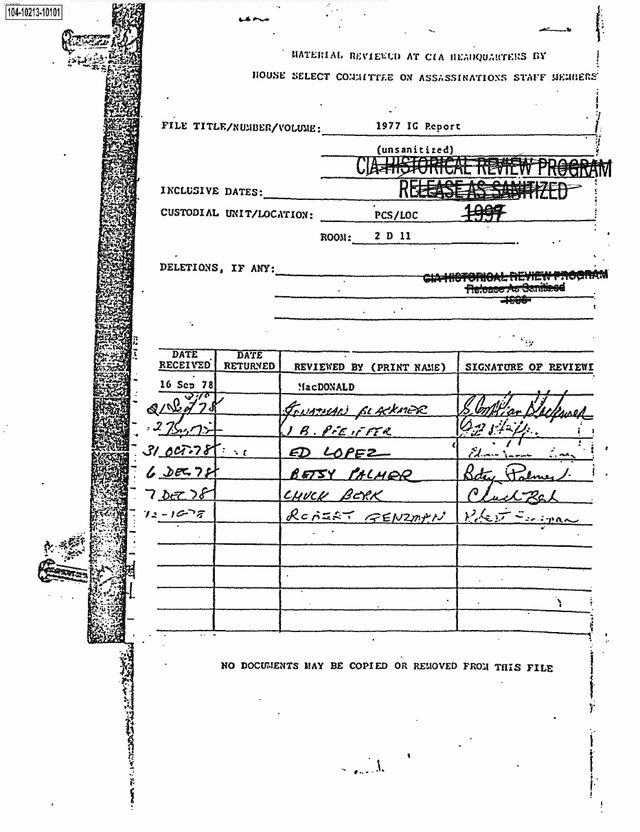
On 7 March 1967 the columnist Drew Pearson reported that the CIA had plotted to kill Fidel Castro. Richard Helms, the Director of Central Intelligence, gave his Inspector General the task of finding out what had happened on 23 March. Two inspectors, K. E. Greer and S. D. Breckinridge, typed every draft themselves, and the report reached Helms in installments from 24 April1. On 23 May Helms returned it with orders that the Inspector General keep it in personal safekeeping and destroy the one other copy and all notes. The cover memorandum says only four men had read it1.
What the inspectors found
They warn at the outset that this is "at best an imperfect history": no official records were kept of planning or approvals, and much rests on memories "fogged by time," on William Harvey's notes and on the appointment records of Dr. Edward Gunn of the Office of Medical Services1. They did not interview Allen Dulles or his deputy, General Cabell1.
They found five phases. Before August 1960 there were schemes to spoil Castro's public image: an LSD-like spray for his broadcasting studio, treated cigars, thallium salts to make his beard fall out1. In August 1960 Richard Bissell asked Sheffield Edwards, the Director of Security, to reach the gambling syndicate. Through the private investigator Robert Maheu came John Roselli, then Sam Giancana and Santos Trafficante. Edwards briefed Dulles and Cabell in deliberately vague terms, and poison pills went to Juan Orta, a former official in Castro's office, and then to the exile leader Tony Varona, until the Bay of Pigs ended the effort1. In April 1962, during Mongoose, Harvey revived it with Roselli: more pills, and a truckload of arms and explosives for Varona's men, before it was wound down in February 19631. In 1963 came two impractical ideas, a contaminated diving suit and an explosive seashell1.
The last phase was AMLASH: Rolando Cubela, a Cuban army major who kept asking for a weapon to kill Castro. On 29 October 1963 Desmond FitzGerald met him in Paris as Robert Kennedy's personal representative, without Kennedy's approval; on 22 November a case officer showed him a ballpoint pen made into a hypodermic syringe and suggested the insecticide Black Leaf 40, at about the moment President Kennedy was shot1. Cubela was arrested in 1966, confessed and was sentenced to 25 years1,4.
The report also records the wiretap at Las Vegas that brought the FBI in, and the briefing of Attorney General Robert Kennedy on 7 May 1962, when he was told of the first phase only while the second was under way1. It confirms that assassination was raised at the Special Group (Augmented) meeting of 10 August 19621. It concludes that most of Pearson's facts were right, and that Roselli was the likely source, through Maheu's lawyer1.
Afterlife and limits
The report stayed in the Inspector General's safe, but the Church Committee drew on it heavily in 1975, citing it page by page in its account of the Cuban plots2,3. See Alleged Assassination Plots Involving Foreign Leaders (1975) and The plots against Fidel Castro. It is an internal fact-finding exercise: it weighs conflicting memories, often fails to reconcile them, and leaves open who in the administration authorized what. Its own comment that officers felt "severe pressures" from the Kennedy administration does not apply to the first phase, which began under Eisenhower1.
Sources
- CIA J. S. Earman, Report on Plots to Assassinate Fidel Castro, 23 May 1967 (NARA record 104-10213-10101), Central Intelligence Agency (copy posted by the National Security Archive) (1967-05-23).
- Congress Alleged Assassination Plots Involving Foreign Leaders, Interim Report, Part III B: Cuba (1975), US Senate Select Committee on Intelligence Activities (copy at the Assassination Archives and Research Center) (1975-11-20).
- Wikipedia CIA assassination attempts on Fidel Castro, Wikipedia.
- Wikipedia Rolando Cubela Secades, Wikipedia.