
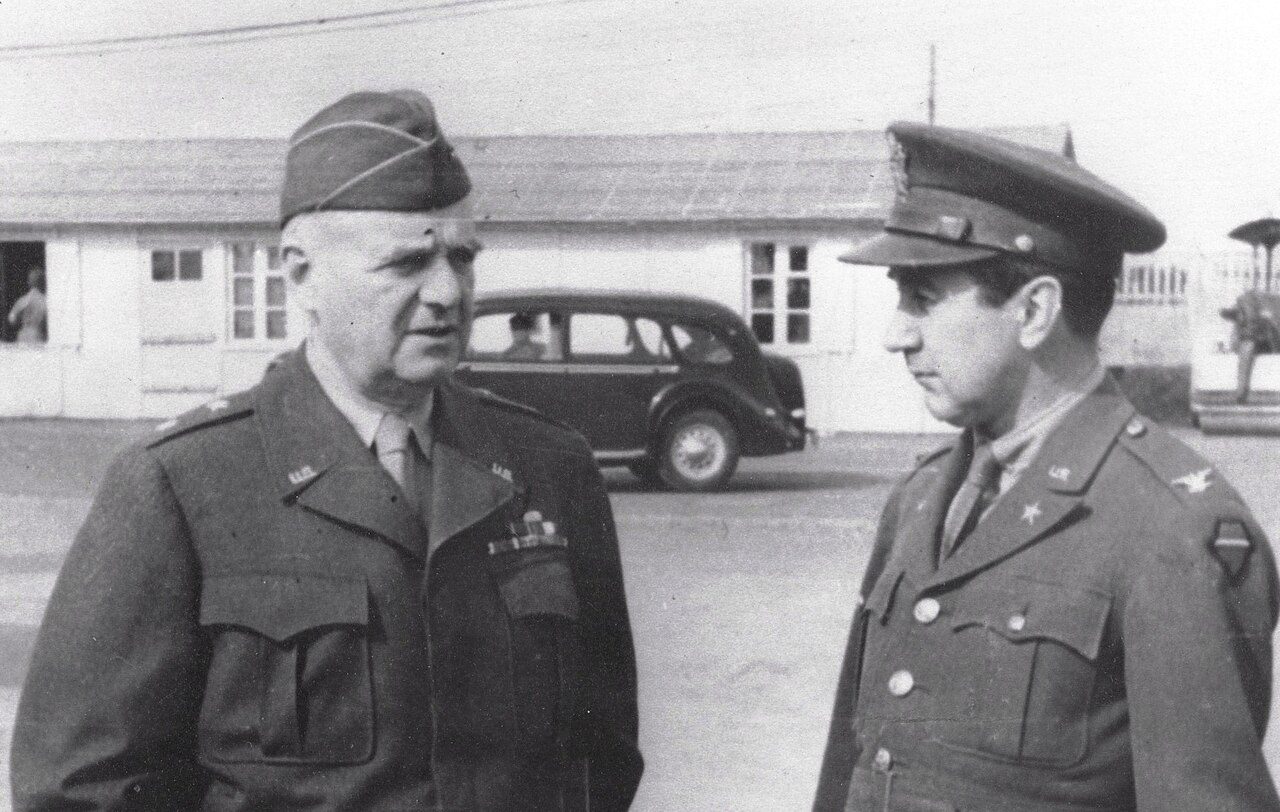

William Joseph Donovan was born in Buffalo, New York, on 1 January 1883, the grandson of Irish immigrants. He graduated from Columbia University in 1905 and from Columbia Law School in 1907. Franklin Roosevelt was a classmate at the law school, though the two were not close. Donovan went home to practice law in Buffalo, and in 1912 he joined the New York National Guard. His cavalry troop served on the Mexican border in 1916.1,2,4
The Fighting 69th
In France he commanded a battalion and then the whole of the 165th Infantry, the old "Fighting 69th" of New York, in the 42nd ("Rainbow") Division. On 14–15 October 1918, at Landres-et-St. Georges, he led an assault on a strongly held German position. He kept directing his men after a machine-gun bullet hit him in the leg. That action brought him the Medal of Honor. He also received the Distinguished Service Cross and the Distinguished Service Medal, and came home a colonel and one of the most decorated American soldiers of the war. The nickname "Wild Bill" dates from these years.2,4,6
Lawyer, prosecutor, traveler
Donovan was US Attorney for the Western District of New York from 1922 to 1924. In 1924 he went to the Justice Department in Washington as Assistant Attorney General, first in the Criminal Division and then in the Antitrust Division. In that post he briefly supervised the young J. Edgar Hoover. He left government in 1929 for a Wall Street practice.1,2
In 1932 he ran for governor of New York as a Republican and lost. He traveled widely through the 1930s and in 1935 toured the Italian lines in Ethiopia. When Frank Knox became Secretary of the Navy in 1940, he brought Donovan to Roosevelt's attention. That summer Roosevelt sent him to judge whether Britain could hold out. Churchill made sure he saw almost everything. A tour of the Balkans and the Mediterranean followed in early 1941.1
Building American intelligence
On 11 July 1941 Roosevelt named Donovan Coordinator of Information. This was the first American intelligence body outside any department. Donovan wanted research and analysis at its center. He recruited university scholars and argued that much of what the government needed to know already sat, uncollected, in its own files and in libraries.1
In June 1942 the office became the Office of Strategic Services under the Joint Chiefs of Staff. Donovan went back into uniform and was promoted to brigadier general in March 1943 and to major general in November 1944. He liked to see the ground himself. CIA's history notes his visits to his people in England, France, Italy, Burma, China and the Soviet Union.1
Even an admiring CIA account calls him "a mediocre administrator, enamored of operations but bored by procedural detail." His bureaucratic enemies included Hoover's FBI, the Army's G-2 and Douglas MacArthur. They kept OSS out of Latin America and most of the Pacific.1,4
Losing OSS
Donovan wanted a permanent, centralized peacetime intelligence service built on the OSS model. Roosevelt promised nothing, and Truman disliked him. On 13 September 1945 Donovan wrote to Truman. He urged the President not to let secret intelligence, counterespionage and analysis be split among different agencies:
Whatever agency has the duty of intelligence should have it as a complete whole. To do otherwise would be to add chaos to existing confusion in the intelligence field.
The memo is reproduced in FRUS.5 A week later Truman signed Executive Order 9621, and OSS ceased to exist on 1 October 1945. Donovan said goodbye to his staff at a rally on 28 September.1
He then served on the American prosecution staff preparing the Nuremberg trials, as an assistant to Justice Robert Jackson.2 The CIA was created in 1947, but Truman did not make Donovan its head, and in 1953 Eisenhower chose Allen Dulles. Eisenhower appointed Donovan ambassador to Thailand. He presented his credentials on 4 September 1953 and left the post on 21 August 1954.3,6 In 1957 Eisenhower gave him the National Security Medal. The Justice Department notes that he is believed to be the only person to have received the Medal of Honor, the Distinguished Service Cross, the Distinguished Service Medal and the National Security Medal.2
Death and legacy
Donovan died in Washington, D.C., on 8 February 1959 and was buried at Arlington National Cemetery.2,4 Wikipedia, citing his biographers, gives the cause as complications of vascular dementia, which had begun to affect him during his Thai posting.6
His title as the "father of American intelligence" is given in official histories, not just in tributes. Four later Directors of Central Intelligence came out of his organization. A statue of him stands at CIA headquarters, dedicated by DCI William Webster on 28 October 1988.1,2
Key dates
- 14 October 1918 Leads the 165th Infantry at Landres-et-St. Georges, France; later awarded the Medal of Honor.
- 11 July 1941 Appointed Coordinator of Information by Franklin Roosevelt.
- 13 June 1942 Becomes Director of the new Office of Strategic Services.
- November 1944 Promoted to major general.
- 20 September 1945 Truman signs Executive Order 9621 dissolving OSS from 1 October.
- 4 September 1953 Presents credentials as US Ambassador to Thailand; leaves post on 21 August 1954.
- 8 February 1959 Dies in Washington, D.C.; buried at Arlington National Cemetery.
Sources
- CIA The Office of Strategic Services: America's First Intelligence Agency, Central Intelligence Agency, Center for the Study of Intelligence (Michael Warner) (2000-05).
- Official history William J. Donovan (1924–1925), US Department of Justice, Criminal Division history.
- Official history William Joseph Donovan (1883–1959), US Department of State, Office of the Historian.
- Official history William "Wild Bill" Donovan, National Park Service.
- FRUS Foreign Relations of the United States, 1945–1950, Emergence of the Intelligence Establishment, Document 9 (Donovan to Truman, 13 September 1945), US Department of State, Office of the Historian (1945-09-13).
- Wikipedia William J. Donovan, Wikipedia.
- Wikipedia English Wikipedia article (used for cross-checking).
Elsewhere in the files
- Agency Central Intelligence Agency (CIA)
- Agency Office of Strategic Services (OSS)
- Agency Special Operations Executive (SOE)
- Document Alias George Wood: CIA's case history of Fritz Kolbe (1966)
- Document Dulles and Gaevernitz's report on SUNRISE-CROSSWORD: 'The First German Surrender' (1945)
- Document Team Frederick in Brittany: the OSS London war diary, 1944
- Operation Operation Jedburgh
- Operation Operation Sunrise
- Person Virginia Hall
- Person William Colby