
 Page 1 of 22
From the document
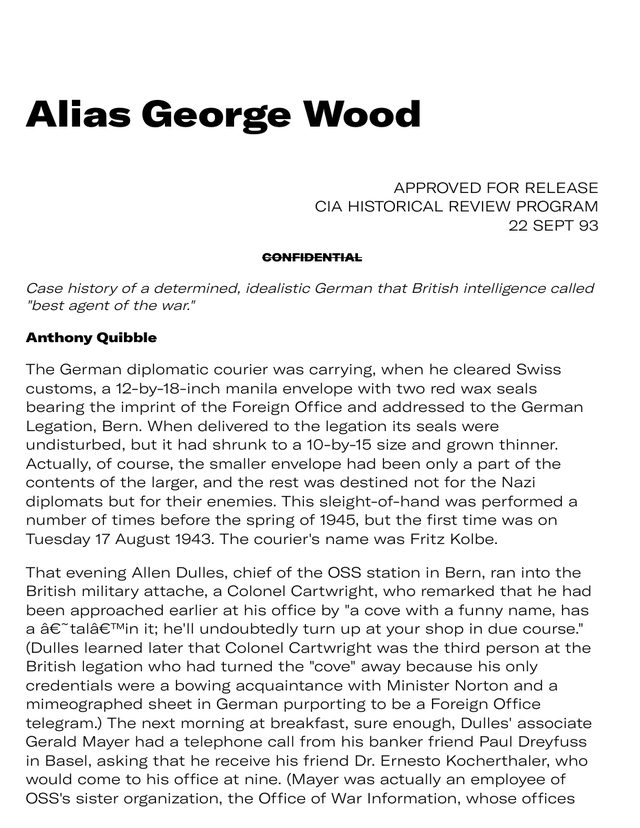
This sleight-of-hand was performed a number of times before the spring of 1945, but the first time was on Tuesday 17 August 1943. The courier's name was Fritz Kolbe.
The British thought them probably a build-up for some grand deception and in this sense "genuine fakes."
More than 200 documents ... I now firmly believe in his good faith and am ready to stake my reputation that they are genuine.
Thus in one theater, at least, a year and half after the beginning and within a month or two of the end, Kolbe's heroic efforts bore some fruit.
Excerpts are passages from a US government work (public domain), quoted exactly as they read in the scan, and checked against the full text on every rebuild.
Fritz Kolbe was a mid-level official in the German Foreign Office who, from August 1943 until the last weeks of the war, carried copies of its secret telegrams to Allen Dulles of the OSS in Bern. The Americans called him George Wood. This case history of him appeared in CIA's classified journal Studies in Intelligence and was marked Confidential1. CIA's archive lists it in volume 10, number 1, which by the journal's numbering falls in 1966, though the page itself gives no year. It names the author as Anthony Quibble; CIA does not state his position1,2. The author worked from Dulles's private file on the "Wood case," narratives that Kolbe and his helpers wrote in 1945, and OSS cable and X-2 records, which he cites by file number1.
What it says
The article follows Kolbe from his first trip as a diplomatic courier. The British legation turned him away; Dulles's associate Gerald Mayer met him and took 16 telegrams as a sample. Kolbe asked for no money. The author describes him as an anti-Nazi who had avoided joining the party and who worked for Ambassador Karl Ritter, the Foreign Office's liaison to the military high command, screening incoming traffic1.
Much of the piece is about disbelief. London suspected a German plant, and OSS handled the case as a counterintelligence matter. In Washington, Col. Alfred McCormack of the Army's Military Intelligence Service first judged a sample "slightly inclined" to be spurious and for months kept the reports, issued as the "Boston Series," from wide distribution. Dulles staked his reputation on Kolbe after a batch of more than 200 documents arrived at the end of December 1943. Acceptance in Washington came only in May 1944, when telegrams from the German attachés in Tokyo convinced Special Branch1.
The The Cicero affair enters in that December batch. Among the documents was von Papen's report of 4 November 1943 from Ankara on "a new walk-in" whom he would call "Cicero." Because it concerned a British embassy, Dulles gave it to MI6. The author judges London's reaction slow: a month passed before the British asked for the exact wording, and another before they urgently asked when the first report had been sent1.
Later sections cover Kolbe's methods: letters through a relative of his Swiss contact, a coded warning on a birthday card, and from October 1944 rolls of film shot in a Berlin surgeon's office. They also cover his link to the anti-Hitler conspirators and his last crossing into Switzerland in April 1945. The author regrets that the material was so poorly used, and notes that the China theater finally received it in cable form in 19451.
How to read it
This is an insider's case study, sympathetic to its subject and to Dulles, and frank about bureaucratic failure. Cicero takes up only a few paragraphs. The CIA copy is a retyped text without the original's page numbers or illustrations1,2.
Some details differ from later research. The article says Kolbe first crossed with the pouch on 17 August 1943 and met Mayer on the morning of Thursday the 19th. A National Archives historian has him leaving Berlin on 15 August and meeting Mayer at midnight1,3. The same historian puts Kolbe's total at more than 1,600 pieces of German diplomatic correspondence3.
Sources
- CIA Anthony Quibble, "Alias George Wood," Studies in Intelligence (CIA Historical Review Program release, 22 September 1993), Central Intelligence Agency, Center for the Study of Intelligence (1966).
- CIA Studies in Intelligence archive, Vol. 10, No. 1: Alias George Wood, Central Intelligence Agency, Center for the Study of Intelligence.
- National Archives Greg Bradsher, "A Time to Act: The Beginning of the Fritz Kolbe Story, 1900–1943," Prologue 34, no. 1 (Spring 2002), US National Archives and Records Administration (2002).
- Wikipedia Fritz Kolbe, Wikipedia.