
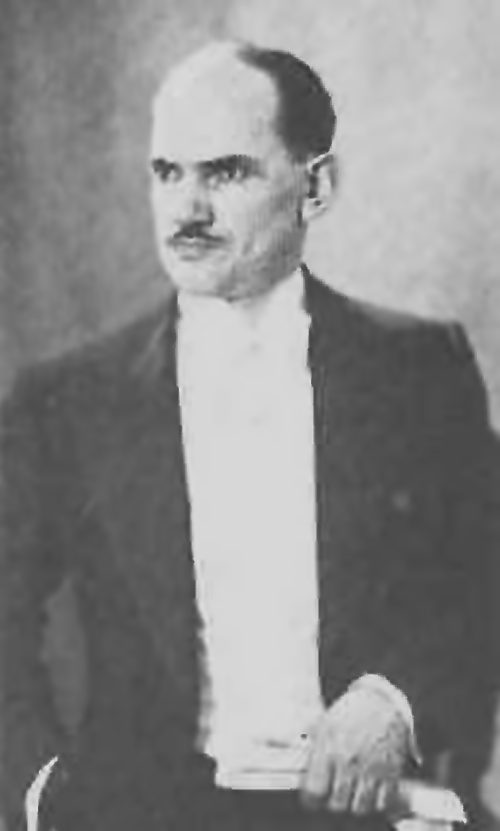
Ankara in 1943 was the capital of a neutral country that both sides wanted. Britain was pressing Turkey to enter the war and lend its airfields. Germany, which depended on Turkish chromium, wanted it to stay out. The German ambassador was Franz von Papen, a former chancellor. The British ambassador, Sir Hughe Knatchbull-Hugessen, had a habit of taking secret papers home from the chancery. His valet noticed.2
The valet
Elyesa Bazna was born in 1904 in Pristina, then in the Ottoman Empire, and had worked as a driver, guard and servant for several diplomats in Turkey. One of them, the German businessman Albert Jenke, sacked him for reading his mail. In 1943 Bazna did odd jobs for the British first secretary, Douglas Busk, who recommended him to the ambassador without checking his background. As valet to Knatchbull-Hugessen he had the run of the residence. According to the main accounts he took impressions of the key to the ambassador's dispatch box and photographed its contents while the ambassador slept, bathed or played the piano.2
On 26 October 1943 Bazna approached the German embassy through his old employer Jenke's household, asking £20,000 for two rolls of film. He was taken on by Ludwig Carl Moyzisch, the officer of the SS intelligence service (SD) who worked under diplomatic cover at the embassy. Von Papen gave the source his cover name.2,3
What Berlin heard
A copy of von Papen's first report survives because it was one of the German Foreign Office telegrams that a disaffected official, Fritz Kolbe, smuggled to Allen Dulles of the OSS in Bern. The CIA's case history of Kolbe quotes it:1
"... a number of [official British] documents have come to us from a new walk-in with whose further exploitation ... I have charged SD officer Moyzisch. ... in future communications I shall designate this source 'Cicero'"
Over the following months Cicero's films covered British dealings with Turkey, the Allied effort to bring Turkey into the war, and material connected with the Moscow, Tehran and Cairo conferences. One document carried the code word Overlord in a reference to keeping up pressure from the eastern Mediterranean "until Overlord is launched." Ribbentrop showed the first photographs to Hitler. Yet the Germans doubted their luck. The stream of material was unusually steady and the pictures unusually good, and the feud between Ribbentrop and von Papen got in the way of using them. According to Moyzisch, the Foreign Office made little use of the documents.2,3
How the leak was found
Kolbe's telegrams arrived in Bern at the end of December 1943, in a batch of more than 200 documents. Dulles passed the Cicero telegrams to MI6, because they concerned a British embassy and for security reasons. The CIA history notes that the British reaction "was slow": on 25 January 1944 London asked for the exact wording of the Cicero reports, and on 29 February it urgently asked for the hour on 3 November when the first one had been sent.1
The British tightened security at the embassy and fitted an alarm to the ambassador's safe. They also tried a trap in January 1944, using a fake Cabinet paper, which caught nobody. Bazna stopped selling material by the end of February. He left the embassy in April 1944 with no questions asked, and he was identified as Cicero only after the war. By then the Allies had another source inside the German embassy: Moyzisch's new secretary, Cornelia Kapp, was passing what she could learn about Cicero to the OSS.2
Paid in forged pounds
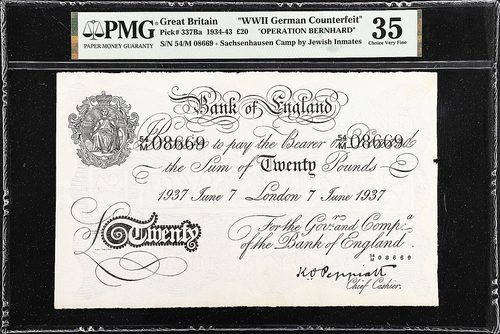
Bazna was paid in British banknotes, and after the war most of them turned out to be counterfeits from Operation Bernhard, the SS forgery workshop at Sachsenhausen. His plans to live on the money collapsed, he was prosecuted over the forged notes, and his appeals to the West German government for compensation got nowhere. He moved to Munich, published a memoir in 1962, and died there in 1970.2,5
After
Moyzisch was questioned by the Allies, testified at Nuremberg and in 1950 published Der Fall Cicero (Operation Cicero). Hollywood made it into 5 Fingers in 1952, with James Mason as the valet. Knatchbull-Hugessen received a formal reprimand in August 1945. A British Foreign Office review after the war found that Cicero had given the Germans a stream of information from the ambassador's desk about Allied plans in the region. A later Foreign Office analysis also found that the material helped von Papen delay Turkey's entry into the war.2,3,4
The documents
Declassified records of this operation, with the scans and their full text hosted here.

Checking the record
Dates and outcome compared in two independent sources: they agree.
- CIA
- Von Papen's telegram of 4 November 1943 reports a new walk-in with British documents; Kolbe brings copies to Bern at the end of December 1943; the British query the Cicero reports on 25 January and 29 February 1944. OSS passes the Cicero telegrams to MI6; the British reaction is slow.
- Wikipedia
- Bazna approaches the German embassy on 26 October 1943; stops selling by the end of February 1944; leaves the embassy around April 1944. Never caught; identified as Cicero after the war; much of his pay counterfeit.
The CIA history covers only the American side and does not say when Cicero stopped; Wikipedia gives the full span. The dates fit together, so this page uses Wikipedia for the start and end and the CIA history for the German telegram and the OSS warning.
Sources
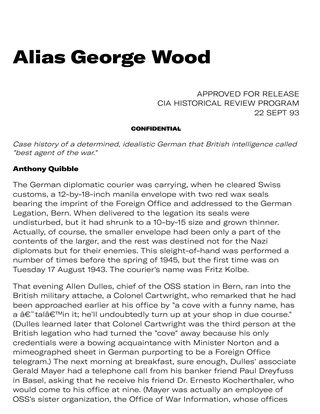
- CIA Alias George Wood, Central Intelligence Agency, Historical Review Program (approved for release 22 September 1993).
- Wikipedia Elyesa Bazna, Wikipedia.
- Wikipedia Ludwig Carl Moyzisch, Wikipedia.
- Wikipedia 5 Fingers, Wikipedia.
- Other Operation Bernhard, Bank of England Museum (2024-01-26).
Elsewhere in the files
Read next
 July 1942 – 6 May 1945
Operation Bernhard
The SS forgery of British banknotes, made by 142 Jewish prisoners in an isolated block at Sachsenhausen from 1942 to 1945 and used to pay spies and buy goods abroad. It was the largest counterfeiting effort of the war.
 United States · 1942–1945
Office of Strategic Services (OSS)
America's wartime intelligence service, 1942–1945: William Donovan's mix of scholars, spies, saboteurs and propagandists, abolished by Truman and reborn in parts as the CIA.
 1893–1969
Allen Dulles
OSS spymaster in wartime Switzerland and Director of Central Intelligence from 1953 to 1961, Allen Dulles presided over the CIA's era of coups and covert wars until the Bay of Pigs ended his tenure.
 Germany · 1920–1944
Abwehr
The German armed forces' intelligence service from 1920 to 1944: spies, saboteurs and counterintelligence under Admiral Canaris, outplayed by the FBI and MI5 and finally absorbed by the SS.
1920s–1990s
Double agents
Agents who seem to serve one service while controlled by another. From the OGPU's Trust to MI5's Double Cross system and the FBI's Duquesne case, the best of them turned an enemy network into a channel for deception.
 January – September 1944
Operation Fortitude
The Allied deception that invented armies in Scotland and southeast England in 1944 to make Germany expect landings in Norway and the Pas-de-Calais, and to see Normandy as a feint.