
 Page 1 of 12
From the document
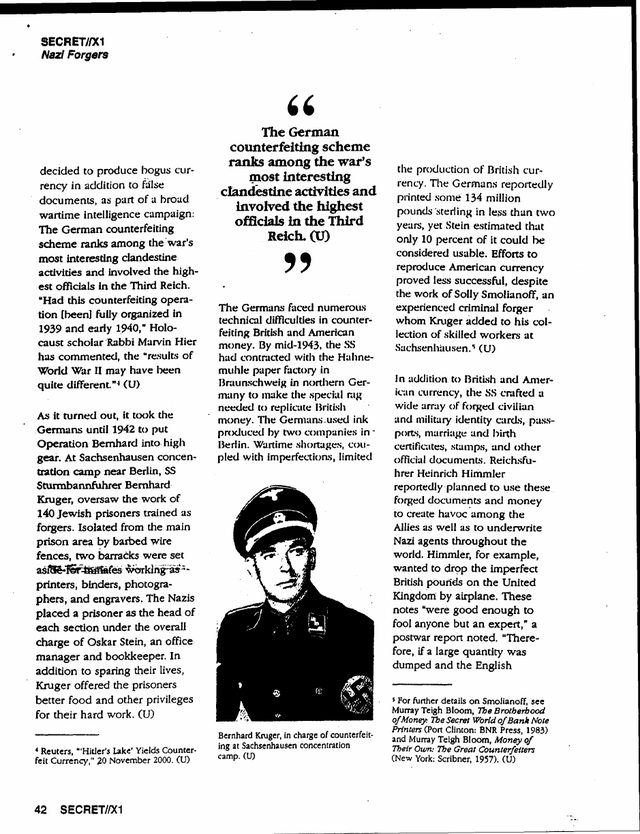
At Sachsenhausen concentration camp near Berlin, SS Sturmbannfuhrer Bernhard Kruger, oversaw the work of 140 Jewish prisoners trained as forgers.
Schwend uncovered more than 7,000 pieces of French and Italian gold that he had buried only days before the end of the war.
comes from a person who ... may possibly be denouncing Schwend for personal or business reasons.
Their cases illustrate the perennial challenge of balancing ends and means in the complex world of intelligence operations.
Excerpts are passages from a US government work (public domain), quoted exactly as they read in the scan, and checked against the full text on every rebuild.
Most accounts of Operation Bernhard end in May 1945, with the forgers liberated and crates of fake pounds at the bottom of Lake Toplitz. This article is about what came after. Its author, Kevin C. Ruffner, was a member of the CIA History Staff, and he wrote it for the agency's classified journal, Studies in Intelligence, in 2002. It ran 13 pages under the heading "Shifting from Wartime to Peacetime Intelligence Operations"1.
Ruffner had access to the agency's own files: Directorate of Operations personnel files on the men involved, and Army and OSS records at the National Archives. He opens with the 2000 search of Lake Toplitz televised by CBS, which brought up counterfeit pounds and dollars, and uses it as his way into the story1.
What it says
The first pages cover the forgery itself. From 1942 about 140 Jewish prisoners at Sachsenhausen, under SS officer Bernhard Krüger, produced some £134 million in British notes. Only about a tenth of it was usable, by the estimate of the unit's bookkeeper, Oskar Stein, and attempts to copy dollars largely failed. In 1945 the unit was moved to Mauthausen, then to Redl-Zipf, and the prisoners were freed at Ebensee on 6 May1.
The article then follows two American investigations. Capt. George J. McNally, a former Secret Service counterfeiting specialist attached to Eisenhower's headquarters, worked with Scotland Yard officers for eight months and wrote the Army's report. Separately, OSS counterintelligence (X-2) went after the men who had sold the notes. An Austrian art dealer, George Spitz, led the OSS to Friedrich Schwend, who had run sales from Schloss Labers near Merano and kept a third of the takings. Ruffner notes that some of the money paid the German agent in Ankara known as Cicero (The Cicero affair)1.
Once arrested, Schwend bargained. In July 1945 he dug up gold for his captors, and X-2 in Munich took on both men as agents, Spitz as TARBABY and Schwend as FLUSH, to report on suspected Nazi underground groups and Soviet activity. Both were later dropped. Dutch investigators linked Spitz to looted art, and Schwend fled in 1947 to Peru on a Red Cross passport. When a former associate accused him in 1948, the CIA told the Army that it had no contact with him. Ruffner follows Schwend through later reports of counterfeiting and smuggling in Latin America, his conviction in Peru for currency smuggling, his deportation to West Germany in 1976, and his death in Peru in 19801,4.
How it was released
The article went out classified Secret, with each paragraph marked. A stamp on its first page records declassification under the Nazi War Crimes Disclosure Act, the law under which the CIA reviewed and opened its files on Nazi war criminals and their postwar contacts1,2. The released copy keeps the text but blacks out the file and job numbers in the footnotes1.
How to read it
This is an agency historian writing about his own service's predecessors, from files most researchers could not then see. Its value lies in the footnotes, which name specific OSS and CIA reports and give their dates. Ruffner's judgment is cautious: the OSS's 1945 history counted the Bernhard pursuit as a success, while he presents Spitz and Schwend as opportunists who did well out of the connection for decades. Figures for the forgery's total output differ between sources; the £134 million here is one estimate among several1,3.
Some details differ from later accounts. The article has the OSS arresting Schwend in June 1945, while other sources say he surrendered in May and worked with the Army's Counter Intelligence Corps1,4.
Sources
- CIA Kevin C. Ruffner, "On the Trail of Nazi Counterfeiters (U)," Studies in Intelligence (2002), declassified copy, Central Intelligence Agency, FOIA Electronic Reading Room (2002).
- National Archives Nazi War Crimes and Japanese Imperial Government Records Interagency Working Group (IWG), US National Archives and Records Administration.
- Wikipedia Operation Bernhard, Wikipedia.
- Wikipedia Friedrich Schwend, Wikipedia.