
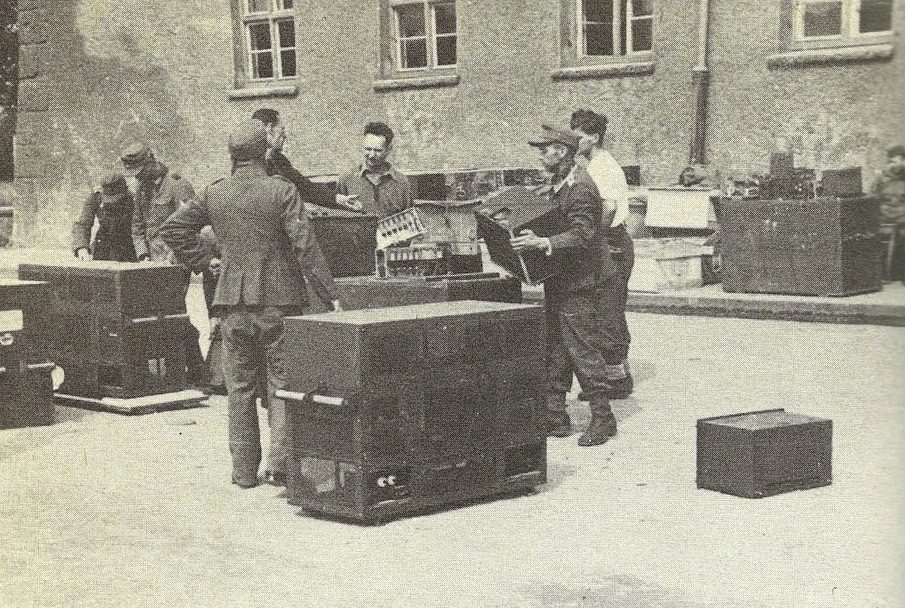
By early 1945 Bletchley Park knew a great deal about German ciphers and much less about German codebreakers. It did not know how much of the Allies' own traffic the Germans had read, which German systems were still unbroken, or what would happen to Germany's cryptologic archives once the Reich collapsed. The Target Intelligence Committee, TICOM, was set up to answer those questions. Its teams would follow the armies into Germany and take the people, machines and files before they were destroyed, looted or captured by the Red Army.1,3
Origins
The 1946 report's glossary defines TICOM as a joint combined committee "organized in the fall of 1944 in England for the exploitation of European Axis signal intelligence centers of special interest."1 The British started it. The senior American signals intelligence officer in Europe pressed for a US role once he learned of it. Army Chief of Staff George Marshall then directed Eisenhower to join.3
Marshall's memo set four aims:
- learn how far German cryptanalysis had succeeded against Britain and America;
- keep those results from falling into unauthorized hands;
- exploit German techniques and inventions before they could be destroyed;
- find anything of value for the war against Japan.3
The teams drew on GC&CS, the US Army Security Agency and the Navy's OP-20-G, most of them Bletchley Park staff.3 TICOM sat alongside other Allied hunts for German science and technology, such as Alsos for nuclear research and the programs that fed Operation Paperclip.3,4
The teams in the field
An early plan had TICOM officers dropping into Berlin with the 101st Airborne Division to hold signals headquarters until an armored column arrived. It was dropped by March 1945. Six teams went out from April instead.3
Team 6 took over the German Navy's B-Dienst headquarters in the British zone in northern Germany. In Saxony, American troops had found the Foreign Office cryptanalytic section, Pers Z S, in a castle at Burgscheidungen. Its files included broken Soviet codes. Because the castle lay in the future Soviet zone, Team 3 was rushed in to evacuate people and papers to England.3
Team 1 had the richest hunt, in Bavaria and Austria. At Kaufbeuren it found the abandoned quarters of the Forschungsamt, Hermann Göring's "Research Bureau." This was the Nazi Party's own signals-intelligence and wiretap agency, and the Allies had learned of it only days earlier from prisoners. Under the British cryptanalyst Major Ralph Tester, part of the team recovered an intact T52 Geheimschreiber, one of the teleprinter cipher machines behind the traffic Bletchley called "Fish." Near Berchtesgaden, an Army unit captured Field Marshal Kesselring's mobile signals convoy with its Fish machines and operators, and handed it to TICOM.3,4
Team 5, a two-man detachment, supervised divers at the Schliersee lake in Bavaria. Archives of OKW/Chi, the Wehrmacht's cipher bureau, were recovered from the lake bed.3,4
The Russian Fish
The capture with the biggest consequences had nothing to do with the war against Germany. At Rosenheim, prisoners from the German Army signals agency, OKH/GdNA, told Team 1 about equipment they had built to intercept a new Soviet high-level radio-teleprinter system. They dug up about seven and a half tons of it, reassembled it and showed it working. The Americans called it the "Russian Fish." Machines and German operators were shipped to England.3,4 Rezabek notes that this gave Britain and the United States a working intercept capability against Soviet traffic from June 1945, at the very start of the Cold War.3
What TICOM learned
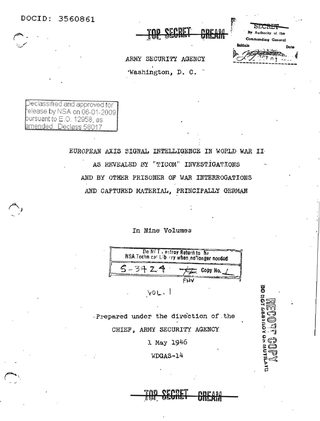
Interrogations went on through 1945 at a center code-named "Dustbin" and elsewhere. German specialists were made to write detailed reports on their own work. In May 1946 the Army Security Agency produced the summary: nine volumes covering OKW/Chi, the Army and Air Force signals services, the Foreign Office section, Göring's bureau, German high-level cryptography and German traffic analysis of Soviet communications.1,3
The findings cut both ways. The German services had read a good deal of medium-grade Allied traffic. The synopsis records German solutions of British and American codes and of the M-209, the US Army's Hagelin-type field cipher machine. In theaters where enough traffic was available, it says, 10 to 30 percent of M-209 traffic was readable, although most of it was read too late to be of tactical use.1 But no German agency broke the top Allied machine systems. The Army's effort against the British Typex was dropped in 1943, the Luftwaffe never solved SIGABA, and OKW/Chi gave up attacking high-level American and British machine ciphers.3 The Germans also believed, wrongly, that a properly used plugboard Enigma was secure, as TICOM's interrogations of OKW/Chi's cryptanalysts showed.4
Secrecy and release
TICOM remained classified long after Ultra became public in 1974. The journalist James Bamford named the Russian Fish as a main reason. Rezabek adds that the report exposed the weakness of many smaller countries' codes, which Britain and the United States went on reading after the war. NSA extended the report's classification in 1992, but released volumes from 1998 and the rest in 2008 and 2009. They were posted online in 2010.1,3 In May 2016 the NSA transferred its final 29,000-plus pages of TICOM records to the National Archives at College Park.2
The documents
Declassified records of this operation, with the scans and their full text hosted here.

Checking the record
Dates and outcome compared in two independent sources: they agree.
- NSA
- Committee organized in England in autumn 1944; teams in the field April–June 1945; final report dated 1 May 1946. German Army, Air Force, Navy, Foreign Office and Nazi Party signals agencies exploited; German successes against Allied medium-grade systems documented.
- Wikipedia
- Formed during the Second World War; Russian FISH tip received 21 May 1945. Six teams seized German cryptologic material, including Kesselring's communications train and the 'Russian Fish' receivers.
The NSA release and the 1946 synopsis date TICOM's founding to 1944; Wikipedia gives no start date but agrees on the teams and captures. This page uses the synopsis and NSA's release for dates and Rezabek's study of the declassified volumes for the team details.
Sources
- NSA European Axis Signal Intelligence in World War II as Revealed by 'TICOM' Investigations, Volume 1: Synopsis, Army Security Agency (released by the National Security Agency) (1946-05-01).
- NSA NSA Releases Thousands of WWII-era Documents to National Archives, National Security Agency (2016-05-23).
- Other TICOM: The Last Great Secret of World War II (Randy Rezabek), Intelligence and National Security 27:4, Taylor & Francis (author's copy on Zenodo) (2012).
- Wikipedia TICOM, Wikipedia.
- Wikipedia English Wikipedia article (used for cross-checking).
Elsewhere in the files
Read next
 December 1932 – May 1945
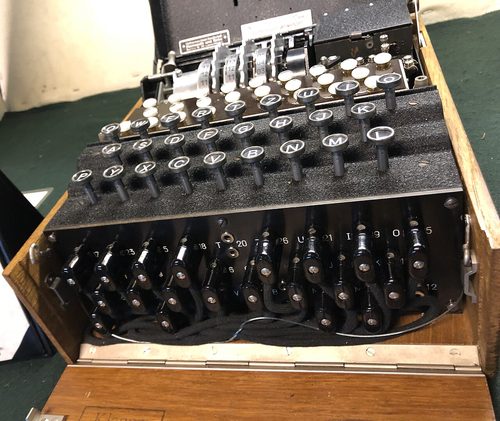
Ultra and the breaking of Enigma
How Polish mathematicians first broke the German Enigma machine, and how Britain's codebreakers at Bletchley Park turned that start into Ultra, the most closely guarded intelligence source of the Second World War.
 1915–1970s
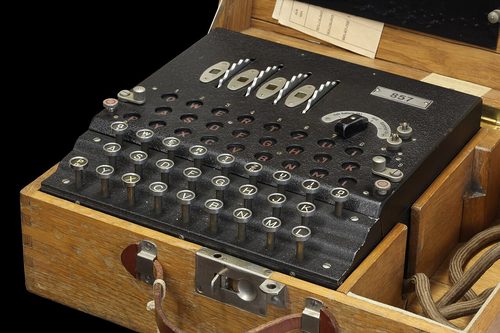
Cipher machines
From Hebern's rotor to Enigma, Purple, Lorenz and SIGABA, the electromechanical machines that carried the secrets of the Second World War, and the codebreakers who read most of them.
 1914–1990s
Signals intelligence
Intelligence from intercepted communications and electronic emissions, from Room 40 and the Zimmermann telegram to Ultra, Venona, the Berlin tunnel and NSA's domestic programs exposed by the Church Committee.
 20 July 1945 – 1962
Operation Paperclip
The US program, first called Overcast, that brought more than 1,500 German scientists and engineers to America after 1945, among them Wernher von Braun's rocket team and men with Nazi pasts.
 United States · 1952
National Security Agency (NSA)
America's signals intelligence and communications security agency, created by a secret Truman directive in 1952 out of the Armed Forces Security Agency, and exposed to public scrutiny by the Church Committee in 1975.
 United Kingdom · 1919
GC&CS and GCHQ
Britain's codebreaking agency: founded in 1919 as the Government Code and Cypher School, it broke Enigma at Bletchley Park, became GCHQ in 1946 and anchored the UKUSA signals partnership with the United States.