
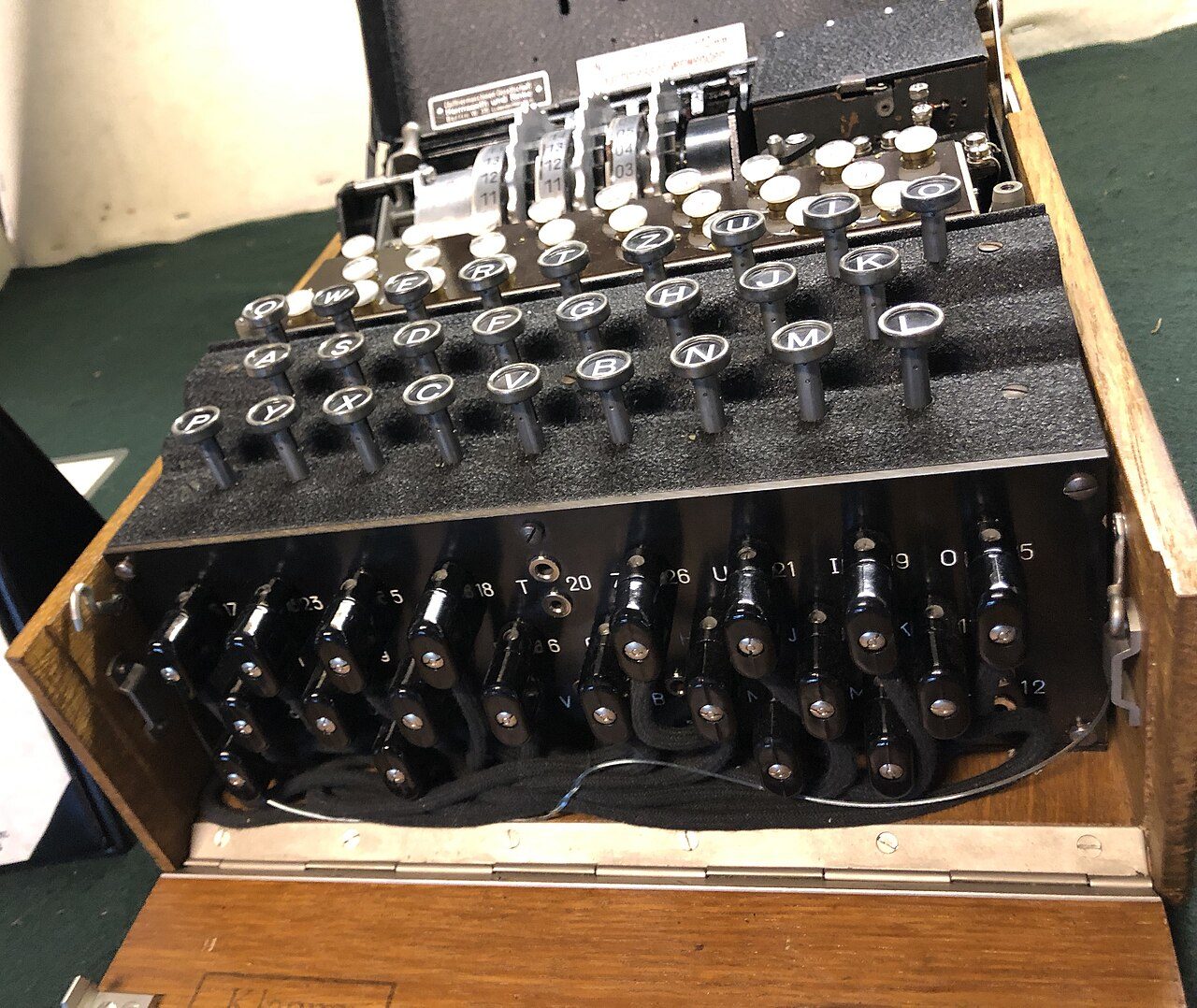

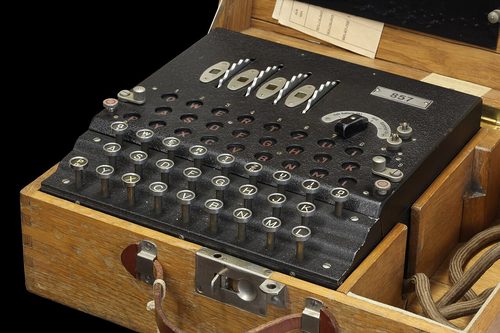
Ultra was the British codeword, adopted in June 1941, for intelligence obtained by breaking the highest-grade enemy machine ciphers. Most of it came from the German Enigma machine, but the label also covered the Lorenz teleprinter cipher used by the German high command and the Hagelin machine used by the Italian navy. The work centered on the Government Code and Cypher School, the forerunner of GC&CS and GCHQ, at Bletchley Park in Buckinghamshire6. Before June 1941 the material went out under other cover names: BONIFACE for army and air force decrypts, implying a well-placed agent in Berlin, and HYDRO for naval traffic6.
The Polish break
On 1 September 1932 the Polish General Staff's Cipher Bureau hired three young mathematicians from Poznań University: Marian Rejewski, Jerzy Różycki and Henryk Zygalski. In December 1932 Rejewski reconstructed the wiring of the German military Enigma, combining permutation theory with operating manuals and monthly keys that French intelligence had bought from a German informant, Hans-Thilo Schmidt7. The Poles then read German traffic for years, devising perforated sheets (Zygalski's method) and an electromechanical aid, the bomba, to recover daily settings7.
German changes to procedure late in 1938 cut deeply into Polish success. With war approaching and British and French guarantees to Poland in place, the Poles shared everything. On 25 and 26 July 1939, in the Pyry forest outside Warsaw, they briefed Alastair Denniston, head of GC&CS, and Dilly Knox, its leading Enigma specialist, together with French officers1. GCHQ's own account says the visitors found the Poles far ahead of them, both in how much traffic they had read and in having built the first electromechanical device for cryptanalysis1. Foreign Office historians judge that this saved the British at least a year2.
Bletchley Park and the bombe
GC&CS moved to Bletchley Park as war began. In January 1940 Alan Turing traveled to France to meet the Polish cryptanalysts, who had escaped there after Poland fell; those conversations, GCHQ says, were fundamental to the design of the British bombe1. Turing's machine was not a copy of the Polish bomba. It tested guessed plaintext, or "cribs," against the machine's possible settings, an approach that kept working after the Germans closed the loophole the Poles had exploited7. The first bombe, named Victory, arrived on 18 March 1940; there were about 210 by the end of the war7.
Naval Enigma was harder. Turing's Hut 8 broke into U-boat traffic in 1941, helped by material seized from the weather ships München and Lauenburg and from the submarine U-1107. On 1 February 1942 the U-boat network switched to a four-rotor machine, and the Atlantic went dark for most of a year. Regular reading resumed in December 1942, after code material was recovered from U-5597. From May 1943 the US Navy, with National Cash Register in Dayton, Ohio, produced 121 fast four-rotor bombes, and Anglo-American cooperation became routine7.
On 21 October 1941 Turing, Gordon Welchman, Hugh Alexander and Stuart Milner-Barry went over their superiors' heads and wrote directly to Churchill, saying that naval keys were being delayed by twelve hours a day for lack of clerks and typists. Churchill ordered at once that their needs be met as a matter of top priority, and by 18 November the head of Secret Intelligence Service (MI6) reported that staff were arriving fast; the papers are in the National Archives as HW 1/1553.
The Lorenz cipher, which the British called Tunny, was a separate problem. Bletchley broke it without ever seeing the machine, and from 1944 attacked it with Colossus, the electronic machine designed by the Post Office engineer Tommy Flowers5,6. GCHQ says Colossus helped confirm that Hitler believed the invasion would come at the Pas-de-Calais rather than Normandy5.
Getting it to commanders safely
Using Ultra without betraying it was as hard as producing it. Army and air force summaries were written in Hut 3 and sent by the Secret Intelligence Service's radio network to Special Liaison Units attached to major headquarters. A liaison officer typically handed a summary to the commander, waited while he read it, and took it back to destroy6. Attacks were often given a cover story: before Axis supply ships bound for North Africa were struck, an aircraft would be sent to be seen "finding" them6. A postwar US Army study records that about 28 American officers served as Ultra advisers to commands in Europe under a letter of 15 March 1944 from General George Marshall to General Dwight Eisenhower, which required each to advise on using Ultra "in such fashion that the security of the source is not endangered"4.
What it achieved
Ultra fed directly into the The Double-Cross System: decrypts of Abwehr traffic showed that German intelligence trusted the double agents run by Security Service (MI5), which made deceptions such as Operation Mincemeat and Operation Fortitude possible and allowed their effect to be measured6. Decrypts also helped in the Mediterranean supply war, the Battle of the Atlantic, and Normandy6. For the parallel American effort against Japan, see Magic and the breaking of Purple. In July 1945 Eisenhower wrote to the SIS chief, Sir Stewart Menzies, that the intelligence had been "of priceless value to me"6.
Secrecy and disclosure
According to Winterbotham, Churchill asked recipients in May 1945 to keep the source secret, and they largely did for nearly three decades6. Polish and French accounts of the prewar break appeared in 1967 and 1973; the British ban was lifted in 1974, the year Winterbotham published The Ultra Secret6. The official history followed between 1979 and 19886. A Director of GCHQ acknowledged in 2014 that the first volume, published in 1979, understated the Polish and French contribution, and that it took nine years to correct8. Postwar interrogation of German cryptographic staff (see TICOM) found that German experts had considered Enigma theoretically vulnerable but believed an attack too costly to be practical6.
The documents
Declassified records of this operation.
Checking the record
Dates and outcome compared in two independent sources: they agree.
- Official history
- Polish, French and British cryptanalysts met near Warsaw on 25 and 26 July 1939; the first British bombe was working at Bletchley Park by the German offensive in the West (May 1940). The Polish disclosures transformed GC&CS's attack on Enigma and led directly, through Turing's talks with Rejewski in January 1940, to the British bombe.
- Wikipedia
- Poles broke Enigma in December 1932; handover to the French and British on 25 July 1939; first bombe delivered 18 March 1940; codeword Ultra adopted June 1941. Ultra became the Allies' standard term for high-grade decrypts; German traffic was read through 1945 and the secret held until 1974.
The sources agree on the sequence. GCHQ gives the Pyry meeting as 25–26 July 1939, Wikipedia gives the handover as 25 July, and the FCDO historians' blog dates the Polish revelation to 26 July; this page uses GCHQ's two-day span.
Sources
- Official history The Pyry Forest Meeting, GCHQ (2020-07-21).
- Official history What's the context? Polish cryptologists reveal they have cracked the Enigma code, 26 July 1939, History of Government blog, UK Government (FCDO Historians) (2019-07-26).
- Official history A dramatic plea for Churchill's help from Bletchley Park (HW 1/155), The National Archives (UK) (1941-10-21).
- NSA Synthesis of Experiences in the Use of ULTRA Intelligence by U.S. Army Field Commands in the European Theatre of Operations (SRH-006), National Security Agency, Record Group 457 (transcription at ibiblio.org).
- Official history GCHQ celebrates 80 years of Colossus, GCHQ (2024-01-18).
- Wikipedia Ultra (cryptography), Wikipedia.
- Wikipedia Cryptanalysis of the Enigma, Wikipedia.
- Official history Director GCHQ commemorates crucial pre-war Enigma information-sharing meeting in Poland, GCHQ (2014-07-03).
- Wikipedia English Wikipedia article (used for cross-checking).
Elsewhere in the files
- Agency GC&CS and GCHQ
- Agency Office of Strategic Services (OSS)
- Agency Secret Intelligence Service (MI6)
- Agency Security Service (MI5)
- Document Friedman's report on breaking PURPLE (14 October 1940)
- Document The BRUSA agreement on 'Special Intelligence' (1943), with the War Department's covering memo
- Document What the Germans could read: the TICOM report, Volume 1, Synopsis (1946)
- Operation Magic and the breaking of Purple
- Operation Operation Fortitude
- Operation Operation Mincemeat
- Operation TICOM
- Operation The Lucy spy ring
- Person Alan Turing
- Person James Jesus Angleton
- Person John Cairncross
- Tradecraft Cipher machines
- Tradecraft Double agents
- Tradecraft Signals intelligence
Read next
 20 February 1939 – September 1945
Magic and the breaking of Purple
In September 1940 a small US Army team rebuilt Japan's top diplomatic cipher machine without ever seeing one. The decrypts, called Magic, shaped American policy before Pearl Harbor and fueled a long argument afterward.
 September 1939 – May 1945
The Double-Cross System
How MI5 caught or recruited Germany's wartime spies in Britain and ran them as double agents, steered by the Twenty Committee, until their reports could carry the D-Day deception.
 January – September 1944
Operation Fortitude
The Allied deception that invented armies in Scotland and southeast England in 1944 to make Germany expect landings in Norway and the Pas-de-Calais, and to see Normandy as a feint.
 1915–1970s
Cipher machines
From Hebern's rotor to Enigma, Purple, Lorenz and SIGABA, the electromechanical machines that carried the secrets of the Second World War, and the codebreakers who read most of them.
 1914–1990s
Signals intelligence
Intelligence from intercepted communications and electronic emissions, from Room 40 and the Zimmermann telegram to Ultra, Venona, the Berlin tunnel and NSA's domestic programs exposed by the Church Committee.
 August 1942 – 19 May 1944
The Lucy spy ring
From Lucerne, the German émigré publisher Rudolf Roessler fed German high command secrets to Soviet intelligence in 1942–1943. Who his sources were, and how the material reached him, is still argued over.