
 Page 1 of 36
From the document
From TICOM sources it is learned that European cryptanalysts were unable to read any U. S. Army or Navy high-level cryptographic systems.
The solution of this system was perhaps for the allies the most disastrous signal intelligence success achieved by the Germans.
From an intelligence standpoint the results obtained by the German cryptanalytic successes were important, but not decisive.
the two most serious German cryptographic mistakes of the war: the continued use in high level German military communications of the plugboard Enigma machine and the teleprinter cipher attachment SZ 42 in their insecure forms.
Excerpts are passages from a US government work (public domain), quoted exactly as they read in the scan, and checked against the full text on every rebuild.
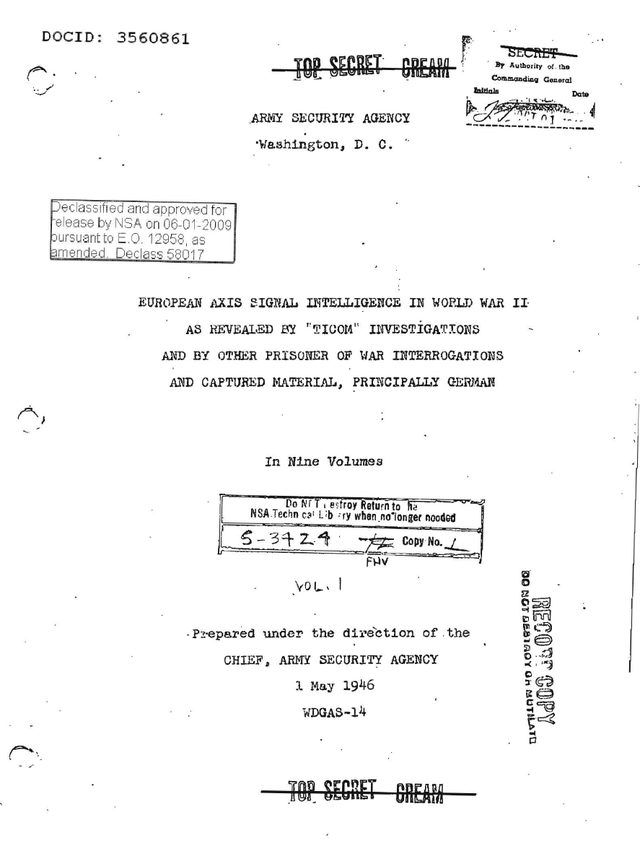
In May 1946 the US Army Security Agency finished a nine-volume, top-secret report on what the Allies had learned by capturing Germany's codebreakers. This is its first volume, the synopsis, prepared "under the direction of the Chief, Army Security Agency" and dated 1 May 19461. The other eight volumes cover German high-level cryptanalysis, each German agency in turn, and German traffic analysis of Soviet communications; this one pulls the findings together1. The hosted extract is the first 36 pages, through paragraph 111.
How TICOM began
Paragraph 1 explains the cover name: TICOM was the "Target Intelligence Committee", a joint Anglo-American body set up in England in October 1944 on the authority of the US Army Chief of Staff, the commander of the US Fleet and the chairman of the London Signals Intelligence Board. The volume credits the idea to Col. George A. Bicher of ETOUSA's Signal Intelligence Division in summer 19441. The plan was at first to seize German signals sites by airborne assault. By March 1945 the German agencies were scattered, so six US-British teams followed the advancing armies instead; the first went to the Neumünster–Flensburg area in April 19451.
The haul is given in figures: about 4,000 German documents weighing five tons, many cipher machines, and 196 interrogation reports. The volume says the real value was what these showed about the security of American systems1. See TICOM for the operation.
What the Germans read
Paragraph 2 is the one historians quote. No high-level US Army or Navy system was read: SIGABA, SIGCUM, SIGTOT, the SIGSALY speech system and the Combined Cipher Machine were "completely secure". The lower levels were another matter. The Germans read the War Department's unenciphered telegraph codes, the compromised Military Intelligence Code No. 11 used by the attaché in Cairo through the summer of 1942, which gave Rommel tactical intelligence, and 10 to 30 per cent of intercepted M-209 traffic, usually too late to matter1.
The worst loss was naval. Combined Naval Cypher No. 3, used for Atlantic convoys, was read "almost 100 per cent" from late 1941 to mid-1943, and the volume ties this to convoy losses six times those of any comparable period. State Department codes and strip ciphers were also read. The judgment: important, "but not decisive"1.
Germany's six agencies
Paragraph 3 counts six main German cryptologic organizations with about 30,000 people, against more than 60,000 in the Anglo-American effort. Four were military: the army, navy and air force agencies and the armed forces high command's OKW/Chi. Two were civilian: the Foreign Office's Pers Z S and Göring's Forschungsamt, which also tapped telephones inside Germany1. The following paragraphs take each in turn. The Luftwaffe's service, the volume says, gave prompt warning of Allied heavy bomber raids. And OKW/Chi is blamed for the two worst German cryptographic mistakes of the war: keeping the plugboard Enigma and the SZ 42 teleprinter cipher in insecure forms1. That is the link to Ultra and the breaking of Enigma.
Reading it
This is the US Army's own assessment, written by the people responsible for American communications security, from captured papers and prisoners' testimony. Its figures come from German sources1. The volumes stayed classified for six decades; NSA released them in 2008–2009 and later transferred its remaining TICOM material to the National Archives2,4.
Sources
- NSA European Axis Signal Intelligence in World War II as Revealed by 'TICOM' Investigations, Volume 1: Synopsis (DOCID 3560861), National Security Agency (1946-05-01).
- NSA NSA Releases Thousands of WWII-era Documents to National Archives, National Security Agency (2016-05-23).
- Other TICOM: The Last Great Secret of World War II (Randy Rezabek), Intelligence and National Security 27:4, Zenodo (author's copy) (2012).
- Wikipedia TICOM, Wikipedia.