
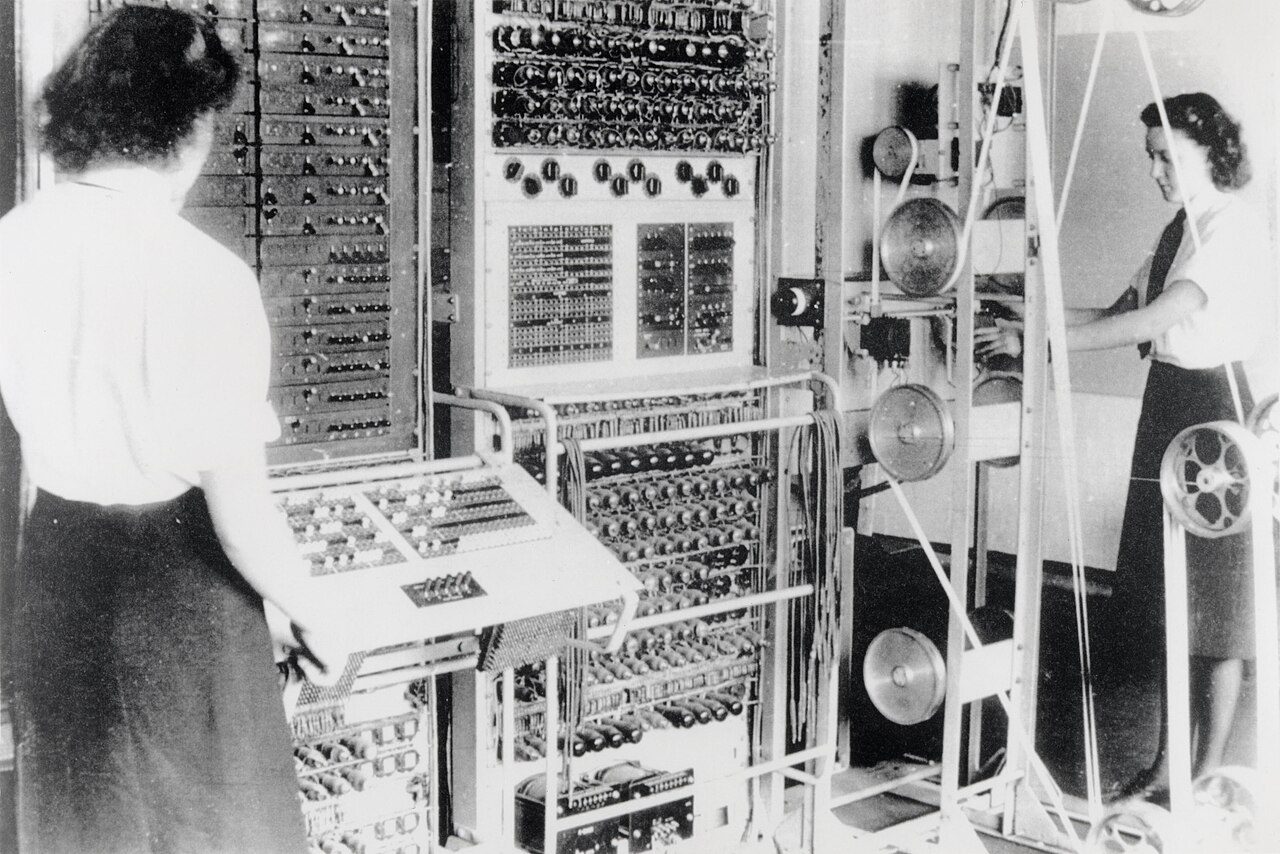

The name was a cover. When the British government set up a peacetime codebreaking bureau in 1919, it called it the Government Code and Cypher School and gave it a public task: advising departments on the security of their own codes. Its real work was reading other governments' messages. Twenty years later that small office moved to a country house in Buckinghamshire, and the name Bletchley Park became shorthand for the most productive codebreaking operation of the Second World War.1,8
From Room 40 to the School
British signals intelligence began in August 1914. The Admiralty's Room 40 and the War Office's MI1(b) read German naval, military and diplomatic traffic throughout the war; GCHQ's own history credits them with warning of German fleet movements before Jutland and with the Zimmermann Telegram of 1917, which helped bring the United States into the war.1
In 1919 the Cabinet decided to keep a single inter-service codebreaking unit. Staff from both wartime bureaus were merged under Admiralty control, with the Director of Naval Intelligence, Hugh Sinclair, as titular head and Alastair Denniston, a Room 40 veteran, as operational chief. The Government Code and Cypher School (GC&CS) formally came into being on 1 November 1919 at Watergate House in London, with roughly 25 to 30 officers.1,2,3,8
The interwar years
In 1922 GC&CS passed to the Foreign Office, since almost everything worth reading was diplomatic, and from 1923 Sinclair was both chief of the Secret Intelligence Service and director of GC&CS. According to GCHQ's own account, through the 1920s the School read every foreign diplomatic cipher that produced enough traffic to attack, except those protected by a one-time pad. Soviet diplomatic traffic was among them, until in May 1927 the government made details from Soviet decrypts public during a political row.2,8
The weaknesses were less visible. Little work was done on military targets until the mid-1930s, and the threat posed by electromechanical cipher machines such as Enigma was not fully appreciated. Service sections were added slowly: naval in 1924, army in 1930, air in 1936. In the late 1930s Denniston built links with Polish and French codebreakers that would prove decisive.2,3
Bletchley Park
In August 1939 GC&CS moved to its war station at Bletchley Park. Fewer than a hundred people had worked for it in 1939; at the wartime peak about 10,000 worked at Bletchley and its outstations. The work there on German Enigma and the Lorenz teleprinter cipher, by Alan Turing and many others, produced the intelligence the Allies called Ultra. In 1943 the first Colossus, an electronic machine built to attack the Lorenz cipher, was made for the section known as the Newmanry.4,6
The organization grew faster than its structure. The National Archives' administrative history records that keeping traffic analysis apart from codebreaking contributed to failures in the 1940 Norwegian campaign, and that the services' analysts were brought into GC&CS during 1940. After an inquiry in January 1942, the diplomatic and commercial sections went back to London under Denniston, and the military work at Bletchley passed to his deputy, Edward Travis.2,3
The American partnership
Cooperation with the United States began before Pearl Harbor. In early 1941 an American mission visited Bletchley and handed over a copy of the Japanese diplomatic cipher machine it had reconstructed (the source of Magic); the British showed it the bombe used against Enigma. The BRUSA agreement of 17 May 1943 committed GC&CS and the US War Department to share intelligence and personnel. On 5 March 1946 the UKUSA agreement extended the arrangement into peacetime; Canada joined in 1949, and Australia and New Zealand in 1956. The agreement's existence was not officially acknowledged for decades, and its files were released to The National Archives in 2010. GCHQ's American counterpart in the partnership became the National Security Agency.5
GCHQ in the Cold War
In April 1946 GC&CS took a new name, Government Communications Headquarters, and moved to wartime buildings at Eastcote in northwest London. Eastcote proved cramped, and GCHQ chose Cheltenham, where two government office sites had served as headquarters of the US Army's Services of Supply in 1942–1944 and were already wired with landlines. The main move began in the summer of 1952 and was effectively complete a year later.4
Communications security was split off in 1954 and returned in 1969 as the Communications-Electronics Security Group. The National Cyber Security Centre's history dates to 1970 the idea of public-key cryptography, conceived inside GCHQ by James Ellis; the work was made public only in 1997. The agency's existence was first exposed in the press in 1976, and in 1984 the government banned trade union membership among its staff, a decision upheld in the courts and reversed only in 1997. The Intelligence Services Act 1994 put GCHQ on a statutory footing; section 3 begins "There shall continue to be a Government Communications Headquarters."3,6,7,8
Key dates
- 1 November 1919 Government Code and Cypher School formally established under Alastair Denniston, merging the wartime Admiralty and War Office codebreakers.
- 1922 Transferred from the Admiralty to the Foreign Office; from 1923 its director is also the chief of SIS.
- August 1939 Moves to its war station at Bletchley Park.
- February 1942 Reorganized: Denniston takes the diplomatic sections back to London, Edward Travis runs the service sections at Bletchley.
- 17 May 1943 BRUSA agreement with the US War Department on sharing signals intelligence.
- 5 March 1946 UKUSA agreement signed in Washington.
- April 1946 Renamed Government Communications Headquarters and moved to Eastcote, northwest London.
- 1952 Main move to Cheltenham begins; complete by the following year.
- 1984 Government bans trade union membership at GCHQ; the ban is lifted in 1997.
- 26 May 1994 Intelligence Services Act 1994 gives GCHQ a statutory basis.
Operations in these files
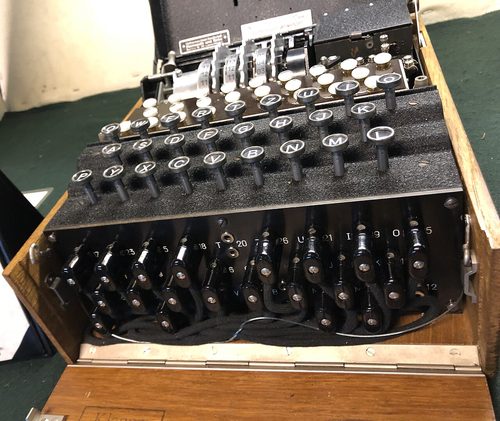 December 1932 – May 1945
Ultra and the breaking of Enigma
How Polish mathematicians first broke the German Enigma machine, and how Britain's codebreakers at Bletchley Park turned that start into Ultra, the most closely guarded intelligence source of the Second World War.
 September 1939 – May 1945
The Double-Cross System
How MI5 caught or recruited Germany's wartime spies in Britain and ran them as double agents, steered by the Twenty Committee, until their reports could carry the D-Day deception.
 1 February 1943 – 1 October 1980
The Venona project
The US Army codebreaking program that, from 1943 to 1980, read parts of some 2,900 wartime Soviet intelligence cables and exposed Fuchs, the Rosenbergs and Donald Maclean.
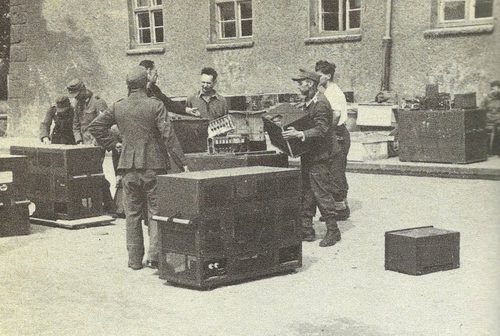 1944 – 1 May 1946
TICOM
The 1945 Anglo-American hunt for Germany's codebreakers, their machines and files, which showed how far the Germans had read Allied traffic and handed the West a working Soviet intercept system.
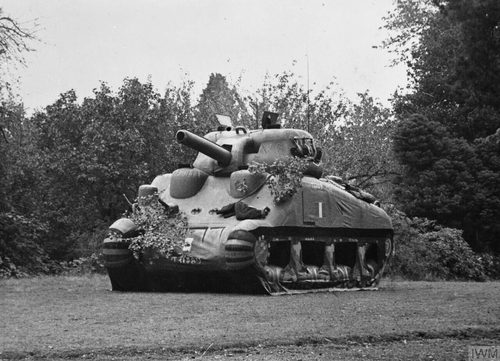 January – September 1944
Operation Fortitude
The Allied deception that invented armies in Scotland and southeast England in 1944 to make Germany expect landings in Norway and the Pas-de-Calais, and to see Normandy as a feint.
People
Sources
- Official history Our origins & WWI, GCHQ.
- Official history Alastair Denniston, GCHQ.
- National Archives Records created or inherited by Government Communications Headquarters (HW): administrative history, The National Archives (UK).
- NSA Cryptologic Almanac 50th Anniversary Series: Fifty Years of GCHQ in Cheltenham (by Peter J. Freeman, GCHQ historian), National Security Agency (2002).
- Official history A Brief History of the UKUSA agreement, GCHQ (2021-03-05).
- Official history Our history, National Cyber Security Centre (part of GCHQ) (2017-06-08).
- Other Intelligence Services Act 1994 (as enacted), legislation.gov.uk (1994-05-26).
- Wikipedia GCHQ, Wikipedia.
- Wikipedia English Wikipedia article (used for cross-checking).
Elsewhere in the files
- Agency National Security Agency (NSA)
- Agency Secret Intelligence Service (MI6)
- Agency Security Service (MI5)
- Document The BRUSA agreement on 'Special Intelligence' (1943), with the War Department's covering memo
- Operation Operation Fortitude
- Operation Operation Mincemeat
- Operation TICOM
- Operation The Double-Cross System
- Operation The Venona project
- Operation Ultra and the breaking of Enigma
- Person Alan Turing
- Person John Cairncross
- Tradecraft Cipher machines
- Tradecraft Signals intelligence