
Portrait: Alan Turing, photographed by Elliott & Fry on 29 March 1951. Elliott & Fry. Wikimedia Commons, Public domain.

On 4 September 1939, the day after Britain declared war on Germany, a 27-year-old Cambridge mathematician reported to Bletchley Park, the wartime station of the Government Code and Cypher School5. Alan Turing had already published the paper that founded the theory of computation. At Bletchley he applied that cast of mind to the German Enigma machine, and the results became a large part of the intelligence later known as Ultra1.
Before the war
Turing was born in Maida Vale, London, on 23 June 19121. He read mathematics at King's College, Cambridge, graduating with first-class honors in 1934, and took his doctorate at Princeton in 19381. In 1936 he completed "On Computable Numbers", which described an abstract machine able to carry out any calculation that can be specified as a procedure, the idea now called the Turing machine5.
Bletchley Park
GCHQ's own account credits Turing with two linked achievements at GC&CS: designing the British Bombe and leading the attack on German naval Enigma in Hut 8, where he worked closely with Joan Clarke1. In January 1940 he met Polish cryptanalysts, whose pre-war work on Enigma gave him the insights he needed for the Bombe1. The machine did not decrypt messages. It tested possible Enigma settings at speed against a guessed fragment of plaintext and discarded those that produced a logical contradiction. The first was installed on 18 March 19405.
Naval Enigma was harder than the Army and Air Force keys, because the German navy used more elaborate procedures. Turing worked out its indicator system and devised a statistical method, called Banburismus, that cut down the number of rotor orders the Bombes had to test5. In October 1941 he was among the senior codebreakers who wrote directly to Winston Churchill to say that shortages of staff were holding back their work. Churchill's minute ordered that they be given all they needed "on extreme priority"5.
In late 1942 Turing went to the United States to share methods and to work on secure speech systems. GCHQ notes that he contributed to the development of the US cipher machine SIGABA1. On his return in 1943 he designed a portable speech scrambler, codenamed Delilah1. He was appointed OBE in 1946, but the reason stayed secret for decades5.
Two mathematical papers he wrote at Bletchley on the use of probability in codebreaking were kept by GCHQ until 2012. That April, for his centenary, they were released to The National Archives as HW 25/37 and HW 25/383.
After the war
At the National Physical Laboratory, Turing produced the design for the Automatic Computing Engine, one of the first detailed designs for a stored-program computer1. From 1948 he worked at the University of Manchester on the Manchester Mark 1 and its successor. In 1950 he proposed the test of machine intelligence that bears his name1.
Prosecution and death
In 1952 Turing was prosecuted for gross indecency over a relationship with another man. GCHQ records that its head of cryptanalysis, Hugh Alexander, was officially allowed to appear as a character witness1. Turing pleaded guilty and chose probation, which was conditional on hormonal treatment1. The conviction also cost him his security clearance, ending his consultancy for GCHQ2.
On 8 June 1954 his housekeeper found him dead at his home in Wilmslow, Cheshire. He had died the day before of cyanide poisoning, and the inquest returned a verdict of suicide5.
Apology and pardon
In September 2009 Prime Minister Gordon Brown issued a public apology for Turing's treatment5. On 24 December 2013 he received a posthumous pardon under the Royal Prerogative of Mercy. The Ministry of Justice called it unusual: no family member had requested it, and there was no claim that he was innocent of the offense as the law then stood2. Section 164 of the Policing and Crime Act 2017 extended posthumous pardons to other men convicted of the same abolished offenses4.
Key dates
- 1936 Completes 'On Computable Numbers', introducing what became known as the Turing machine.
- 4 September 1939 Reports to Bletchley Park, wartime home of GC&CS.
- 18 March 1940 First British Bombe, built to his design, is installed.
- October 1941 Co-signs the codebreakers' letter to Churchill asking for more staff; Churchill orders 'Action this day'.
- 31 March 1952 Convicted of gross indecency; sentenced to probation conditional on hormone treatment.
- 7 June 1954 Dies of cyanide poisoning at Wilmslow, Cheshire.
- 17 April 2012 GCHQ releases two of his wartime research papers to The National Archives (HW 25/37–38).
- 24 December 2013 Granted a posthumous royal pardon.
Sources
- Official history Alan Turing, GCHQ.
- Official history Royal pardon for WW2 code-breaker Dr Alan Turing, Ministry of Justice, GOV.UK (2013-12-24).
- Official history HW 25/37: The Applications of Probability to Crypt (Alan Turing wartime research paper released by GCHQ), The National Archives (UK), Discovery catalogue (2012).
- Other Policing and Crime Act 2017, section 164: Posthumous pardons for convictions etc of certain abolished offences, legislation.gov.uk (2017).
- Wikipedia Alan Turing, Wikipedia.
- Wikipedia English Wikipedia article (used for cross-checking).
Elsewhere in the files
Read next
 December 1932 – May 1945
Ultra and the breaking of Enigma
How Polish mathematicians first broke the German Enigma machine, and how Britain's codebreakers at Bletchley Park turned that start into Ultra, the most closely guarded intelligence source of the Second World War.
 United Kingdom · 1919
GC&CS and GCHQ
Britain's codebreaking agency: founded in 1919 as the Government Code and Cypher School, it broke Enigma at Bletchley Park, became GCHQ in 1946 and anchored the UKUSA signals partnership with the United States.
 1915–1970s
Cipher machines
From Hebern's rotor to Enigma, Purple, Lorenz and SIGABA, the electromechanical machines that carried the secrets of the Second World War, and the codebreakers who read most of them.
 1914–1990s
Signals intelligence
Intelligence from intercepted communications and electronic emissions, from Room 40 and the Zimmermann telegram to Ultra, Venona, the Berlin tunnel and NSA's domestic programs exposed by the Church Committee.
 20 February 1939 – September 1945
Magic and the breaking of Purple
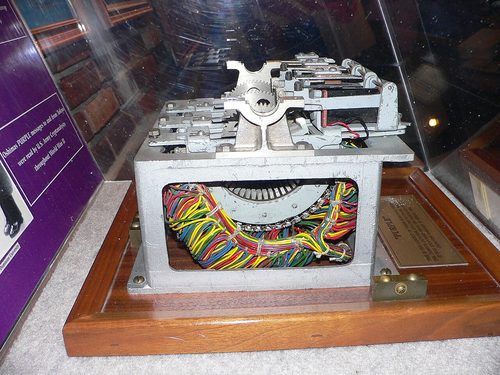
In September 1940 a small US Army team rebuilt Japan's top diplomatic cipher machine without ever seeing one. The decrypts, called Magic, shaped American policy before Pearl Harbor and fueled a long argument afterward.