
 Page 1 of 27
From the document
Apparently, the machine had with malicious intent but brilliantly been constructed to suppress all plain text repetition.
This, on September 20, 1940, at about 2:00 P.M., was the very first indication that a successful attack might be possible.
It was all the more gratifying that this could be done on the very day that announcement was made of the signing of the Tripartite Agreement among Germany, Italy, and Japan.
the name of no one person can be selected as deserving of the major portion of credit for this achievement.
Excerpts are passages from a US government work (public domain), quoted exactly as they read in the scan, and checked against the full text on every rebuild.
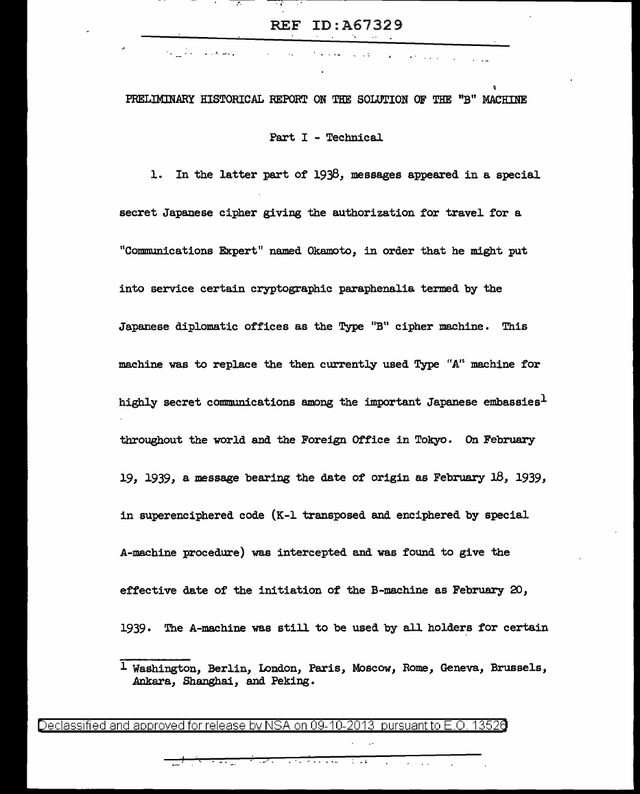
On 14 October 1940 William F. Friedman, the Army's principal cryptanalyst, signed a 27-page report on what his Signal Intelligence Service (SIS) had just done: solve the cipher machine that the Japanese Foreign Office used for its most secret traffic. The Americans called the machine PURPLE; Friedman's report calls it the "B" machine. He wrote it less than four weeks after the decisive day, while the team was still working out the machine's settings, so he titled it "preliminary"1. It is the founding document of Magic and the breaking of Purple.
Part I: how the machine was solved
Friedman starts with the intercepts. In late 1938 messages arranged travel for a Japanese "Communications Expert" who was to install the new machine, and one intercepted on 19 February 1939 gave the date it would come into use: 20 February1.
The team first recovered the part of the machine they already partly understood. As in the older "A" machine, six letters of the alphabet were enciphered separately from the other twenty. By 10 April 1939 SIS could read the "sixes" in almost any long message. Those scattered letters were treated as clues, and cryptanalysts filled in the rest of the words by hand. Japanese texts were made harder by a shorthand of abbreviations that the Foreign Office adopted on 1 May 1939. Copies of English texts that the Japanese were quoting, obtained through Army intelligence (G-2), helped more1.
The twenties defeated every normal attack. Statistical tests showed fewer repeats than random letters would give, and Friedman believed the designers had suppressed repetition on purpose. He hoped that very feature would be the system's "undoing"1. With only 120 indicators and a daily plugboard change, the team built a method of "homologs" to put messages from different days onto the same base. It produced six messages in indicator 59173, and on the afternoon of 20 September 1940 the distribution tables for those messages showed repeated sequences. A week later, on 27 September, the team turned in two translations1.
Friedman then describes the machine as SIS had reconstructed it, without ever seeing one: banks of 25-point stepping switches of the kind used in automatic telephone exchanges, whose six possible stepping orders were spread across the 120 indicators. Parts for two automatic copies had been ordered, and a hand-operated model built by the section was already in use. Solutions for over a third of the indicators were in hand1. Pieces of a real machine found in the Japanese embassy in Berlin in 1945 showed how close that reconstruction was2.
Part II: credits
The second part lists who did what. Friedman names Frank B. Rowlett and Robert O. Ferner as joint directors of the work and credits Leo Rosen with suggesting telephone switches for the "sixes" and with supervising the hand-built machine. He also names about two dozen others, among them junior cryptanalysts, clerks, tabulating-machine operators and translators. One clerk, Mary Louise Prather, found the paraphrased message that helped break into the system. He thanks the Navy for the use of the Navy Yard's radio laboratory shop1. His own role, he says, was general supervision from August 19391.
The report does not say who first saw the repeated sequences on 20 September. It lists Genevieve Grotjan among the junior cryptanalysts who recovered the "sixes." Later historians credit her with the observation2,3.
Reading it now
This is a report written for the service by the man in charge, and it reads that way. It is generous with credit and spare with technical detail, which Friedman twice calls "too involved to explain in this report." It is not an account of how the decrypts were used. The NSA declassified it in September 2013 as part of its release of Friedman's papers1.
Sources
- NSA William F. Friedman, "Preliminary Historical Report on the Solution of the 'B' Machine," 14 October 1940 (REF ID A67329), NSA Friedman Collection posting as captured by the Wayback Machine, 21 February 2017, National Security Agency (Internet Archive copy) (1940-10-14).
- Wikipedia Type B Cipher Machine, Wikipedia.
- Wikipedia Genevieve Grotjan Feinstein, Wikipedia.