
 Page 1 of 91
From the document
In 1951, the British advised CIA that they had for some years been tapping Soviet cables through a system of tunnels in the Vienna area and offered to share the take with the U.S.
The second question, "Where do we put the dirt?", haunted the minds of project personnel for many weeks and a great many ingenious ideas were brought forth and discarded for one reason or another until the suggestion was made facetiously that we "dig a hole and put the dirt in it." This in effect was the solution.
BLAKE stated that he had informed his Soviet contact of the planned tunnel at the time the final decision was made on its location in the latter part of 1953.
indicates that the Soviet discovery of PBJOINTLY was purely fortuitous and was not the result of a penetration of the U.S. or U.K. agencies concerned, a security violation, or testing of the lines by the Soviets or East Germans.
Excerpts are passages from a US government work (public domain), quoted exactly as they read in the scan, and checked against the full text on every rebuild.
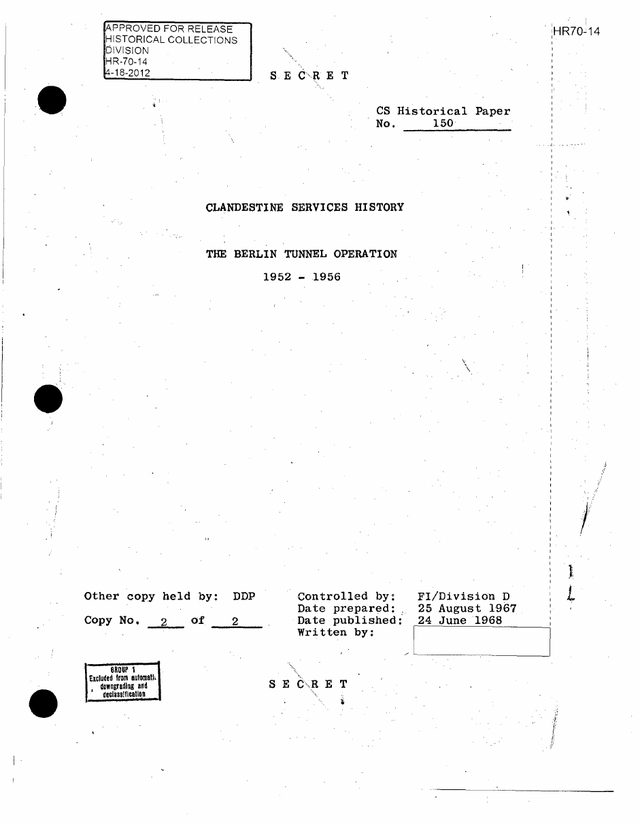
The man who wrote this history knew the tunnel from the inside. His preface says he was headquarters case officer for PBJOINTLY, the CIA's name for the Berlin Tunnel, from the winter of 1952–53 until the summer of 1954, and then field case officer until February 1955. His name is still withheld. He finished the paper in August 1967 for the Clandestine Service's series of internal histories, and it was published, in two copies, on 24 June 19681,3. He also records that Allen Dulles ordered as little as possible about the project to be put on paper, an order he thought had rarely been "so conscientiously obeyed"1.
What it covers
The narrative runs in six short chapters. The introduction traces the idea to the late 1940s: the loss of other sources, reports of a new Soviet scrambler, and an agent network inside the East Berlin telephone administration that by March 1952 had pinpointed the key Soviet circuits1.
It is also one of the few official records of the British cable taps in Vienna, Operation Silver. It says only a little, but it is specific: in 1951 the British told CIA they had been tapping Soviet cables from tunnels near Vienna for some years, offered to share the take, and suggested Berlin might offer the same chance. Later the author notes that the Berlin tunnel "far exceeded anything which had been done by the British in Vienna," and that British skills from Vienna "stood us in good stead"1.
Planning and construction follow, with engineering detail: a warehouse with a deep basement to hold some 3,000 tons of spoil, a steel-lined tunnel 1,476 feet long dug by an Army engineer team, and a tap chamber under a busy highway. The division of labor is set out: the Americans built the site and tunnel and processed the teletype traffic in Washington, while SIS dug the final shaft, made the taps and ran a voice-processing center in London. The three cables were tapped on 11 May, 21 May and 2 August 19551.
Production, discovery and Blake
The production chapter gives the numbers: 368,000 Soviet conversations fully transcribed in London, 18,000 six-hour Soviet teletype reels in Washington, 1,750 reports by September 1958, at a total cost of $6,706,000. Appendix B lists what the material, code-named REGAL, revealed about Soviet forces, atomic work and intelligence services1.
Appendix A, a staff memorandum of 15 August 1956, reconstructs the night of 21–22 April 1956 from the tap chamber's own microphone: flooded cables, Soviet and East German crews digging, the moment someone said "the cable is tapped," and the microphone going dead1.
The termination chapter then adds what that memorandum could not know. George Blake, an SIS officer recruited by the Soviets as a prisoner in Korea, had told his Soviet contact about the tunnel in late 1953. The history dates MI-6's discovery of Blake to "April 1956"; Blake was in fact exposed and confessed in 1961, so the date appears to be an error in the document1,5.
How to read it
This is the operators' own account, written to record a success, and it reads that way: it praises the engineers and treats world press reaction as a gain in American prestige. It is thin on what the intelligence was worth compared with other sources; Wikipedia notes that an NSA history was cooler about the take1,4. A first redacted version was approved in February 2007; this copy is the April 2012 release, which still blanks names and some technical passages. The illustrations, maps, site photographs and diagrams, are poor photocopies1,3.
Sources
- CIA Clandestine Services History: The Berlin Tunnel Operation, 1952–1956 (CS Historical Paper No. 150), HR70-14 release of 18 April 2012, Central Intelligence Agency (copy posted by the National Security Archive) (1968-06-24).
- CIA A Look Back ... The Berlin Tunnel: Exposed, Central Intelligence Agency (archived copy) (2009).
- Other Clandestine Services History: The Berlin Tunnel (Secrecy News), Federation of American Scientists (2007-04).
- Wikipedia Operation Gold, Wikipedia.
- Wikipedia George Blake, Wikipedia.