
 Page 1 of 30
From the document
Here, Subject agreed to work directly for MAROGNA with the latter's assurance that he would do everything possible to save Subject's mother from persecution in return.
Subject's first assignment came on 1 May 1940 when he was sent to Sofia for six weeks to establish contacts and potential agents for obtaining information concerning Bulgarian airfields, numbers and types of planes, etc.
Subject approached LONGIN on the subject of obtaining positive air intelligence on the Red Air Force for him.
LONGIN travelled to Rome during latter part of July and returned with his Chief's approval, (later known to be General TURKUL).
Excerpts are passages from a US government work (public domain), quoted exactly as they read in the scan, and checked against the full text on every rebuild.
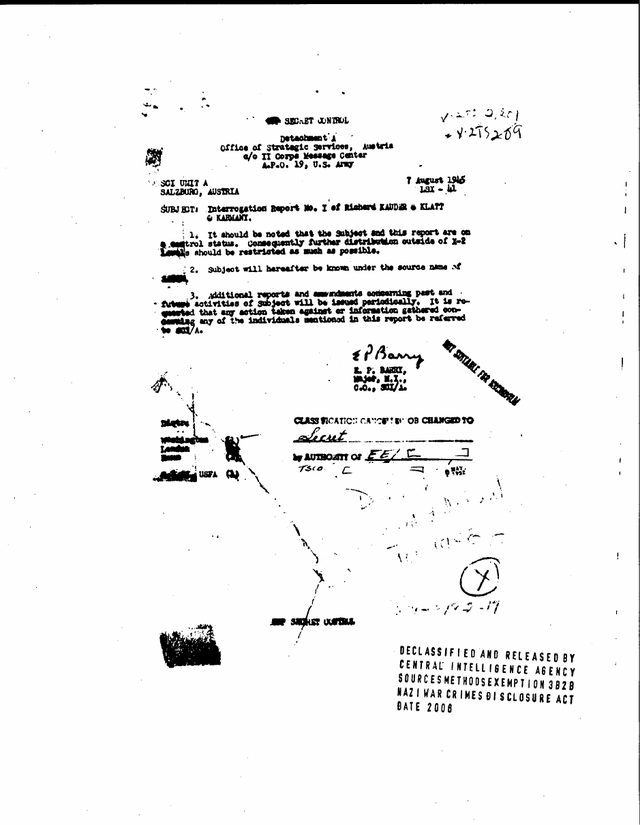
In May 1945 American counterintelligence troops in the Austrian Alps arrested a 44-year-old Viennese businessman who had spent the war running one of the most prized sources of the German army's intelligence on the Soviet Union. His name was Richard Kauder; the Abwehr had given him papers as Richard Klatt. This report, issued on 7 August 1945 by the Office of Strategic Services' counterintelligence unit in Salzburg, was the first full American account of him, and it put Kauder on "control status" under a new source name, which is still blacked out1.
What it says
The report is told in Kauder's own words, as the interrogators recorded them, in numbered paragraphs. It begins with his life: a Catholic-baptized son of Jewish parents, an engineering graduate who sold furniture and sporting goods, and in 1938 fled to Budapest, where the Hungarian police arrested him for lacking a residence permit1. In February 1940 Count Rudolf von Marogna-Redwitz of the Abwehr station in Vienna had him brought from prison and made a bargain: Kauder would work for the Abwehr's air intelligence section, and Marogna would try to protect his mother. He received a German passport as Klatt1.
The core of the report traces what Kauder called the Luftmeldekopf Südost, the "Klatt Bureau." His first job was Bulgarian airfields. In June 1940 he enlisted Ira Longin, a White Russian émigré he had met in a Budapest cell, to produce intelligence on the Red Air Force; Longin cleared it with his chief, the émigré General Anton Turkul, and from then on, the report notes, Turkul remained Longin's "genuine boss"1. From 1941 the bureau worked from Sofia with its own radio links to Vienna and Berlin and a station in the Spanish legation in Ankara. The report counts about 3,000 intelligence reports sent to Vienna by radio in 1942 and about 4,500 in 1944, after the bureau moved to Budapest under the cover of the Hungarian army's intelligence branch1.
The later pages are a diary of collapse: arrest by German customs police in Vienna on 12 February 1945, weeks of questioning and Gestapo custody (the charges included sending money to Switzerland and, as a Jew, living with an "Aryan" fiancée), release, a chance meeting with Turkul in Salzburg, and arrest by the US 42nd Division's counterintelligence detachment on 24 May with Longin1. A hand-drawn chart shows the bureau's radio links as of February 1945, and an appendix lists its members and cover names1.
The question it leaves open
The report records where Kauder said his Soviet reports came from, Longin and Turkul's émigré organization, without testing it. That is the heart of a long dispute1.
How to read it
This is a prisoner's account written down by interrogators who were still learning the names, and it is often vague on how information reached Longin. The scan is a poor carbon copy, so the text shown with it has many reading errors; the page images are the authority. The CIA released the file in 2006 under the Nazi War Crimes Disclosure Act, with the source name the OSS gave Kauder still blacked out1.
Sources
- CIA Interrogation Report No. 1 of Richard Kauder @ Klatt @ Karmany, 7 August 1945 (Kauder, Richard, vol. 1, document 0012), Central Intelligence Agency, FOIA Electronic Reading Room (copy fetched from the Internet Archive) (1945-08-07).
- Official history Operatsiya 'Monastyr' (Russian Foreign Intelligence Service history page; Internet Archive copy), Sluzhba Vneshney Razvedki Rossiyskoy Federatsii.
- Wikipedia Operatsiya 'Monastyr'', Wikipedia (Russian).
- Wikipedia Klatt Bureau (Richard Kauder), Wikipedia.