
Portrait: Harry Gold, in a photograph entered as Government Exhibit 5 at the Rosenberg trial, 1951. Unknown authorUnknown author or not provided. Wikimedia Commons, Public domain.

Harry Gold was born Heinrich Golodnitsky in Switzerland to Jewish parents from the Russian Empire and came to the United States as a small child in 1914. The family settled in South Philadelphia, where his father worked as a cabinetmaker6. Gold studied chemistry at night, at the University of Pennsylvania and later the Drexel Institute, while working as a laboratory chemist for a sugar company1,6.
A courier for hire
Gold was drawn into espionage during the Depression through a friend who had found him work. From 1934 he passed industrial chemical processes from his employer to Soviet contacts6. At the Rosenberg trial he testified that he had engaged in Soviet espionage from 1935 until his arrest in 19502. He was useful because he was unremarkable: a quiet, single laboratory chemist who could travel to other cities, meet sources under false names with recognition signals and pass envelopes to a Soviet officer2.
The Venona decrypts preserve one of his most important errands. A KGB cable from New York of 9 February 1944, listed by its CIA and NSA editors as "Gold meets Fuchs", reports a first meeting on 5 February between GUS (also rendered GOOSE) and REST3. REST was Klaus Fuchs, who knew Gold as "Raymond"3,5.
The New Mexico trip
Gold's Soviet controller from 1944 to 1946 was "John", identified at trial as Anatoli Yakovlev of the Soviet consulate in New York2. Gold met Fuchs in New York in 1944 and in Cambridge, Massachusetts, in January 19452. In late May 1945 Yakovlev sent him to Santa Fe to see Fuchs again, and, over Gold's protest, added a second stop in Albuquerque, giving him a name, an address on High Street, a piece cut from a food package and the greeting "I am from Julius"2.
On 2 June 1945 Fuchs handed Gold a package in Santa Fe. The next day in Albuquerque, Gold met the Army machinist David Greenglass, matched the cardboard pieces, introduced himself as "Dave from Pittsburgh" and collected an envelope of material for $5002. Back in New York on 5 June he gave both envelopes to Yakovlev2. The FBI later called this a basic Soviet security error, since it linked two separate networks through one courier2.
Confession and sentence
After Fuchs confessed in Britain in January 1950, his description of his American contact led the FBI to Gold. He confessed on 22 May 1950 and was arrested in Philadelphia, where the news made front pages across the country1,2. He cooperated fully, and his account of the Albuquerque meeting led to Greenglass and through him to Julius and Ethel Rosenberg2.
Gold pleaded guilty in Philadelphia in July 1950, refusing only to admit any intent to injure the United States1. Judge James McGranery appointed John D. M. Hamilton, a former chairman of the Republican National Committee, to defend him without fee. At sentencing on 9 December 1950, Gold told the court he had tried to make amends "by revealing every last scrap, shred, and particle of evidence." The government asked for twenty-five years; McGranery imposed thirty, the maximum, "to deter others"1.
In March 1951 Gold was a principal prosecution witness at the Rosenberg trial2,4. The Second Circuit noted that the jury had been told to treat his testimony, like that of the Greenglasses, "with caution" as an accomplice's4.
Later life
Gold served his sentence at the federal penitentiary in Lewisburg, Pennsylvania, where he was a model prisoner, and was paroled in May 1966 after about fifteen years1. He returned to Philadelphia and worked as a clinical chemist in a hospital pathology laboratory. He died on 28 August 1972 during heart surgery1,6.
Key dates
- 1934 Begins passing industrial chemical processes to Soviet intelligence.
- 5 February 1944 First meeting with Klaus Fuchs in New York, reported in a KGB cable.
- 2 June 1945 Collects material from Fuchs in Santa Fe; next day from David Greenglass in Albuquerque.
- 22 May 1950 Confesses to the FBI in Philadelphia.
- 9 December 1950 Sentenced to thirty years in federal court in Philadelphia.
- March 1951 Testifies for the prosecution at the Rosenberg trial.
- May 1966 Paroled from Lewisburg penitentiary.
Sources
- Court record Judge James P. McGranery (court history), US District Court for the Eastern District of Pennsylvania.
- FBI Atom Spy Case/Rosenbergs, Federal Bureau of Investigation (archived copy).
- NSA Venona, Part II: Selected Messages, 1939–1957, Central Intelligence Agency and National Security Agency (1996).
- Court record United States v. Rosenberg, 195 F.2d 583 (2d Cir. 1952), Caselaw Access Project, Harvard Law School (1952-02-25).
- Official history Klaus Fuchs, MI5 (archived copy).
- Wikipedia Harry Gold, Wikipedia.
- Wikipedia English Wikipedia article (used for cross-checking).
Elsewhere in the files
Read next
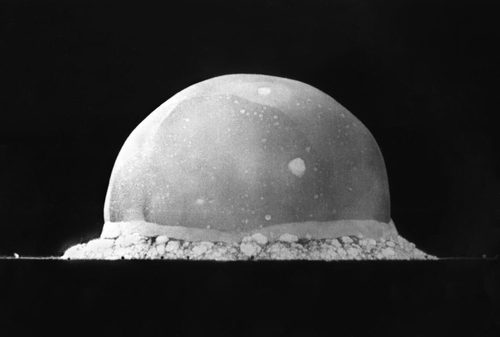 September 1941 – June 1950
Soviet atomic espionage (Enormoz)
How Soviet intelligence penetrated the Manhattan Project under the codename ENORMOZ, who its sources were, how Venona and confessions exposed them, and what the stolen secrets were worth.
 1 February 1943 – 1 October 1980
The Venona project
The US Army codebreaking program that, from 1943 to 1980, read parts of some 2,900 wartime Soviet intelligence cables and exposed Fuchs, the Rosenbergs and Donald Maclean.
 United States · 1908
Federal Bureau of Investigation (FBI)
The US Justice Department's investigative service, founded in 1908: chief hunter of foreign spies at home from the 1930s, and under J. Edgar Hoover the author of secret domestic programs exposed in the 1970s.