
Portrait: Klaus Fuchs in a British police photograph, about 1940. The National Archives UK. Wikimedia Commons, Public domain.

Klaus Fuchs was the son of a Lutheran pastor who became a Quaker and a socialist. As a student at Leipzig and Kiel he moved from the Social Democrats to the Communist Party, and after the Reichstag fire in 1933 he went into hiding and then fled, reaching England in September 19332,6. He took a doctorate in physics at Bristol and worked with Max Born at Edinburgh2.
Into the bomb project
Interned as an enemy alien in 1940 and shipped to a camp in Canada, Fuchs was released and returned to Edinburgh early in 19411,6. That spring Rudolf Peierls, a fellow German refugee and a leading figure in Britain's atomic research, brought him to Birmingham to work on the bomb project known as Tube Alloys2. He became a British subject on 31 July 19426.
Soon after Germany invaded the Soviet Union in June 1941, Fuchs went to the exiled German communist Jürgen Kuczynski and offered information1. He was put in touch with an officer of Soviet military intelligence (the GRU) at the embassy and, from 1942, with Kuczynski's sister Ursula, codenamed SONYA, whom he met near Banbury1. His later explanation, in his confession, was that he "had complete confidence in Russian policy" and believed the Western Allies were letting Germany and Russia fight each other to the death2.
New York and Los Alamos
Fuchs sailed with the British mission in December 1943 and worked first on gaseous diffusion in New York2. His Soviet contact there was a courier he knew as "Raymond", in fact the Philadelphia chemist Harry Gold1. On 14 August 1944 he arrived at Los Alamos to work on implosion in Hans Bethe's Theoretical Division; Bethe called him "one of the most valuable men in my division"2.
From there he passed the case for an implosion design for plutonium, critical-mass figures and, in June 1945, a sketch of the bomb with its components and dimensions2. Gold collected material from him in Cambridge, Massachusetts, in early 1945 and in Santa Fe on 2 June and again in September 19455. Fuchs stayed at Los Alamos into 1946 and attended an April 1946 conference on the hydrogen bomb2.
Harwell and capture
Back in Britain in August 1946, he became head of theoretical physics at the Atomic Energy Research Establishment at Harwell and resumed meetings with Soviet officers until 19491,3. He was caught through Venona: decrypted KGB cables described his reports, and by September 1949 investigators had narrowed the source to him1. The decrypts could not be shown in court, so MI5's William Skardon questioned him over several months, confronted him in December 1949 and, in late January 1950, obtained a confession1. The National Archives' catalog notes that his conviction "rested solely on his own detailed confession"3. His signed statement of 27 January 1950 ends, oddly, with praise for the "deep-rooted firmness" of the English people he had met at Harwell4.
Fuchs was arrested on 2 February 1950. On 1 March he pleaded guilty at the Old Bailey to four offences under the Official Secrets Act and was given the maximum, fourteen years1,6. He was stripped of British nationality in 19513,6. His description of Gold led the FBI to the courier, and from Gold to David Greenglass and Julius Rosenberg5.
Later life
Released on 23 June 1959 after nine years, Fuchs flew to East Germany. He became deputy director of the Central Institute for Nuclear Physics at Rossendorf near Dresden and a member of the ruling party's central committee, and received the Order of Karl Marx in 19792,6. He died in East Berlin on 28 January 19882.
Key dates
- 24 September 1933 Arrives in England as a refugee from Nazi Germany.
- 1941 Joins Rudolf Peierls on the British Tube Alloys project and offers information to Soviet military intelligence.
- 14 August 1944 Arrives at Los Alamos with the British mission.
- 2 June 1945 Hands Harry Gold atomic bomb material in Santa Fe.
- September 1949 FBI and British investigators identify him as the Venona source REST/CHARLES.
- 27 January 1950 Signs his confession in London.
- 1 March 1950 Pleads guilty at the Old Bailey; sentenced to fourteen years.
- 23 June 1959 Released; leaves for East Germany.
Sources
- Official history Klaus Fuchs, MI5 (archived copy).
- Official history Klaus Fuchs (Physicist and Spy, Britain and Los Alamos, 1941–1949), US Department of Energy, Office of History and Heritage Resources.
- Other KV 2/1263: Emil Julius Klaus FUCHS (prosecution file), The National Archives, Kew (1950).
- Other Cold War on File: Klaus Fuchs confesses, The National Archives.
- FBI Atom Spy Case/Rosenbergs, Federal Bureau of Investigation (archived copy).
- Wikipedia Klaus Fuchs, Wikipedia.
- Wikipedia English Wikipedia article (used for cross-checking).
Elsewhere in the files
Read next
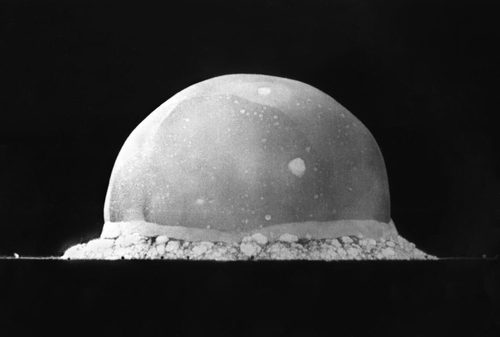 September 1941 – June 1950
Soviet atomic espionage (Enormoz)
How Soviet intelligence penetrated the Manhattan Project under the codename ENORMOZ, who its sources were, how Venona and confessions exposed them, and what the stolen secrets were worth.
 1 February 1943 – 1 October 1980
The Venona project
The US Army codebreaking program that, from 1943 to 1980, read parts of some 2,900 wartime Soviet intelligence cables and exposed Fuchs, the Rosenbergs and Donald Maclean.
 United Kingdom · 1909
Security Service (MI5)
Britain's domestic security service, founded in 1909 as the home section of the Secret Service Bureau: hunter of German spies in two world wars, runner of the Double-Cross System, and a target of Soviet penetration.
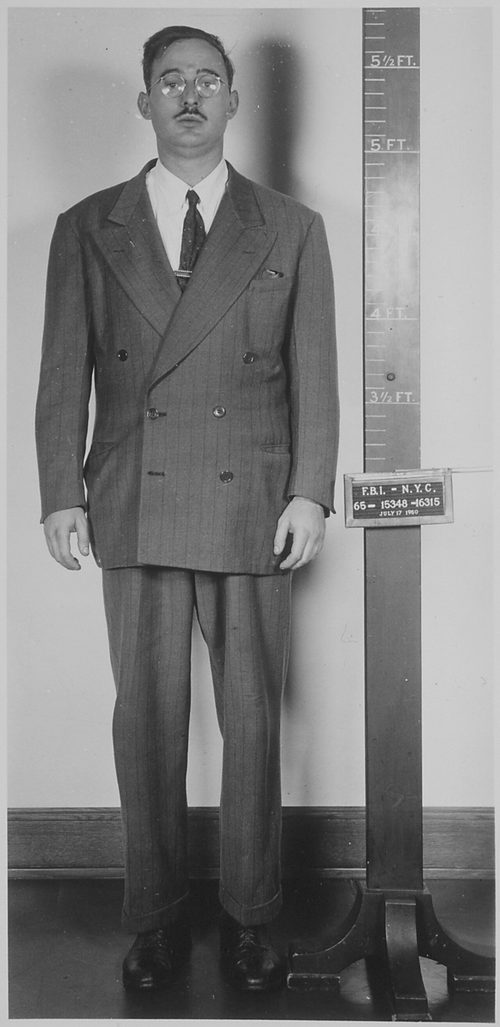 1918–1953
Julius Rosenberg
New York electrical engineer who ran a Soviet espionage ring of fellow engineers and recruited his brother-in-law at Los Alamos; convicted of conspiracy and executed in 1953.