
 Page 1 of 1

From the document
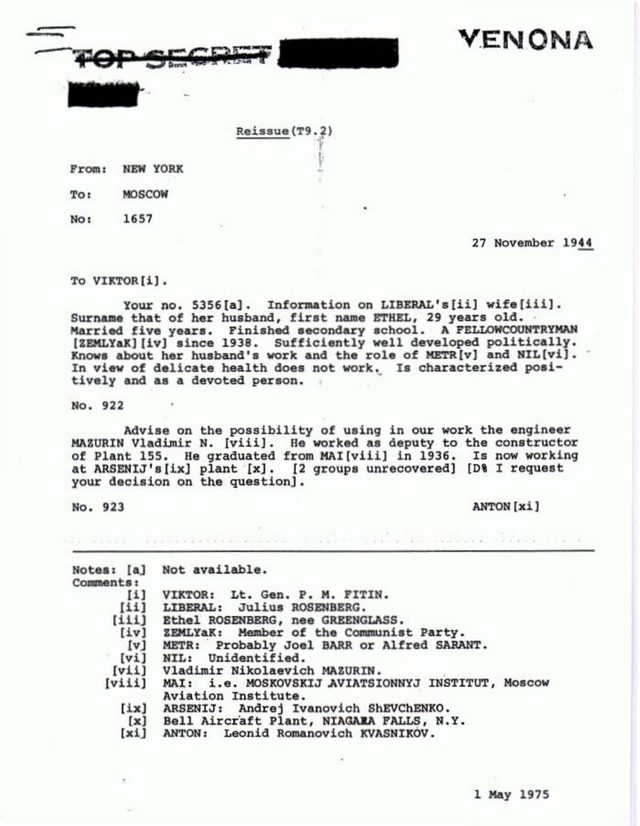
Your no. 5356[a]. Information on LIBERAL's[ii] wife[iii]. Surname that of her husband, first name ETHEL, 29 years old. Married five years. Finished secondary school.
A FELLOWCOUNTRYMAN [ZEMLYaK][iv] since 1938. Sufficiently well developed politically. Knows about her husband's work and the role of METR[v] and NIL[vi]. In view of delicate health does not work. Is characterized positively and as a devoted person.
Advise on the possibility of using in our work the engineer MAZURIN Vladimir N. [viii].
Excerpts are passages from a US government work (public domain), quoted exactly as they read in the scan, and checked against the full text on every rebuild.
Most Venona messages are fragments, with gaps where groups of the code could not be recovered. This one is almost complete: a few lines of cable traffic and a block of analysts' footnotes. It has carried more weight in an argument than almost any other page in the collection1.
The cable
On 27 November 1944 the KGB station in New York sent message number 1657 to Moscow. It was addressed to VIKTOR, Lieutenant General Pavel Fitin, chief of the KGB's First Directorate (foreign intelligence), and signed ANTON, whom the footnotes identify as Leonid Kvasnikov1,2. It answered an earlier query from Moscow, number 5356, which has not survived1.
The cable has two parts. The first, serial 922, gives Moscow the background it had asked for on the wife of an agent called LIBERAL. She was 29, had been married five years, had finished secondary school, and had been a "FELLOWCOUNTRYMAN," KGB slang for a Communist Party member, since 1938. She knew about her husband's work and about two other agents, METR and NIL. She did not work because of poor health, and the station described her as "devoted"1. The second part, serial 923, has nothing to do with her. It asks whether the KGB should use an engineer named Vladimir Mazurin, a graduate of the Moscow Aviation Institute then working at the Bell Aircraft plant in Niagara Falls1.
The footnotes do the identifying. LIBERAL is Julius Rosenberg, the wife is Ethel Rosenberg, born Greenglass, and METR is "probably Joel BARR or Alfred SARANT." NIL is "unidentified"1. The page is marked "Reissue (T9.2)" and dated 1 May 1975, the date of this revised translation; the message itself had been partly read in the late 1940s1,2,3.
How it was read
Like the rest of Venona, the cable was readable only because of a Soviet production error: duplicate one-time pad pages printed in Moscow for a few months in early 1942, which American codebreakers began exploiting at Arlington Hall after 1943 (see The Venona project and One-time pads)2. By 1947 the linguist Meredith Gardner had read enough of it to mention it in his "Special Report #1." That report notes a covername LIBERAL, earlier ANTENNA, and a message of 27 November speaking of his wife "ETHEL, 29 years old"2. In late June 1950 the FBI matched LIBERAL to Julius Rosenberg, and the Bureau found that two messages also implicated his wife2.
Use in court and after
The Venona messages were never put before the jury. The Rosenbergs were convicted in March 1951 on the testimony of their confederates, chiefly David and Ruth Greenglass, and executed on 19 June 19532,5. The cable stayed secret for another four decades. In July 1995 Director of Central Intelligence John Deutch released the first Venona translations at CIA headquarters. By 1996 some 2,900 messages were public, and this one was reprinted as Translation 73 in the CIA/NSA documentary volume edited by Robert Louis Benson and Michael Warner1,2. The National Security Agency put it online as part of its Venona collection4. A mirror of the agency's file is on the Internet Archive3.
Why this one
Thousands of Venona messages are longer or reveal more. This one matters because it names a woman the United States executed, in the words of the service she was accused of helping, and because it was written for Moscow's eyes only, with no thought of a courtroom. It is also a fair sample of what Venona is: a translation built up over decades by analysts, with brackets, guesses and footnotes that are as much a part of the evidence as the Soviet text.
Sources
- NSA Venona, Part II: Selected Messages, 1939–1957 (Translation 73: New York 1657 to Moscow, 27 November 1944), Central Intelligence Agency and National Security Agency (1996).
- CIA Venona: Soviet Espionage and the American Response, 1939–1957 (Foreword and Introduction), Central Intelligence Agency and National Security Agency (eds. Robert L. Benson and Michael Warner) (1996).
- NSA 27nov mrs rosenberg (NSA Venona release, mirrored), National Security Agency, via Internet Archive (1944-11-27).
- NSA Venona documents, National Security Agency.
- Wikipedia Julius and Ethel Rosenberg, Wikipedia.
Elsewhere in the files
- Document Hoover tells the White House about Gouzenko (September 1945)
- Document Meredith Gardner's first Venona report: "Covernames in Diplomatic Traffic" (1947)
- Document The Long Telegram (1946)
- Operation Soviet atomic espionage (Enormoz)
- Operation The Cambridge Five
- Operation The Venona project
- Person Donald Maclean