
 Page 1 of 7
From the document
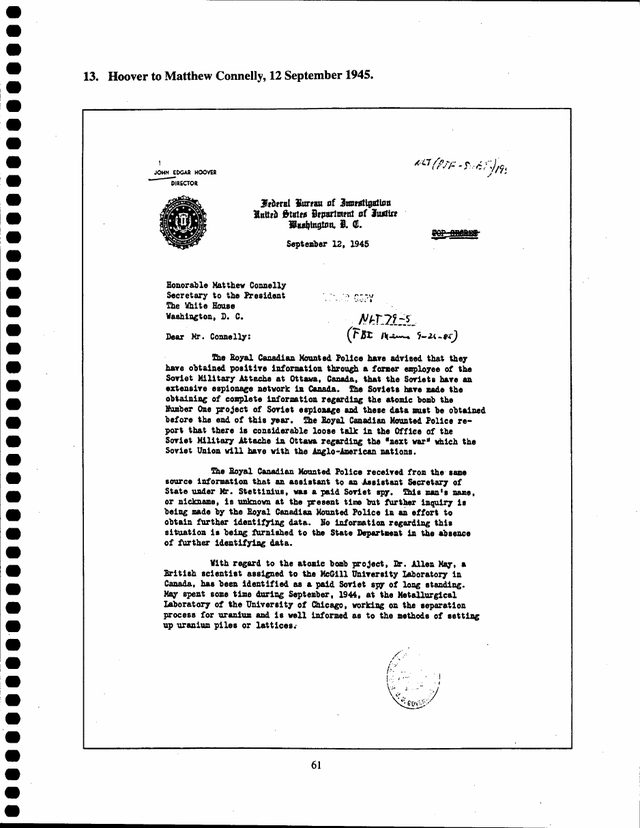
The Soviets have made the obtaining of complete information regarding the atomic bomb the Number One project of Soviet espionage and these data must be obtained before the end of this year.
May is reported to have furnished the Soviets in Ottawa with a small quantity of U233 which is one of the isotopes of uranium and this specimen was flown directly to Moscow.
Malenkov, according to Guzenko, is actually the head of all intelligence activity, and Military Intelligence, Naval Intelligence, the NKVD and the political apparatus are all ultimately responsible to him.
Since the atomic bomb has been used by the United States, they have set their calendar ahead and have instructed all espionage agents to make the obtaining of the complete construction plans of the bomb itself the No. 1 espionage project.
Excerpts are passages from a US government work (public domain), quoted exactly as they read in the scan, and checked against the full text on every rebuild.
On the night of 5 September 1945, Igor Gouzenko, a cipher clerk for the Soviet military attaché in Ottawa, left the embassy with documents from the GRU station's files2,3. A week later J. Edgar Hoover put what the Royal Canadian Mounted Police had learned in front of President Truman's staff. These two letters are that first report and a longer follow-up to the State Department, both printed in facsimile in the 1996 NSA–CIA volume on The Venona project1,2.
The letter to the White House, 12 September
Hoover wrote to Matthew Connelly, Truman's secretary, on FBI letterhead marked Top Secret. The letter is two pages. It never names Gouzenko; he is "a former employee of the Soviet Military Attache at Ottawa"1. Hoover passes on four points: that the Soviets had an extensive espionage network in Canada; that the atomic bomb was the "Number One project" of Soviet espionage, to be completed before the end of the year; that an assistant to an Assistant Secretary of State under Edward Stettinius was a paid Soviet spy, name unknown; and that "Dr. Allen May", a British scientist, had been a Soviet agent "of long standing"1.
The scientist was Alan Nunn May, who worked on the Anglo-Canadian atomic project in Montreal. Hoover reports that May gave the Soviets a sample of uranium-233 that was flown to Moscow, and in July 1945 described American radar-fuzed shells used against Japanese suicide planes. He adds that General Leslie Groves of the Manhattan Project and the Office of Naval Intelligence had been told1. May was arrested in Britain in 1946 and sentenced on 1 May to ten years4.
The memorandum to State, 24 September
The second letter, to Frederick B. Lyon of the State Department's Division of Foreign Activity Correlation, follows an earlier memorandum of 18 September and records what an FBI representative had heard from Gouzenko directly1. It is about the system rather than names. Gouzenko said Georgy Malenkov of the Politburo coordinated all Soviet intelligence; that military and naval attachés reported to their own espionage chiefs, not to the Foreign Commissariat; and that ambassadors were often only "a front"1. He spoke of NKVD contacts close to the Polish and Yugoslav cipher rooms, said a Czech military attaché in Washington was already a Soviet agent, and reported that Moscow was keeping war production up while the West converted to consumer goods1. The last hosted page returns to the State Department source: Gouzenko said he did not know the man's name, only that he had been told of him; his account of how, starting from a conversation with a newly arrived officer named Kulakov, runs on past the hosted pages1.
How to read them
These are first reports, relayed through the RCMP and an FBI interviewer, and they carry errors of transmission: May's first name is misspelled and his laboratory described loosely1,4. The volume's editors note that Gouzenko brought out GRU messages identifying agents but no codebooks or one-time pads, so he did not directly help the Venona codebreakers2. What the letters show is how fast Washington knew: Hoover had the outline of the Canadian network on Truman's desk five months before the Canadian government made it public, and he sent Elizabeth Bentley's allegations to the White House in November2,3.
Our copy is the 1996 facsimile, with the FBI and declassification stamps visible. The second letter runs to a fifth page that is not in the hosted range1.
Sources
- FBI Venona, Part I: Documents Illustrating the US Response to Soviet Espionage (documents 13 and 14), National Security Agency and Central Intelligence Agency (Center for the Study of Intelligence) (1945-09).
- Official history Venona: Soviet Espionage and the American Response, 1939–1957, ed. Robert Louis Benson and Michael Warner (front matter, introduction and chronology), National Security Agency and Central Intelligence Agency (1996).
- Wikipedia Gouzenko Affair, Wikipedia.
- Wikipedia Alan Nunn May, Wikipedia.
- Wikipedia Alger Hiss, Wikipedia.