
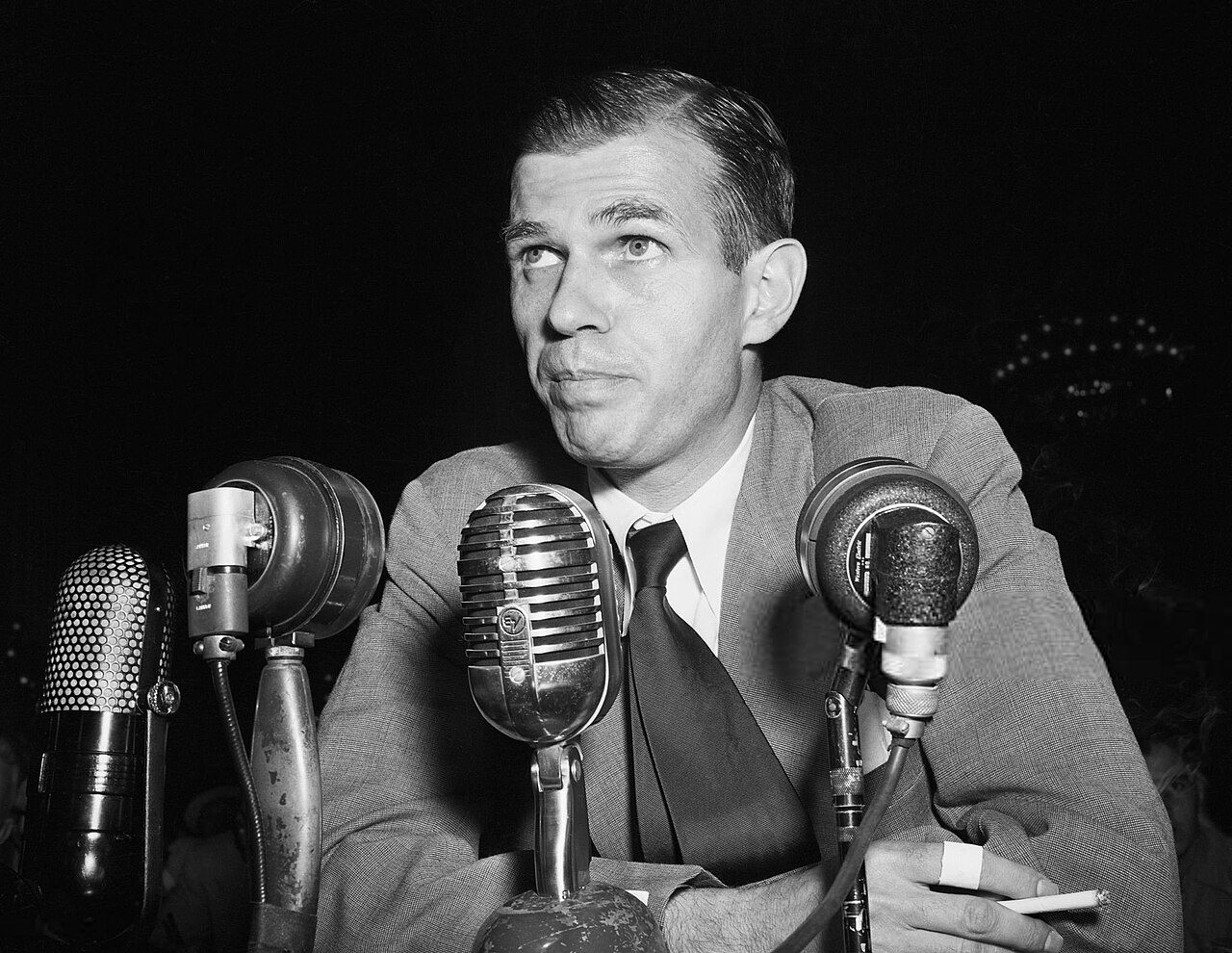

Alger Hiss came from an old Baltimore family, graduated from Johns Hopkins and Harvard Law School, where he was a protégé of Felix Frankfurter, and clerked for Justice Oliver Wendell Holmes5. He joined the New Deal as a government lawyer, served on the staff of the Senate's Nye Committee on the munitions industry, and moved to the State Department in 1936 as an assistant to Assistant Secretary Francis B. Sayre1,5. By 1945 he was a senior official in postwar planning: he attended the Yalta Conference and was secretary-general of the San Francisco conference that drafted the United Nations Charter5. In 1946 he left government to become president of the Carnegie Endowment for International Peace1.
The accusation
On 3 August 1948 Whittaker Chambers told the House Committee on Un-American Activities that Hiss had belonged to a secret Communist group in Washington in the 1930s1. Hiss denied it and denied knowing anyone named Chambers. At a confrontation on 17 August, after studying Chambers's teeth and voice, he identified him as "George Crosley", a writer to whom he had sublet his apartment in 19351. He challenged Chambers to repeat the charge without congressional immunity and sued him for libel when he did1.
The suit backfired. On 17 November 1948 Chambers produced typed copies of confidential State Department documents dated in the first three months of 1938 and four memoranda in Hiss's handwriting; the government later established, and the defense conceded, that the memoranda were in Hiss's hand and all but one of the typed documents came from the Hisses' Woodstock typewriter1. Microfilm followed from a pumpkin on Chambers's farm1.
Perjury
Espionage charges were barred by the statute of limitations. Instead, after Hiss told a grand jury on 15 December 1948 that he had never passed documents to Chambers and had not seen him after 1 January 1937, he was indicted on two counts of perjury1. His first trial ended in July 1949 with a hung jury; the second ended on 21 January 1950 with a conviction on both counts1,5. He was sentenced to five years5. The Second Circuit affirmed on 7 December 1950, finding Chambers's testimony adequately corroborated by the documents and the typewriter evidence1.
Hiss entered prison in March 1951 and was released from the federal penitentiary at Lewisburg on 27 November 19545. He spent the rest of his life contesting the verdict; in 1975 he was readmitted to the Massachusetts bar5. He died in New York on 15 November 19965.
The later evidence
The case did not end with the appeals. Every new archive was searched for Hiss's name.
- Venona. A KGB cable from Washington of 30 March 1945 reports a conversation with a source called ALES, who had worked continuously with the "neighbors" (the GRU) since 1935, led a small group "for the most part consisting of his relations", and after the Yalta Conference had gone on to Moscow. The NSA analysts' note reads: "ALES: Probably Alger HISS"2. The FBI had reached that view by June 19503.
- The Moynihan Commission. In its 1997 report, after reviewing the Venona material, it wrote that "the complicity of Alger Hiss of the State Department seems settled"4.
- Gouzenko. Information from Igor Gouzenko in 1945 about an unnamed assistant in Secretary of State Stettinius's office led J. Edgar Hoover to suspect Hiss5.
Key dates
- 1936 Joins the State Department.
- February 1945 Attends the Yalta Conference as a member of the US delegation.
- 25 April 1945 Secretary-General of the San Francisco conference that drafts the UN Charter.
- 3 August 1948 Named by Whittaker Chambers before the House Committee on Un-American Activities.
- 15 December 1948 Denies passing documents before a federal grand jury, which indicts him for perjury.
- 21 January 1950 Convicted on two counts of perjury at his second trial.
- 7 December 1950 Court of Appeals affirms the conviction.
- 27 November 1954 Released from Lewisburg federal prison.
Sources
- Court record United States v. Hiss, 185 F.2d 822 (2d Cir. 1950), Caselaw Access Project, Harvard Law School (1950-12-07).
- NSA Venona, Part II: Selected Messages (Washington 1822 to Moscow, 30 March 1945), Central Intelligence Agency and National Security Agency (1945-03-30).
- CIA Venona: Soviet Espionage and the American Response, 1939–1957 (Introduction), Central Intelligence Agency and National Security Agency (1996).
- Congress Report of the Commission on Protecting and Reducing Government Secrecy, Appendix A, US Government Printing Office (1997).
- Wikipedia Alger Hiss, Wikipedia.
- Wikipedia English Wikipedia article (used for cross-checking).
Elsewhere in the files
Read next
 1 February 1943 – 1 October 1980
The Venona project
The US Army codebreaking program that, from 1943 to 1980, read parts of some 2,900 wartime Soviet intelligence cables and exposed Fuchs, the Rosenbergs and Donald Maclean.
 5 September 1945 – 27 June 1946
The Gouzenko affair
In September 1945 a GRU cipher clerk walked out of the Soviet embassy in Ottawa with over a hundred documents, exposing a Soviet spy network in Canada and a British atomic scientist.
 1895–1972
J. Edgar Hoover
Director of the Bureau of Investigation and then the FBI for 48 years, from 1924 until his death in 1972. He built a modern police agency and a secret domestic intelligence apparatus that the Senate later condemned.