
 Page 1 of 128
From the document
This account of the role of the Central Intelligence Agency in the political action operation that altered the course of history in Iran was written with the enthusiastic cooperation of
the military coup that overthrew Mosadeq and his National Front cabinet was carried out under CIA direction
Peacefully or in war, the Soviet Union appeared to be the only potential beneficiary of Mosadeq's policies.
He failed to take his objective, the Staff Headquarters, and breaking down, he either turned himself in or was arrested by troops loyal to Mosadeq.
Excerpts are passages from a US government work (public domain), quoted exactly as they read in the scan, and checked against the full text on every rebuild.
The paper carries no date and no author's name. Its foreword says only that the CIA History Staff wrote it with the "enthusiastic cooperation" of the Directorate of Operations, from the files that remained after "the great bulk" of the operation's cables and correspondence was destroyed in 1962, from a draft history written in 1954 by a "Dr." whose name is blacked out, from interviews with serving and retired officers, and from open sources1. Its footnotes cite books of 1974, so it was written in or after that year1,2. It is marked "Administrative – Working Paper"1.
What the released pages contain
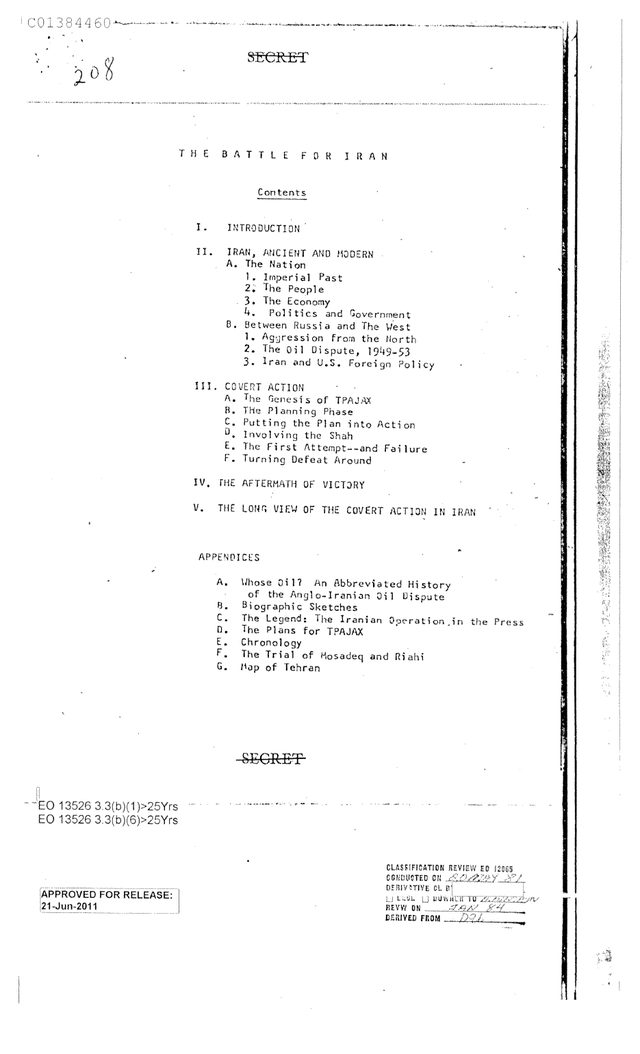
More than a quarter of the paper is background. Part II surveys Iran's history, people, economy and constitution, then its place between Russia and Britain: the Anglo-Soviet occupation of 1941, the internment in Palestine of officers named in German papers, among them Fazlollah Zahedi, the Azerbaijan crisis of 1946, and the Majlis vote of 22 October 1947, 102 to 2, rejecting a Soviet oil agreement1. It follows the oil dispute from the nationalization law and Mosadeq's appointment as premier on 29 April 1951 to the break in relations with Britain in October 1952, and sets American policy against Truman's containment doctrine1.
Part III, "Covert Action," is where the release stops short. Its opening pages survive. They argue that most published accounts miss the key point: the coup was carried out under CIA direction "as an act of U.S. foreign policy, conceived and approved at the highest levels of government," and TPAJAX was "a last resort" against the risk that a British use of force would bring Soviet troops into northern Iran under the 1921 treaty1. A surviving page records a State Department desk paper of 10 June 1953 that urged more aid to Mosadeq, and notes that by late June State knew of the plan1. After that come some forty blank pages: the planning, the Shah's part, the failed first attempt, the turnaround, the aftermath and the author's assessment are all withheld1.
The appendices left in are a history of the oil concession from 1872 to the 1954 consortium, and biographical sketches of Mosadeq, General Zahedi and his son Ardeshir, General Nader Batmangelich and the Shah1. The sketch of Batmangelich records his failure on the night of 15 August; that of Mosadeq ends by judging that he gambled on total victory over Britain, the United States and the oil companies, "and he lost"1. Appendices D to G (the plans for TPAJAX, a chronology, the trial of Mosadeq and Riahi, and a map of Tehran) are blank in this release1.
Release and how to read it
The CIA released a heavily cut version in 1981 in answer to an American Civil Liberties Union lawsuit, with every mention of TPAJAX removed. The National Security Archive obtained this 2011 version under the Freedom of Information Act and published it on 19 August 2013, the coup's sixtieth anniversary, as what it believed to be the agency's first formal acknowledgment that it planned and carried out the coup. Each version withholds passages the other releases2. The State Department's retrospective Foreign Relations volume of 2017 later printed the operational record that is missing here3.
It is an agency history, written two decades on from surviving papers and interviews. It defends the decision and is scornful of Mosadeq, whom it credits with "fantasies of omnipotence"1. Its claim of CIA direction is the agency's own verdict on itself, and it has not settled the argument among historians4.
Sources
- CIA CIA History Staff, The Battle for Iran (undated, c. mid-1970s), release approved 21 June 2011, Central Intelligence Agency (copy posted by the National Security Archive) (2011-06-21).
- National Security Archive CIA Confirms Role in 1953 Iran Coup (Electronic Briefing Book No. 435, ed. Malcolm Byrne), National Security Archive (2013-08-19).
- FRUS Foreign Relations of the United States, 1952–1954, Iran, 1951–1954 (retrospective volume), Preface, US Department of State, Office of the Historian (2017).
- Wikipedia 1953 Iranian coup d'état, Wikipedia.