
 Page 1 of 73
From the document
To fight the war on this level, the government developed a special program called Phung Hoang or Phoenix. The government has publicized the need for this effort to protect the people against terrorism and has called upon all the citizens to assist by providing information and they are doing so.
Over the year 1969, the number captured was 8,515, rallied 4,832 and killed 6,187, to a total of 19,534. About 30 percent were killed.
Now, I would not want to say here that none has ever actually been executed, but certainly the program, the government's policy and its directives are that these people when captured are placed in detention centers and held for the appropriate period
I would not want to testify that nobody was killed wrongly or executed in this kind of a program. I think it has probably happened, unfortunately.
Excerpts are passages from a US government work (public domain), quoted exactly as they read in the scan, and checked against the full text on every rebuild.
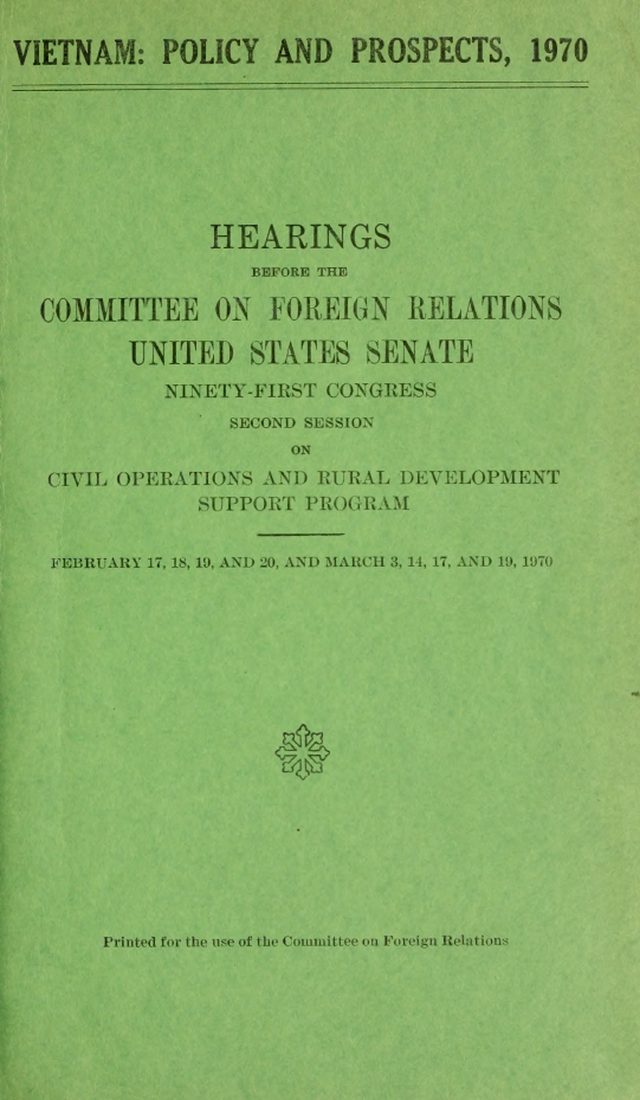
In February 1970 the Senate Foreign Relations Committee turned from the war's grand strategy to the work done in the villages. J. W. Fulbright opened the hearings on 17 February by explaining that the committee would hear not only the official in charge of CORDS, the American pacification organization in Vietnam, but also advisers from the field, and that every witness would be sworn1. The first was William Colby, a CIA officer who had gone to Saigon in 1968 as deputy to Robert Komer and succeeded him as head of CORDS1,4. The pages served here are the cover, front matter and that first day.
Colby's statement
Colby described a "people's war" fought on three levels and a Vietnamese program that the United States only advised and supported. He gave the numbers: CORDS had 6,361 military personnel and 948 civilians authorized; some 400,000 weapons had gone to the People's Self Defense Force; elections had been held in 961 villages and 5,344 hamlets during 19691. The Phoenix program, in his account, was the government's answer to the Viet Cong's secret political network, which he said had killed over 6,000 people in terrorist incidents in 1969, 1,200 of them by selective assassination. Phoenix brought police, military and intelligence services together to identify its members, who were then "captured, turn themselves in as ralliers or are killed in fire fights"1.
Under questioning
Fulbright had that morning's Washington Post in front of him, an article by Robert G. Kaiser, Jr. reporting that American advisers scorned Phoenix; Colby said he had read it, and both men returned to it through the day1. Pressed on quotas, Colby gave the 1969 total of 19,534 neutralized, about 30 percent of them killed, and conceded that the figures on the size of the infrastructure were soft1. He rejected Fulbright's description of a program for "the assassination of civilian leaders," calling it an internal security program, and said Americans did not themselves capture people under it1.
Senator Clifford Case asked whether Phoenix was a counter-terror operation. Colby said under oath that it was not, that the "counter terror" name belonged to an earlier organization that had become the Provincial Reconnaissance Units, and that these worked under the province chiefs with American support1. A memorandum to the 303 Committee two months earlier, since published in the State Department's documentary series, shows that the CIA funded those units and kept administrative control of them2.
The record also prints, at the committee's request, a January 1970 Army letter and fact sheet on Phoenix and CORDS's written instructions to Phoenix advisers, which say Americans were "specifically not authorized to engage in assassinations" and could ask to leave the program1. At the end of the day, asked about a 1969 Wall Street Journal report, Colby conceded that people had probably been killed wrongly1.
How to read it
This is the public half of an argument. Passages were deleted at the request of State and Defense, and the committee's later witnesses, the field advisers, are in the full volume, not here1. Colby's picture of a disciplined, mostly Vietnamese program has been contested ever since: a witness at 1971 congressional hearings on aid to Vietnam called it a murder program, while official figures for 1970–71 attribute most of the deaths to ordinary military operations3.
Sources
- Congress Vietnam: Policy and Prospects, 1970. Hearings before the Committee on Foreign Relations, United States Senate, 91st Congress, 2nd Session, on Civil Operations and Rural Development Support Program, US Government Printing Office (Internet Archive scan of a Boston Public Library copy) (1970).
- FRUS Foreign Relations of the United States, 1969–1976, Volume VI, Vietnam, January 1969–July 1970, Document 157: The Provincial Reconnaissance Unit Program in Vietnam (memorandum for the 303 Committee, 11 December 1969), US Department of State, Office of the Historian (1969-12-11).
- Wikipedia Phoenix Program, Wikipedia.
- Wikipedia William Colby, Wikipedia.