
 Page 1 of 44
From the document
Our best estimate of the life-span of the Rote Drei operation—that is, the period during which the Swiss net exchanged W/T communications with Moscow—is 33 months, from August 1941 to May 1944.
Lucy's true function was no different from that of Taylor. Both were mere cut-outs.
We have no basis for matching true and cover names, although Oster seems the likeliest candidate for Werther.
There can be no doubt that Lucy himself was motivated chiefly, if not entirely, by mercenary considerations.
Excerpts are passages from a US government work (public domain), quoted exactly as they read in the scan, and checked against the full text on every rebuild.
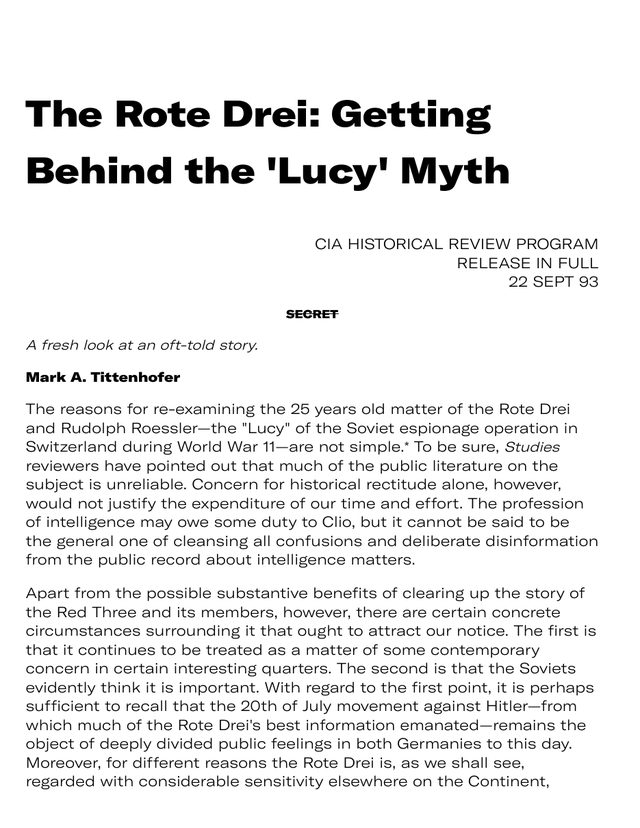
By the late 1960s the story of "Lucy", the anti-Nazi publisher Rudolf Roessler in Lucerne who supposedly fed Hitler's plans to Moscow, had grown into a legend. It had been retold in books by Alexander Foote, a radio operator for the network, and by the French writers Pierre Accoce and Pierre Quet. This article, written for CIA's classified journal Studies in Intelligence, set out to replace the legend with the record1. CIA lists it in volume 13, number 3, and gives the author as Mark A. Tittenhofer. CIA does not state his position. The text speaks of "our holdings" and of research in classified files, and its citations, the latest from 1968, put it in about 19691,2. An editor's note says it is an abridgement of a longer study1.
What it says
Tittenhofer builds everything on the radio traffic. He estimates that the Swiss network sent and received about 5,000 messages, and his collection holds 437 judged authentic, about 8 percent. Some of these come from the 129 messages Swiss police found when they arrested the operators Edmond and Olga Hamel on 9 October 19431.
The traffic dates things. Rachel Dübendorfer ("Sissy") took on Lucy's cut-out, Christian Schneider ("Taylor"), only in the late summer of 1942. That rules out Foote's claim that Lucy warned Moscow of the June 1941 invasion; Tittenhofer suspects the messages behind that story are forgeries1. Messages show Moscow pressing Sissy, and Sissy refusing, to say who Lucy and his sources were1.
The article then counts. Of 332 messages from Alexander Radó ("Dora") to Moscow, 69 cite Werther, 31 Teddy, 26 Olga and 11 Anna, about 42.5 percent of the outgoing traffic. All four came through Lucy1. Tittenhofer rejects the idea that the names stood for offices (Werther for Wehrmacht and so on). He reports that in 1955 Roessler named four sources to a confidant, and he reads one of them as Hans Oster, chief of staff of the Abwehr under Canaris. He argues that the reports moved by Abwehr couriers and telephone lines controlled by the anti-Hitler conspirators1.
The rest covers the other branches of the network, Ursula Kuczynski (Ruth Werner), the Czech officer Karel Sedláček who passed Lucy's material to London, and Roessler's second career selling reports to Czechoslovak intelligence from 1947 until his conviction in 1953. It closes on Swiss intelligence, which Tittenhofer says was far more involved than Switzerland admitted1.
How to read it
This is an analyst's reconstruction, not a release of the messages themselves. Its counts depend on a collection that holds 8 percent of the traffic, and the author says so. Its judgments of people are sharp and sometimes speculative, for instance that Gisevius may have been the source "Rot." It was released in full in September 19931.
The copy served here leaves out one page that names a wartime source's relatives; nothing else is omitted. For the network's history in full, see The Lucy spy ring and The Red Orchestra (Rote Kapelle)1.
Sources
- CIA Mark A. Tittenhofer, "The Rote Drei: Getting Behind the 'Lucy' Myth," Studies in Intelligence (CIA Historical Review Program release, 22 September 1993), Central Intelligence Agency, Center for the Study of Intelligence (1993-09-22).
- CIA Studies in Intelligence archive, Vol. 13, No. 3: The Rote Drei: Getting Behind the Lucy Myth, Central Intelligence Agency, Center for the Study of Intelligence.
- CIA Mark A. Tittenhofer, "More Yet on 'Lucy'" (reply to Andrew K. Megaris), Studies in Intelligence, Central Intelligence Agency, Center for the Study of Intelligence (1996-07-02).
- Wikipedia Lucy spy ring, Wikipedia.
- Wikipedia Rudolf Roessler, Wikipedia.