


Rote Kapelle began as a German filing label. In counterintelligence slang a Kapelle, a band, was an operation against clandestine transmitters, and the radio operators were its musicians. The Abwehr's Brussels office opened a case under that name in 1941 against a Soviet station it had detected in Belgium, and the name stuck to everything the case later touched2,5.
What it touched was two very different things. One was a set of Soviet military intelligence networks in Belgium, the Netherlands and France. The other was a loose circle of friends in Berlin who opposed Hitler and, in 1941 and 1942, passed military information to Moscow1,4.
The western networks
In 1938 the Fourth Department of the Red Army staff, later the GRU, sent Leopold Trepper, a veteran Communist who had worked for Soviet intelligence since 1930, to Brussels to build commercial cover for networks in France and the Low Countries. With an old associate, Léon Grossvogel, he set up an export business tied to a Brussels raincoat firm, and later trading companies called Simexco in Brussels and Simex in Paris1,5. Anatoly Gurevich, known in Moscow's traffic as "Kent," ran the Belgian group after Trepper moved to Paris in 1940. A separate officer, Konstantin Jeffremov, ran another net in Belgium, and Johann Wenzel and Anton Winterink operated radios in Belgium and the Netherlands1,5.
German radio intelligence picked up the Brussels transmitter in June 1941. Direction-finding teams narrowed the search to the Etterbeek district, and early on 13 December 1941 the Abwehr raided a house at 101 rue des Atrébates, arresting the radio operator, a cipher clerk and a courier; Mikhail Makarov walked in the next day and was taken too1. Trepper himself called at the house, showed papers good enough to be released, and warned Gurevich, who fled to France1.
The courier, Rita Arnould, became an informant. Her help with the book the network used for its cipher let German cryptanalysts read part of the backlog of intercepted messages5. Arrests followed through 1942: Wenzel at another Brussels transmitter in July, Jeffremov and Winterink the same summer, Gurevich in Marseille in November1,5. The Germans traced Trepper through Simex and arrested him in a Paris dentist's chair late in 1942; a German report quoted in CIA's history gives 5 December, while most later accounts give 24 November1,5.
The Berlin circle
In Berlin, Arvid Harnack, an economist in the Reich Economics Ministry, and his American wife Mildred, and Harro Schulze-Boysen, an officer in the Air Ministry, and his wife Libertas, stood at the center of several overlapping groups. By 1940–1941 they connected more than 150 people: students, artists, journalists and civil servants, many of them women, who distributed leaflets, helped people in danger and documented Nazi crimes4.
Harnack had been talking to a Soviet trade official known as Alexander Erdberg for years. CIA's history dates his formal recruitment to the turn of 1940–1941, and Schulze-Boysen's to early 19411. Both passed warnings of the coming invasion of the Soviet Union in the spring of 1941; one such report, presented to Stalin on 17 June, was dismissed as disinformation5. Their careers as agents lasted little more than a year1.
The Berlin circle fell because of Moscow's own traffic. Radio messages sent to Brussels in 1941 had named Kuckhoff and the Schulze-Boysens and given their Berlin addresses; once German cryptanalysts could read them, the Gestapo had a list1,5. Horst Heilmann, a young member who worked in a German cipher office, tried to warn Schulze-Boysen and failed. Schulze-Boysen was arrested at the end of August 1942, and the Harnacks and dozens of others in the weeks that followed1.
Trials and playbacks
The Reich Court Martial tried the Berlin defendants in secret from December 1942. On 22 December, eleven were executed at Plötzensee Prison, among them both Schulze-Boysens and Arvid Harnack; the eight men were hanged and the three women beheaded1. Mildred Harnack, first given six years, was retried on Hitler's order and executed on 16 February 19431. In all, more than fifty members of the Berlin groups were put to death4.
In the west, the Germans kept several captured transmitters on the air and sent controlled messages to Moscow, a radio deception the Germans called a Funkspiel and a close cousin of the double-agent game. Trepper's set went back on the air from Paris on 25 December 1942, and Gurevich's playback ran until 3 May 19455. Trepper escaped from German custody in September 19431.
Afterlives
The western Allies showed little interest in prosecuting the Germans who had tortured Red Orchestra prisoners. Army counterintelligence instead questioned Roeder and others in the late 1940s for what they knew about Soviet methods2. In the Soviet Union the networks went unmentioned for two decades; when Moscow did raise the subject in the mid-1960s, a CIA reviewer noted, it presented the Berlin group as antifascist resistance and said nothing about the GRU networks in France, Belgium, the Netherlands or Switzerland3.
The Swiss end of the story, the "Rote Drei," had its own legend, told on the The Lucy spy ring page.
Checking the record
Dates and outcome compared in two independent sources: they agree.
- CIA
- Brussels transmitter seized 13 December 1941; Schulze-Boysen arrested 30 August 1942; first eleven Berlin executions at Plötzensee 22 December 1942; Trepper arrested 5 December 1942 (per a German report quoted in the study); Trepper escaped September 1943. Belgian, Dutch, German and French networks largely destroyed; captured operators played back against Moscow.
- Wikipedia
- Rue des Atrébates raided 12/13 December 1941; Schulze-Boysen arrested 31 August 1942; executions from 22 December 1942; Trepper arrested 24 November 1942; escaped 13 September 1943. Networks destroyed; about 65 death sentences carried out in Germany; Funkspiel ran until May 1945.
The sources agree on sequence and outcome but differ by a day on the Brussels raid and the Schulze-Boysen arrest, and by eleven days on Trepper's arrest; this page gives month-level dates where they conflict. The CIA study, compiled largely from German and Allied interrogations, treats the Berlin circle as a Soviet espionage network; this page follows the German Resistance Memorial Center in describing it as a resistance network that also passed intelligence.
Sources
- CIA The Rote Kapelle: The CIA's History of Soviet Intelligence and Espionage Networks in Western Europe, 1936–1945 (University Publications of America, 1979), full text on the Internet Archive, Central Intelligence Agency (via Internet Archive) (1979).
- National Archives Report on the IRR File on The Red Orchestra (Paul Brown, IWG Historical Researcher), National Archives and Records Administration, Nazi War Crimes Interagency Working Group.
- CIA New Light on Old Spies: A Review of Recent Soviet Intelligence Revelations (Studies in Intelligence; CIA Historical Review Program release, 18 September 1995), Central Intelligence Agency, Center for the Study of Intelligence (1995-09-18).
- Other 14 The Red Orchestra, German Resistance Memorial Center (Gedenkstätte Deutscher Widerstand).
- Wikipedia Red Orchestra (espionage), Wikipedia.
- Wikipedia English Wikipedia article (used for cross-checking).
Elsewhere in the files
Read next
 August 1942 – 19 May 1944
The Lucy spy ring
From Lucerne, the German émigré publisher Rudolf Roessler fed German high command secrets to Soviet intelligence in 1942–1943. Who his sources were, and how the material reached him, is still argued over.
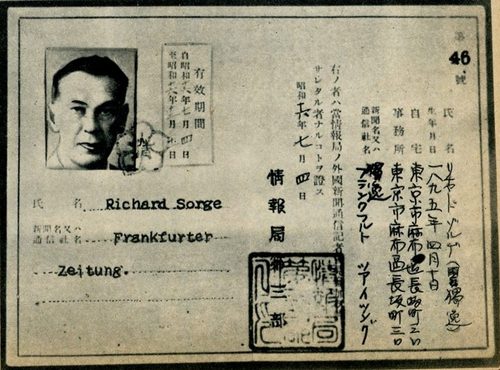 September 1933 – 18 October 1941
The Sorge spy ring
From 1933 to 1941 a Soviet military intelligence network in Tokyo, run by the German journalist Richard Sorge, reported from inside the German embassy and Prince Konoe's circle until Japanese police broke it.
 Germany · 1920–1944
Abwehr
The German armed forces' intelligence service from 1920 to 1944: spies, saboteurs and counterintelligence under Admiral Canaris, outplayed by the FBI and MI5 and finally absorbed by the SS.
1920s–1990s
Double agents
Agents who seem to serve one service while controlled by another. From the OGPU's Trust to MI5's Double Cross system and the FBI's Duquesne case, the best of them turned an enemy network into a channel for deception.
 1914–1990s
Signals intelligence
Intelligence from intercepted communications and electronic emissions, from Room 40 and the Zimmermann telegram to Ultra, Venona, the Berlin tunnel and NSA's domestic programs exposed by the Church Committee.
Soviet Union · 1918–1992
GRU (Soviet military intelligence)
The Red Army's foreign intelligence service from 1918 to 1992: its interwar illegals, its wartime networks in America, the Western spies inside it, and its part in the war scare of the 1980s.