
Portrait: Richard Sorge, Soviet military intelligence resident in Japan, 1933–1941. Министерство обороны Российской Федерации. Wikimedia Commons, CC BY 4.0.

Richard Sorge spent the last eight years of his freedom as one of the best-informed Germans in Tokyo, and the information flowed two ways: to the German embassy, which relied on his reading of Japanese politics, and by radio to Soviet military intelligence in Moscow4.
From the trenches to the Comintern
Sorge was born on 4 October 1895 at Sabunchi, an oil settlement outside Baku, to a German engineer and a Russian mother; the family moved to Berlin when he was small4. He volunteered for the German army in 1914 and was badly wounded in 1915 and again in 1917, injuries that left him with a lasting limp. He came out of the war a Marxist, took a doctorate in political science at Hamburg in August 1919, and worked as a Communist Party activist and journalist4.
In 1924 he moved to Moscow to work for the Communist International and in 1925 became a Soviet citizen. In 1929 he transferred to the Red Army's Fourth Department, the military intelligence service later called the GRU, whose chief Yan Berzin sent him first to Britain and Germany and then, in 1930, to Shanghai4. There he worked under cover as a journalist, and he met two people who would matter later: the Japanese correspondent Hotsumi Ozaki and the German Communist Ursula Kuczynski, who became a Soviet intelligence agent and is better known as Ruth Werner4. CIA's study of the Swiss networks independently records that Kuczynski and her husband worked as Red Army intelligence agents in Shanghai between 1930 and 19353.
Ramsay in Tokyo
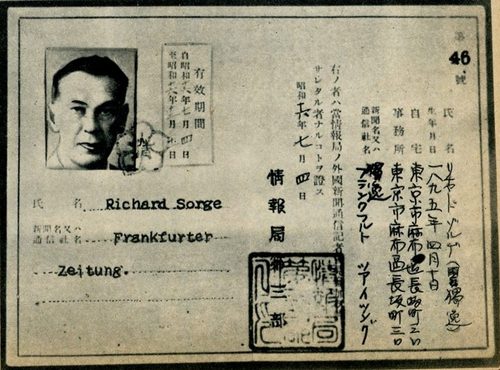
In 1933 the Fourth Department chose Sorge to build a network in Japan under the code name Ramsay. He spent months in Berlin joining the Nazi Party and collecting press commissions, and arrived in Yokohama on 6 September 1933 as correspondent for the Frankfurter Zeitung4,6. The work of the network he built is described on the The Sorge spy ring page. His own contribution was access to the German embassy: he became a friend and adviser of Eugen Ott, the military attaché who was ambassador from 1938, and read and helped draft embassy reporting4.
Sorge's warnings in 1941 about the German attack on the Soviet Union and his September report that Japan would not strike north that year are the basis of his reputation4.
Arrest, confession and execution
Japanese police arrested Sorge on 18 October 1941, a few days after Ozaki4,6. In custody he wrote a long statement about his career. A typed fragment in German, with corrections in his hand, is in CIA's files; the agency's note on it says the bulk of the original manuscript was lost to fire in the bombing of Tokyo and that the confession was candid in places and evasive in others2. The Tokyo District Court sentenced him to death on 29 September 1943, and his appeal failed in January 19445. He was hanged at Sugamo Prison on 7 November 1944, the same day as Ozaki4.
Posthumous career
His body lay in a common grave until 1949, when Ishii Hanako, the Japanese woman with whom he had lived since 1936, recovered and identified it; his remains were later reburied at Tama Cemetery in Tokyo4,6.
The Soviet Union said nothing about him for twenty years. Then, beginning with a Pravda article in late 1964, it built him into a public hero. A decree of the Presidium of the Supreme Soviet on 5 November 1964 made him a Hero of the Soviet Union, and a postage stamp with his portrait followed in 19651. A CIA analyst reviewing the campaign at the time noted that the official accounts left out his drinking and his affairs and added almost nothing to what the Japanese investigation had already shown1.
Key dates
- August 1919 Receives a doctorate in political science from the University of Hamburg; by then a member of the German Communist Party.
- 1929 Joins the Red Army's Fourth Department (military intelligence) under Yan Berzin.
- 1930 Sent to Shanghai under journalistic cover.
- 6 September 1933 Arrives in Yokohama to build a network in Japan.
- 14 September 1941 Reports that a Japanese attack on the Soviet Union is no longer likely that year.
- 18 October 1941 Arrested in Tokyo.
- 29 September 1943 Sentenced to death by the Tokyo District Court.
- 7 November 1944 Hanged at Sugamo Prison, Tokyo.
- 5 November 1964 Named a Hero of the Soviet Union by decree.
Sources
- CIA New Light on Old Spies: A Review of Recent Soviet Intelligence Revelations (Studies in Intelligence; CIA Historical Review Program release, 18 September 1995), Central Intelligence Agency, Center for the Study of Intelligence (1995-09-18).
- CIA The Confession of Richard Sorge (surviving fragment), CIA Reading Room document 0001289798, mirrored on the Internet Archive, Central Intelligence Agency (via Internet Archive).
- CIA The Rote Drei: Getting Behind the 'Lucy' Myth (CIA Historical Review Program release, 22 September 1993), Central Intelligence Agency, Center for the Study of Intelligence (1993-09-22).
- Wikipedia Richard Sorge, Wikipedia.
- Wikipedia Richard Sorge, Wikipedia (German).
- Other Tokyo Espionage: Legendary Soviet Spy Richard Sorge, Nippon.com.
- Wikipedia English Wikipedia article (used for cross-checking).
Elsewhere in the files
Read next
 September 1933 – 18 October 1941
The Sorge spy ring
From 1933 to 1941 a Soviet military intelligence network in Tokyo, run by the German journalist Richard Sorge, reported from inside the German embassy and Prince Konoe's circle until Japanese police broke it.
1907–2000
Ruth Werner (SONYA)
German communist and Soviet military-intelligence officer who worked in Shanghai, Poland and Switzerland and, as SONYA, was Klaus Fuchs's courier in wartime Oxfordshire.
 1938 – 3 May 1945
The Red Orchestra (Rote Kapelle)
Rote Kapelle was the German counterintelligence name for Soviet radio networks in Belgium, France and the Netherlands and for a Berlin resistance circle that passed secrets to Moscow. Most were rounded up in 1942.
 1920s–1980s
Illegals and legends
Soviet officers who lived abroad as private citizens under borrowed identities, with no diplomatic protection. The Abel and Portland court records show how their legends were built and how they came apart.
Soviet Union · 1918–1992
GRU (Soviet military intelligence)
The Red Army's foreign intelligence service from 1918 to 1992: its interwar illegals, its wartime networks in America, the Western spies inside it, and its part in the war scare of the 1980s.