
 Page 1 of 26
From the document
Shortly after his arrest, Richard Sorge prepared a confession of his activities for his Japanese captors. Part of it was a straight-forward account of his espionage activities; other parts were evasive or deceptive.
Es war im Laufe der Zeit, das heisst zwischen 193o und 1932 offensichtlich, dass die Nanking Regierung immer staerker von den Schanghaier und Chekiang Bankleuten, von den Gaenstern und Opiumhaendlern unterstuetzt wurde.
Ueber die maschinelle Einrichtung des Nanking-Arsenals erhielt ich ausgiebiges Material von meinen chinesichen Mitarbeitern; teilweise erhielt ich sogar die wichtigsten Blaupausen.
Excerpts are passages from a US government work (public domain), quoted exactly as they read in the scan, and checked against the full text on every rebuild.
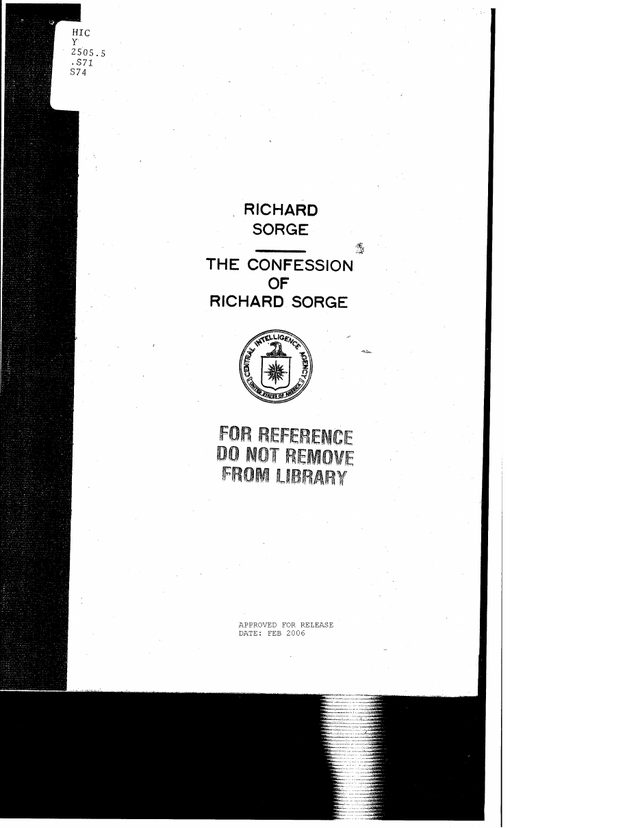
This is not a translation. The 24 typed pages that follow the CIA's two cover sheets are in German, typed by Richard Sorge himself on his own confiscated typewriter in the Tokyo detention house, with his corrections in ink1,2. The CIA's note on the second page calls it "The Confession of Richard Sorge, Typed and Corrected by Sorge, himself" and says it is a small fragment, the only part to survive after most of the manuscript burned in the bombing of Tokyo1.
What it is
Sorge, a German journalist who ran the Soviet military intelligence (GRU) ring in Tokyo, was arrested on 18 October 1941 and hanged on 7 November 19443. The procurator who examined him, Yoshikawa Mitsusada, told Congress in 1951 how the statement came about. After Sorge confessed, he offered to write an outline of his activities. He typed it chapter by chapter in the examination room, read each part back, corrected it in Yoshikawa's presence, and handed it over; Yoshikawa read it with a dictionary2. An official interpreter, Professor Ikoma of the School of Foreign Languages, then translated the finished German text into Japanese, and the Justice Ministry's Criminal Affairs Bureau printed the translation in two parts. The English versions later used by the US Army and Congress were translations of that finished statement, not of this draft2.
These pages were never part of that finished statement. In an affidavit of 19 February 1949, Yoshikawa swore that Sorge's first account of his Shanghai period had been too thin, that Sorge retyped and expanded it, and that the replaced 24 pages, typed and corrected "during October and November 1941", stayed in Yoshikawa's own possession until 14 February 1949, when he gave them to Lt. Col. Paul Rusch of G-2, General Headquarters, Far East Command2. That is how the draft reached American files. The words are Sorge's; only the cover sheets are the CIA's.
The CIA copy matches that description: 24 pages, unsigned, on Shanghai and China1,2. The CIA's cover note says nothing of Yoshikawa, and calls the text "the confession", not a draft the procurator rejected. Its claim that the rest burned is broadly echoed by Yoshikawa, who said only that the interrogation record had "possibly" been lost in the bombing1,2. HUAC's counsel described the exhibit as "the first draft in German of the Sorge confession" and said it added nothing to the completed statement2.
What Sorge says
The draft covers his Shanghai years, 1930 to December 1932. He describes the other Soviet networks in the city: a radio "apparat" sent by the Fourth Department, whose radio operator, Max Clausen, Sorge took over; the Fourth Department's Harbin network; and the Comintern's two-part organization, whose organizational branch was kept so secret that Sorge learned of its chief, known as Noulens, only when he was arrested. He names the Japanese who worked with him, among them Ozaki Hotsumi, whom he believed he met through Agnes Smedley1.
Then come his instructions from the "Moscow Center": to study the Nanking government's strength, its relations with rival generals, the great powers and Japan, and its army. He says he was expressly forbidden to deal with the Chinese Communist Party. He drew on Chinese helpers and on the German military advisers to Chiang Kai-shek, and he claims to have obtained detailed material, even blueprints, on the Nanking arsenal. A long passage explains his move from Comintern work to the Fourth Department as a shift of the movement's centre of gravity to the Soviet state1.
Reading it
Sorge was writing for his captors, and the CIA's note warns that parts of his confession were "evasive or deceptive"1. The typescript is also a rejected first version. Black boxes on most pages cover archival markings, not his text1. The OCR of the German is poor; read the page images. For the hearings that put this draft on the record, see Hearings on American Aspects of the Richard Sorge Spy Case (HUAC, 1951).
Sources
- CIA The Confession of Richard Sorge (CIA document 0001289798), Central Intelligence Agency, FOIA Electronic Reading Room (1941).
- Congress Hearings on American Aspects of the Richard Sorge Spy Case (House Committee on Un-American Activities, 9, 22 and 23 August 1951), GPO print, US House of Representatives, via Internet Archive (1951).
- Wikipedia Richard Sorge, Wikipedia.