
 Page 1 of 12
From the document
We believe strongly that Soviet actions are not inspired by, and Soviet leaders do not perceive, a genuine danger of imminent conflict or confrontation with the United States.
Although the Soviet reaction was somewhat greater than usual, by confining heightened readiness to selected air units Moscow clearly revealed that it did not in fact think there was a possibility at this time of a NATO attack.
We are at present uncertain as to what novelty or possible military objectives the Soviets may have read into recent US and NATO exercises and reconnaissance operations because a detailed comparison of simultaneous “Red” and “Blue” actions has not been accomplished.
Our assessment of both Soviet talk about nuclear war and Soviet military activities indicates a very low probability that the top Soviet leadership is seriously worried about the imminent outbreak of nuclear war
Excerpts are passages from a US government work (public domain), quoted exactly as they read in the scan, and checked against the full text on every rebuild.
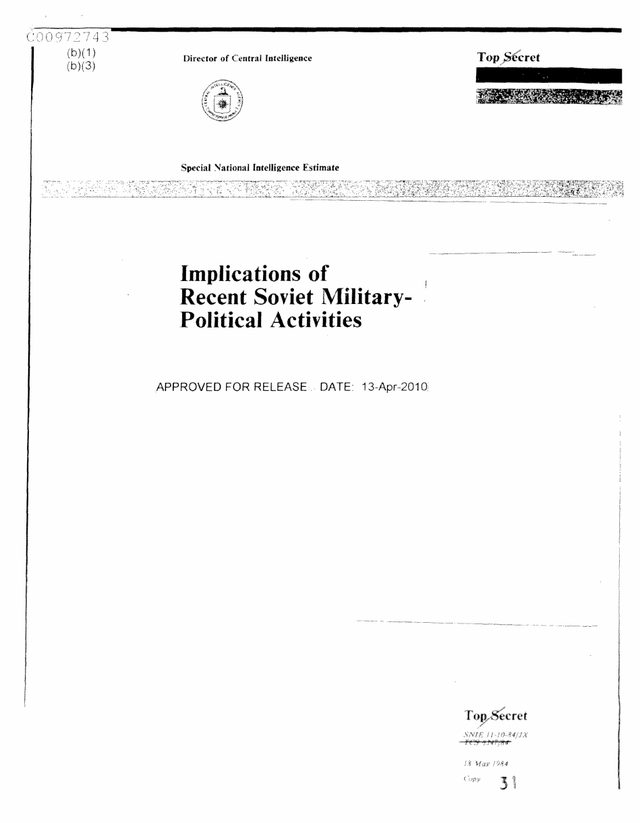
Six months after NATO's nuclear-release exercise Able Archer 83, the US intelligence community set out to answer a question the British had been pressing: whether the Soviet Union was frightened, belligerent, or neither. This Special National Intelligence Estimate, issued by the Director of Central Intelligence on 18 May 1984 with the concurrence of the National Foreign Intelligence Board, was its answer. The CIA, DIA, NSA and the State Department's intelligence bureau took part, with the four military service intelligence chiefs1,2. The National Security Archive says its principal author was the national intelligence officer for the Soviet Union, Fritz Ermarth4.
What it says
The estimate begins with a list of Soviet activity since November 1983: new SS-20 bases after Andropov ended the moratorium on 24 November, cruise-missile submarines off the US coast, a large Northern Fleet exercise in the Norwegian Sea, minimum-altitude rules in the Berlin air corridors from 20 February 1984, heavy bombing in Afghanistan from 21 April, and a troop-rotation airlift that began ten days later than usual1. It then tests five explanations: orchestrated posturing, reaction to US policy, masking of a surprise attack, a weak leadership under military sway, and unrelated events1.
Its verdict is in the Key Judgments. Soviet "war scare" talk was orchestrated propaganda aimed at the West's peace movements and at domestic audiences, and the leadership saw no imminent danger of war. The evidence offered is negative: no forcewide readiness moves, no fear or threats in private diplomacy. Each military activity had its own rationale; together they showed Moscow "speaking with a louder voice"1.
Paragraph 18 is the estimate's only treatment of Able Archer itself. It records that Soviet air units in East Germany and Poland went to heightened readiness, and reads the limited scope of the alert as proof that Moscow did not expect a NATO attack1. The authors admit, in the next paragraph and again at the end, that no one had yet compared Soviet activity with simultaneous US and NATO exercises and reconnaissance, so they could not say how Moscow had read them1.
What happened next
The estimate's key sentence was repeated in a second SNIE that August. In February 1990 the President's Foreign Intelligence Advisory Board quoted it and said the evidence "did not, and certainly does not now, support such categoric conclusions." The board's chief complaint was procedural: estimates of this weight should set out alternative scenarios and weigh their risks3. That review is on this site as The Soviet "War Scare" (PFIAB, 1990). The board also gave weight to evidence the estimate does not discuss, including the Soviet RYAN program, which was meant to warn Moscow when the United States had gained decisive military superiority3.
How to read it
This copy is the CIA release approved on 13 April 2010, with redactions in the paragraph on Able Archer and elsewhere. The Foreign Relations volume printed in 2021 has the same text, but in paragraph 18 it withholds lines the 2010 release shows, such as the new command procedures for authorizing nuclear use and the extra intelligence flights1,2. The National Security Archive also found that the version passed to NATO allies left out every reference to Able Archer4. The estimate is an analyst's argument from the absence of evidence, written before the community had studied its own side's exercises.
Sources
- CIA SNIE 11-10-84/JX, Implications of Recent Soviet Military-Political Activities, 18 May 1984 (CIA release C00972743, posted in Electronic Briefing Book No. 428, document 6), Central Intelligence Agency (copy posted by the National Security Archive) (1984-05-18).
- FRUS Foreign Relations of the United States, 1981–1988, Volume IV, Soviet Union, January 1983–March 1985, Document 221 (SNIE 11–10–84/JX), US Department of State, Office of the Historian (2021).
- Official history The Soviet 'War Scare' (President's Foreign Intelligence Advisory Board report, 15 February 1990), President's Foreign Intelligence Advisory Board (copy posted by the National Security Archive) (1990-02-15).
- National Security Archive The 1983 War Scare: 'The Last Paroxysm' of the Cold War, Part III (Electronic Briefing Book No. 428), National Security Archive.
- Wikipedia Able Archer 83, Wikipedia.