
 Page 1 of 25
From the document
We believe that the Soviets perceived that the correlation of forces had turned against the USSR, that the US was seeking military superiority, and that the chances of the US launching a nuclear first strike -- perhaps under cover of a routine training exercise -- were growing.
As it happened, the military officers in charge of the Able Archer exercise minimized this risk by doing nothing in the face of evidence that parts of the Soviet armed forces were moving to an unusual level of alert.
In 1983 we may have inadvertently placed our relations with the Soviet Union on a hair trigger.
Excerpts are passages from a US government work (public domain), quoted exactly as they read in the scan, and checked against the full text on every rebuild.
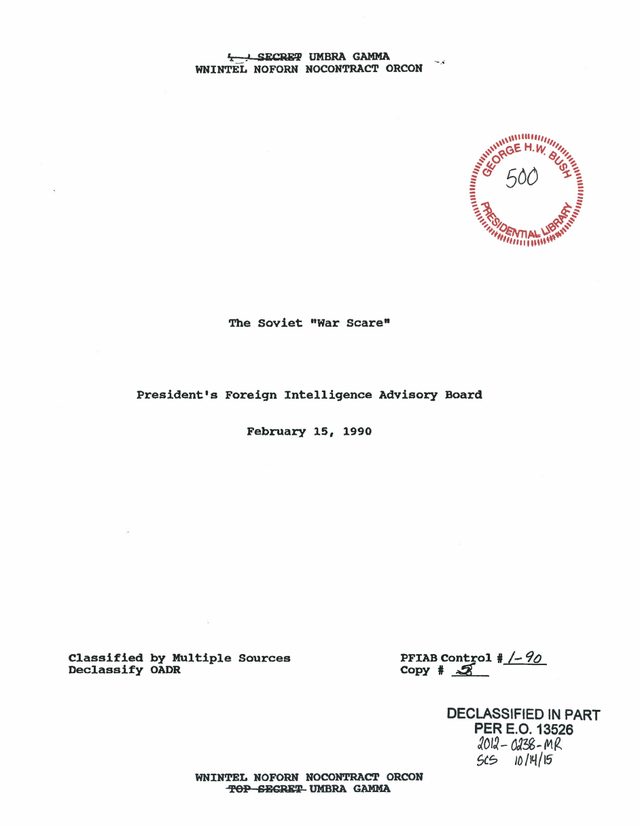
The question behind this report was whether the world had come close to nuclear war in November 1983 without Washington noticing. The President's Foreign Intelligence Advisory Board, a small panel of outsiders who advise the President on intelligence, spent a year on it. The Board read hundreds of documents, interviewed more than 75 American and British officials, and reread six years of national intelligence estimates on the subject1. Its report is dated 15 February 1990, in the Bush administration, and carried some of the highest classification markings in the system1.
What the report says
The executive summary opens with a catalogue. From the late 1970s to the mid-1980s, the Board wrote, Soviet forces and intelligence services changed in ways that suggested the leadership feared a sudden American and NATO strike1. The list is long: Warsaw Pact readiness measures, civil defense exercises on an unusual scale, the end of military help with the harvest, more forward-deployed special forces, higher readiness for missile submarines and nuclear-capable aircraft, and a new warning condition for a surprise attack. It also includes an urgent KGB tasking to watch for Western war preparations (see Operation RYAN) and a KGB computer model, which the report calls VRYAN, meant to signal when the balance of forces had tipped far enough to justify a preemptive strike1. During the NATO nuclear-release exercise Able Archer 83, it adds, the Soviets carried out military and intelligence activities "that previously were seen only during actual crises," including putting Soviet air forces in Germany and Poland on heightened alert1.
The Board then turned to the American side. In two Special National Intelligence Estimates of May and August 1984, the intelligence community had said it believed "strongly" that Soviet leaders did not perceive a genuine danger of war and that their statements were propaganda1. The Board said the evidence did not support "such categoric conclusions" then and did not now. As a result, the President had been given assessments that "understated the risks to the United States"1. It noted that analysts had changed their view by February 1988, and that reporting from several sources, including Oleg Gordievsky, a senior KGB officer who had defected to Britain, pointed strongly to a real belief in Moscow1.
The officer who did nothing
The best-known passage concerns Able Archer itself. The Board found that American commanders had reduced the danger "by doing nothing" when Soviet forces went on alert, but that they "acted correctly out of instinct, not informed guidance"1. Later in the report it names the officer: Lieutenant General Leonard Perroots, in 1983 the Assistant Chief of Staff for Intelligence of US Air Forces in Europe and later Director of the Defense Intelligence Agency. He advised against raising US readiness in response, a choice the Board called "fortuitous, if ill-informed"1. Perroots wrote to the Director of Central Intelligence and the Board in January 1989, as he retired, complaining that the war scare had never been properly assessed. The Board was puzzled by the National Intelligence Council's reply to that letter1.
Recommendations
The Board said its criticism was "in larger part procedural." On questions of national survival, estimates should set out alternative scenarios and weigh each by both its probability and the cost of wrongly rejecting it1. It asked the National Security Council to oversee a reassessment of how the intelligence community understood Soviet decision-making, proposed interviewing former Eastern Bloc officials while the Iron Curtain was open, and urged a review of how the United States ran military exercises1.
Release
The report stayed classified for 25 years. The National Security Archive first asked for it in 2004. It was declassified in part, with several passages still blacked out, after the Interagency Security Classification Appeals Panel intervened, and the Archive published it on 24 October 20153. A public-domain copy is now on Wikimedia Commons2.
The National Security Archive, which fought for its release, describes it as the only study of the episode written with access to all US intelligence files on NATO's actions and the Soviet response3.
Sources
- Official history The Soviet "War Scare", President's Foreign Intelligence Advisory Board, 15 February 1990 (MDR 2012-0238-MR), President's Foreign Intelligence Advisory Board, via the National Security Archive (1990-02-15).
- Other President's Foreign Intelligence Advisory Board, "The Soviet 'War Scare'," February 15, 1990 (PDF), Wikimedia Commons (public-domain copy).
- National Security Archive The 1983 War Scare Declassified and For Real (Electronic Briefing Book No. 533), National Security Archive (2015-10-24).
- Wikipedia Able Archer 83, Wikipedia.