
 Page 1 of 16
From the document
Subsequent visits by Dr. Gassner and a "Dr. Renken," later identified as Major Nickolaus Ritter of the German Secret Service, persuaded Sebold to cooperate with the Reich because he feared reprisals against family members still living in Germany.
During this time, the FBI's radio station transmitted over 300 messages to Germany, and received 200 messages from Germany.
During a visit to Germany in 1938, Lang conferred with German military authorities and reconstructed plans of the confidential materials from memory.
He requested authority to steal the diplomatic bag of a British officer traveling aboard his ship and to dispose of the officer by pushing him overboard.
Excerpts are passages from a US government work (public domain), quoted exactly as they read in the scan, and checked against the full text on every rebuild.
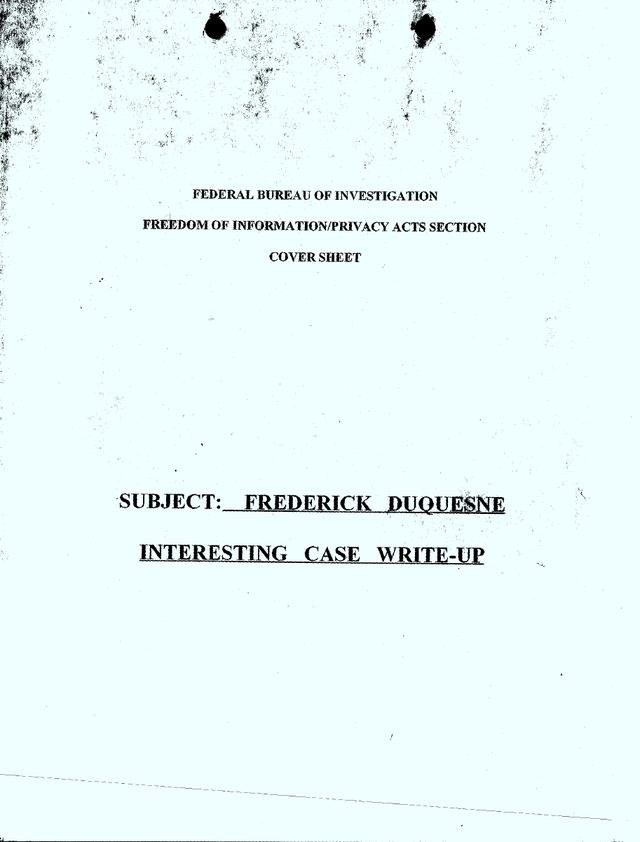
Forty-four years after the trial, someone at FBI headquarters typed up the Duquesne case again. The result, dated 12 March 1985 and filed under the heading "Interesting Case Write-Up," is all the FBI Vault holds on the largest espionage prosecution in American history: a cover sheet and 15 typed pages. It is not a 1941 investigative file. It is the Bureau's own retelling, drawn from that file, and it reads like one1.
What it says
The first three pages tell the story of William Sebold. A German-born naturalized American, he went back to Germany in February 1939 to see his mother, was approached by the Gestapo, and was pressed by a "Dr. Gassner" and a "Dr. Renken," whom the FBI later identified as Major Nikolaus Ritter of the Abwehr. When he went to the American consulate in Cologne for a new passport, he told the staff he had been recruited and wanted to work with the FBI. He was trained in Hamburg in codes and microphotographs, sailed from Genoa as "Harry Sawyer," and landed in New York on 8 February 19401.
The FBI gave him an office as a consulting diesel engineer, chosen so agents could watch every meeting, and from May 1940 ran a shortwave station on Long Island that served as the ring's main link to Germany for 16 months. Nineteen of the accused pleaded guilty; the other 14 went to trial in Brooklyn on 3 September 1941 and were convicted on 13 December. Sentences, handed down on 2 January 1942, totaled more than 300 years1.
The remaining twelve pages give a paragraph or three on each of the 33, in alphabetical order after Frederick Joubert Duquesne himself: when they arrived, their jobs (ship's cooks, stewards, a Westinghouse inspector, a draftsman for Army and Navy work), what they passed, and the sentence. Duquesne, who made Sebold move their first talk to an Automat for fear of microphones, got 18 years; Herman Lang also got 18; Paul Fehse, who called himself head of the "Marine Division," got 151.
How to read it
This is a promotional summary as much as a record. Its subject is Sebold's success and the FBI's, and it never describes a misstep. It names no FBI agents and no sources beyond Sebold. Its phrasing is also the basis of the FBI's public history of the case: whole sentences on Sebold's recruitment and the Long Island station reappear almost word for word on the Bureau's website1,2.
The write-up is also careful about secrets that were no longer secret. Of Lang it says only that he worked for "a company manufacturing highly confidential materials" and rebuilt the plans from memory in Germany in 1938. Other accounts identify the company as the Carl L. Norden Corporation and the material as drawings of the Norden bombsight1,3.
Small details need checking against other sources: Ritter's first name, for one, is spelled "Nickolaus." The scan is poor in places, and the OCR text has gaps where the page is faint1.
Release
The Vault lists the file as a single part, "Duquesne Spy Ring Part 01." One short block beside the letterhead on the first typed page is blacked out; nothing else is withheld. All 33 defendants were convicted in 1941 or 1942; Duquesne himself died in New York in 19561,3.
Sources
- FBI Duquesne Spy Ring (FBI Vault), Part 01, Federal Bureau of Investigation (1985-03-12).
- FBI Duquesne Spy Ring (Famous Cases and Criminals), Federal Bureau of Investigation, History.
- Wikipedia Duquesne Spy Ring, Wikipedia.