
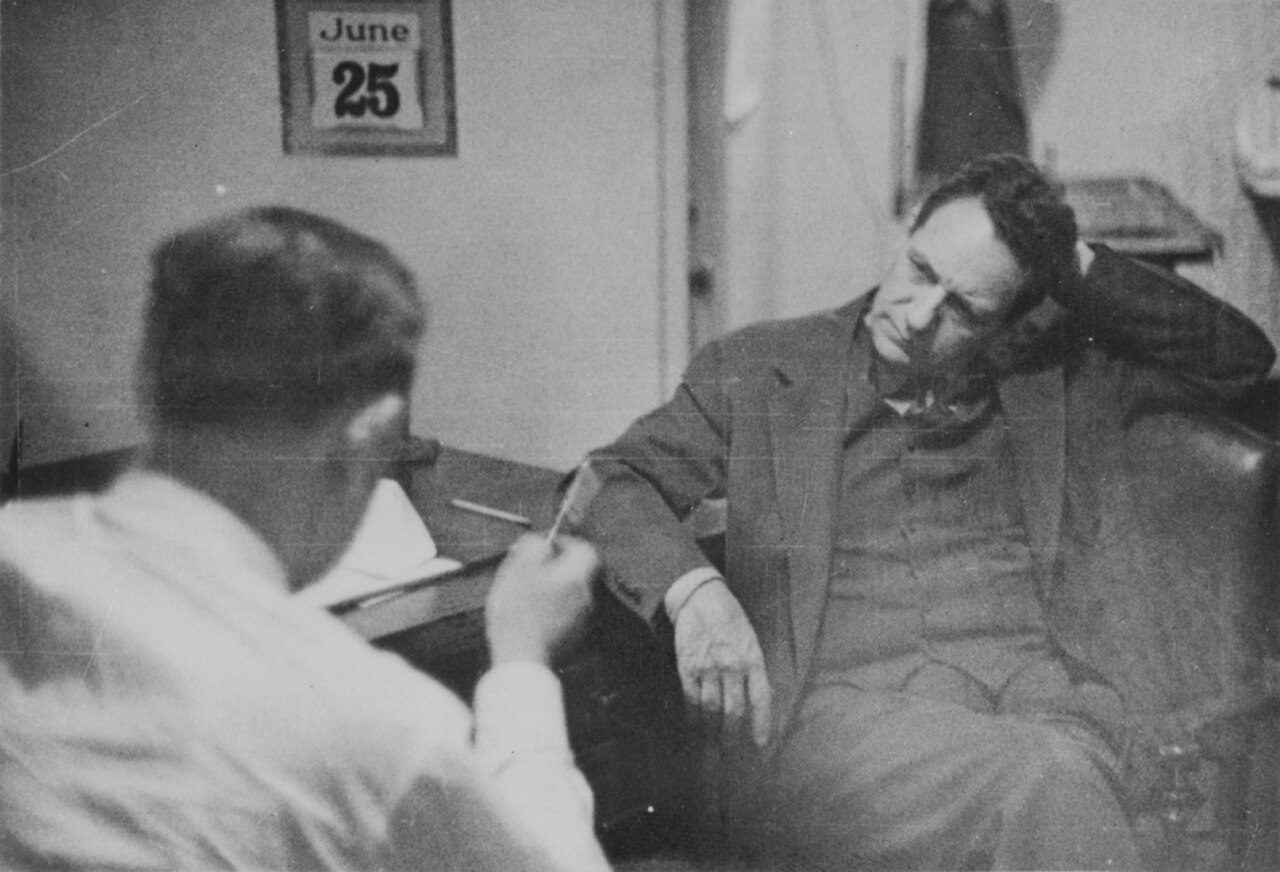
The largest espionage case in American history to end in convictions began with a German-American machinist visiting his mother. It ended six days after Pearl Harbor, with every member of a 33-person Abwehr network either convicted or pleading guilty, and much of the evidence on film.1,3
A recruit who went to the consulate
William Sebold had left Germany in 1921 and became a naturalized American citizen on 10 February 1936, working in aircraft and industrial plants. In February 1939 he went back to see his family. In Hamburg a Gestapo man told him he would be contacted. That September a "Dr. Gassner" questioned him about American military aircraft and asked him to return to the United States as a German agent. A "Dr. Renken," later identified by the FBI as Major Nikolaus Ritter of the Abwehr, followed up. Sebold agreed because he feared for relatives still in Germany.1
His passport then went missing, and he had to apply for a new one at the American consulate in Cologne. There he quietly told consulate staff about his recruitment and said he wanted to work with the FBI when he got home. He was trained in Hamburg in coding and in reducing documents to microphotographs, and given five microphotographs of instructions: two to keep and three to deliver to agents in America. Under the name "Harry Sawyer" he sailed from Genoa and reached New York on 8 February 1940. The Abwehr's cover name for him was TRAMP.1,5
The FBI runs the channel
The FBI knew he was coming. It set him up as a consulting diesel engineer and built two traps. The first was a shortwave station on Long Island, built by FBI Laboratory engineers. In May 1940 it made contact with the Abwehr's station in Germany. For 16 months it was the network's main line to its controllers, and FBI operators, posing as Sebold, sent more than 300 messages and received about 200.1
The second was an office in Manhattan fitted with hidden microphones and a two-way mirror, through which agents filmed every meeting. Sebold's visitors brought information on ship sailings to Britain, defense plants and new equipment. One, Paul Bante, discussed a fuse bomb and later handed over dynamite and detonators.1
Fritz Duquesne and the others
The most senior visitor was Frederick "Fritz" Joubert Duquesne, born in the Cape Colony in 1877, a Boer War veteran and First World War German agent whom Canaris had asked Ritter to reactivate. Ritter and Duquesne met again in New York on 3 December 1937. In Sebold's office Duquesne explained how fires could be started in industrial plants and handed over photographs and specifications of a new bomb he said came from the DuPont plant in Wilmington, Delaware. Much of his material came simply from writing to manufacturers as a student and asking for it. He suspected bugs; at one meeting he passed Sebold a note suggesting they talk elsewhere, and they moved to an Automat.1,3,4
Others had been at work before Sebold arrived. Herman Lang, an inspector at the Carl L. Norden company, had copied drawings of the secret Norden bombsight and sent them to Germany in January 1938. Everett Roeder, a Bronx-born designer at Sperry Gyroscope, had agreed to spy after a visit to Germany in 1936. Lilly Stein, from Vienna, had been trained at the same Hamburg school as Sebold. Ship's cooks, a Pan American clipper steward and a secretary to a law firm acting for the German consulate rounded out the network.1,3
Arrests, trial and sentences
The FBI arrested the network in June 1941. Nineteen pleaded guilty. The other 14 went on trial in federal court in Brooklyn on 3 September 1941 and were all convicted by the jury on 13 December 1941. On 2 January 1942 the 33 were sentenced to more than 300 years in prison in total. Duquesne received 18 years for espionage, with a concurrent two-year term and a $2,000 fine under the Registration Act. Lang also received 18 years, and Roeder 16.1
J. Edgar Hoover called it the greatest spy roundup in American history. The FBI's own conclusion was that the United States entered the war confident that no major German espionage network was hidden on its soil. A year later the Abwehr turned to sabotage teams landed by U-boat in Operation Pastorius; they were caught too.1,3
What remains
The FBI later put its case files on the FBI Vault, and its history pages reproduce stills from the surveillance film, including Sebold and Duquesne talking across the desk in the wired office. Duquesne served his sentence at Leavenworth, was released in 1954 because of ill health, and died in New York on 24 May 1956. Sebold was given a new identity after the trials. The 1945 film The House on 92nd Street was a thinly disguised retelling of the case.1,2,3
The documents
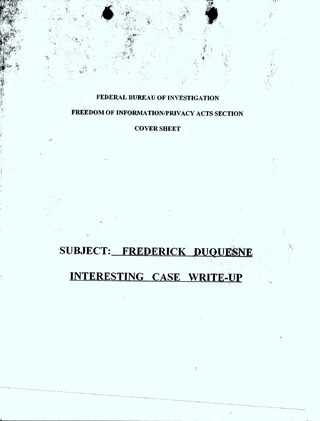
Declassified records of this operation, with the scans and their full text hosted here.

Checking the record
Dates and outcome compared in two independent sources: they agree.
- FBI
- Sebold arrives in New York on 8 February 1940; radio contact with Germany from May 1940 for 16 months; trial opens 3 September 1941; verdicts 13 December 1941; sentencing 2 January 1942. 33 spies arrested; 19 plead guilty, 14 convicted at trial; total sentences of over 300 years.
- Wikipedia
- Trial from 3 September 1941, verdicts 13 December 1941, sentences 2 January 1942; Sebold sent to New York on 8 February 1940. 33 convicted, 19 by plea and 14 by jury; more than 300 years in total.
The two agree on every date and number. The FBI page gives the arrests only as June 1941; Wikipedia's Canaris article dates them to 28 June 1941. This page follows the FBI wording and gives the month.
Sources
- FBI Duquesne Spy Ring, Federal Bureau of Investigation, History.
- FBI FBI Case Records on the Duquesne Spy Ring (FBI Vault), Federal Bureau of Investigation.
- Wikipedia Duquesne Spy Ring, Wikipedia.
- Wikipedia Wilhelm Canaris, Wikipedia.
- Wikipedia Abwehr, Wikipedia.
- Wikipedia English Wikipedia article (used for cross-checking).
Elsewhere in the files
Read next
 Germany · 1920–1944
Abwehr
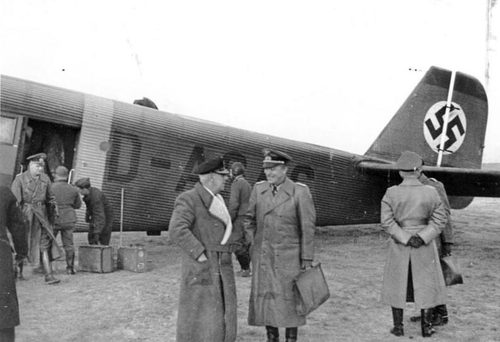
The German armed forces' intelligence service from 1920 to 1944: spies, saboteurs and counterintelligence under Admiral Canaris, outplayed by the FBI and MI5 and finally absorbed by the SS.
 13 June – 8 August 1942
Operation Pastorius
In June 1942 U-boats landed eight Abwehr saboteurs on Long Island and in Florida. One turned himself in, all were caught within two weeks, and the Supreme Court upheld their trial by military commission.
1920s–1990s
Double agents
Agents who seem to serve one service while controlled by another. From the OGPU's Trust to MI5's Double Cross system and the FBI's Duquesne case, the best of them turned an enemy network into a channel for deception.
 1870–1960s
Microdots
A page of text photographed down to the size of a printed full stop. The Abwehr's wartime microdots, Popov's Pearl Harbor questionnaire and the Soviet illegals' kits in New York and London show how far the trick went.
 September 1939 – May 1945
The Double-Cross System
How MI5 caught or recruited Germany's wartime spies in Britain and ran them as double agents, steered by the Twenty Committee, until their reports could carry the D-Day deception.