
 Page 1 of 48
From the document
The four were there landed from the submarine in the hours of darkness, on or about June 13, 1942, carrying with them a supply of explosives, fuses, and incendiary and timing devices.
Unlawful combatants are likewise subject to capture and detention, but in addition they are subject to trial and punishment by military tribunals for acts which render their belligerency unlawful.
Citizenship in the United States of an enemy belligerent does not relieve him from the consequences of a belligerency which is unlawful because in violation of the law of war.
We hold only that those particular acts constitute an offense against the law of war which the Constitution authorizes to be tried by military commission.
Excerpts are passages from a US government work (public domain), quoted exactly as they read in the scan, and checked against the full text on every rebuild.
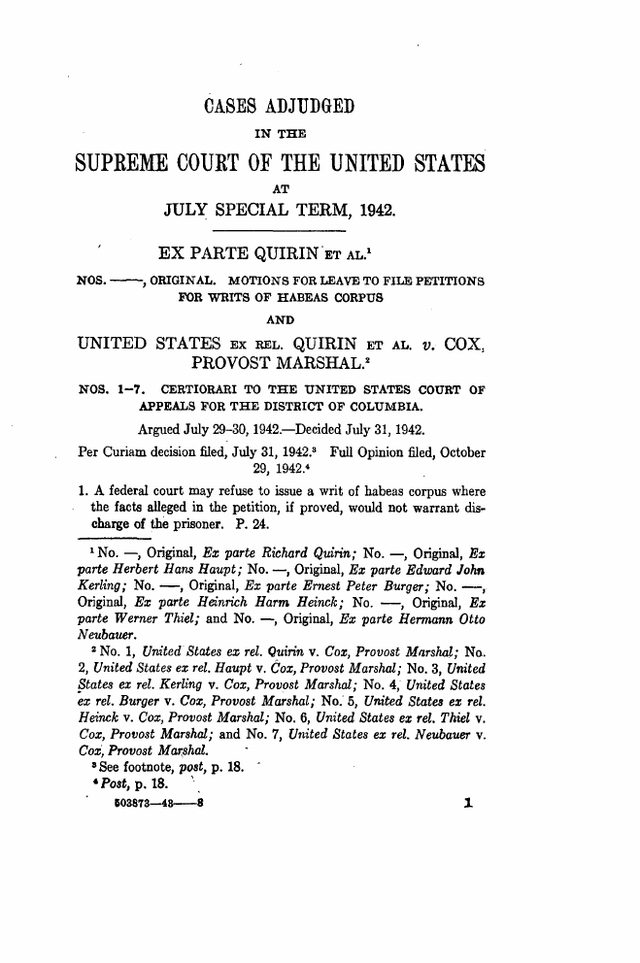
The Supreme Court decided this case twice. On 31 July 1942, two days after hearing argument in a special summer session, it issued a short unsigned order: the eight German saboteurs of Operation Pastorius could be tried by the military commission President Roosevelt had created, and their petitions for habeas corpus were denied. The reasons came only on 29 October 1942, in Chief Justice Harlan F. Stone's full opinion1. By then six of the men had been executed, on 8 August, and the other two were in prison3,4. The hosted file is the case as printed in volume 317 of the United States Reports, pages 1 to 48: the reporter's syllabus, the lawyers' arguments, the July order and the October opinion1.
The facts the Court accepted
The opinion's statement of facts is a compact official account of the landings. All eight petitioners were born in Germany, had lived in the United States and had gone back between 1933 and 1941. After the declaration of war they trained at a sabotage school near Berlin in explosives and secret writing. Four, with George Dasch, who was not a petitioner, were landed from a submarine at Amagansett Beach on Long Island on or about 13 June 1942; the other four came ashore at Ponte Vedra Beach, Florida, on or about 17 June. Both groups wore German uniforms or caps, buried them with their explosives, and moved on in civilian clothes. The FBI arrested all of them in New York or Chicago. They carried substantial sums in American money from the German High Command1. The opinion does not say how they were caught; the FBI's own history credits Dasch's decision to turn himself in3.
Roosevelt's order and proclamation of 2 July 1942 set up the commission and declared that enemy agents entering through coastal defenses were subject to military tribunals and barred from the courts. The Army charged the men with violating the law of war, the 81st and 82nd Articles of War (aiding the enemy and spying) and conspiracy, and the trial began on 8 July1.
What the Court held
The defense, led by Col. Kenneth C. Royall, argued that civilian courts were open, that Ex parte Milligan (1866) forbade military trial of civilians in such places, and that the beaches were not zones of military operations1,4. The Court disagreed. It held first that the proclamation could not shut the courts against the question whether the trial was lawful. On the merits, it reasoned that Congress, through the Articles of War, had authorized military commissions to try offenses against the law of war; that enemy combatants who cross the lines out of uniform to destroy life or property are "unlawful combatants" triable by such commissions; and that this was true even of a citizen, which disposed of Herbert Haupt's claim to American citizenship without deciding it. Milligan was distinguished: Milligan had not been an enemy belligerent1.
The Court decided only the first charge and declined to rule on the others. On the President's procedures, it was unanimous that they gave no ground for release but admitted that the Justices did not agree on the reasons. Justice Frank Murphy took no part1. The Chief Justice's son had served on the defense team before the commission; all counsel asked Stone to sit anyway, and he did1.
Reading it
The opinion is careful to "hold only" what the facts required, but it was written to justify a judgment already given and sentences already carried out, and commentators have long debated it for that reason4. It is a court record, so its facts are those stipulated or alleged in 1942. For the operation itself and the men's fate, see Operation Pastorius2,3.
Sources
- Court record Ex parte Quirin, 317 U.S. 1 (1942), United States Reports facsimile (PDF), Library of Congress (1942-10-29).
- Court record Ex parte Quirin, 317 U.S. 1 (1942), Legal Information Institute, Cornell Law School.
- FBI Nazi Saboteurs and George Dasch, Federal Bureau of Investigation.
- Wikipedia Ex parte Quirin, Wikipedia.