
Portrait: Duško Popov, the MI5 double agent TRICYCLE, in New York, 1941. Unknown [2]. Wikimedia Commons, Public domain.

The summary MI5 wrote for its TRICYCLE files is unusually expansive. It lists, in one paragraph, warnings of German rocket development, deception about the Normandy landings, and "early intimations from German sources of the Japanese attack on Pearl Harbour"1. That last phrase explains why Duško Popov, a Yugoslav lawyer who spent the war as a British-controlled double agent, is better known than most of his colleagues in the Double-Cross System.
Recruitment
Popov was born in 1912 at Titel, then in Austria-Hungary, into a wealthy Serbian family. He studied law in Belgrade and took a doctorate at Freiburg, where he befriended Johnny Jebsen, son of a German shipping family3. In 1940 Jebsen, by then working for the Abwehr, drew Popov into German service. According to the National Archives catalogue, Popov reported the approach to the British embassy in Belgrade and was taken on by SIS, then run in London by MI5 while the Abwehr ran him from Lisbon, which he visited seven times between 1941 and 19441. The Germans called him IVAN; the British first called him SCOOT, then TRICYCLE1,3.
He communicated with the Germans by wireless, secret writing and microdots1. He sat at the center of a cluster of related double agents: his brother Ivo (DREADNOUGHT), FREAK, METEOR, BALLOON and GELATINE. Jebsen himself, codenamed ARTIST, became the British services' best source on the Abwehr's internal affairs1.
The American mission and the Pearl Harbor questionnaire
In August 1941 the Abwehr sent Popov to the United States to set up a network there. He arrived in New York carrying a list of intelligence requirements, delivered to him on microdot, that included a page-long set of questions about the defenses of Pearl Harbor2. The British and the FBI agreed to the plan, but the Bureau insisted on controlling him and wanted him to help catch German agents rather than run a deception channel2. The catalogue describes the American project bluntly as "a failure"1. The relationship with J. Edgar Hoover's FBI was poor, and Popov was recalled to London2.
Deception and the loss of ARTIST
Back in London, Popov carried deception material on Allied intentions in the Mediterranean and, in 1944, material supporting the Fortitude cover plan for Normandy1,2. That spring Jebsen was seized by the Germans and taken to Germany, where he died; MI5 feared the arrest had exposed TRICYCLE and stopped using his channel for the most sensitive D-Day material3.
Later life and memoir
After the war Popov received the OBE, took British nationality and settled in France1. He kept silent until J. C. Masterman's account of the Double-Cross System was published in 1972, then published his own memoir, Spy/Counterspy, in 19741,3. Comparisons with the files have shown it to be broadly accurate but embellished in places3. He died at Opio, in the Alpes-Maritimes, in August 19813. MI5 opened his files at The National Archives in 20021.
Key dates
- 1940 Recruited by the Abwehr through his friend Johnny Jebsen; reports this to the British in Belgrade.
- August 1941 Arrives in New York with a German questionnaire that includes a page on Pearl Harbor's defenses.
- 1944 Passes deception material supporting the Normandy cover plan.
- 1974 Publishes the memoir Spy/Counterspy.
- 1 May 2002 MI5's TRICYCLE files (KV 2/845 onward) opened at The National Archives.
Sources
- Official history KV 2/845: Dusko POPOV, codenamed TRICYCLE: alias Duchan, Dusan, Hans, SKOOT, The National Archives (UK), Discovery catalogue (2002).
- CIA Review of Into the Lion's Mouth: The True Story of Dusko Popov, by David A. Foy, Studies in Intelligence 62, no. 1 (March 2018), Central Intelligence Agency, Center for the Study of Intelligence (2018-03).
- Wikipedia Duško Popov, Wikipedia.
- Wikipedia English Wikipedia article (used for cross-checking).
Elsewhere in the files
Read next
 September 1939 – May 1945
The Double-Cross System
How MI5 caught or recruited Germany's wartime spies in Britain and ran them as double agents, steered by the Twenty Committee, until their reports could carry the D-Day deception.
 January – September 1944
Operation Fortitude
The Allied deception that invented armies in Scotland and southeast England in 1944 to make Germany expect landings in Norway and the Pas-de-Calais, and to see Normandy as a feint.
 1912–1988
Juan Pujol García (GARBO)
A Catalan former poultry farmer who invented a spy network for the Abwehr, became MI5's double agent GARBO, and helped persuade Hitler that Normandy was a feint.
 1870–1960s
Microdots
A page of text photographed down to the size of a printed full stop. The Abwehr's wartime microdots, Popov's Pearl Harbor questionnaire and the Soviet illegals' kits in New York and London show how far the trick went.
1920s–1990s
Double agents
Agents who seem to serve one service while controlled by another. From the OGPU's Trust to MI5's Double Cross system and the FBI's Duquesne case, the best of them turned an enemy network into a channel for deception.
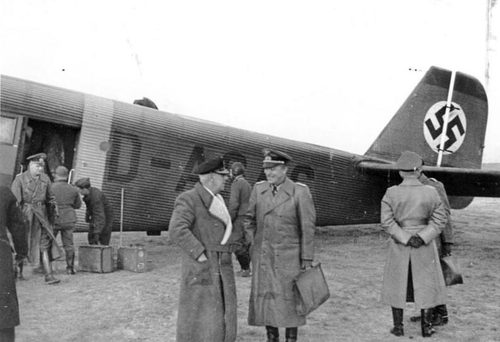 Germany · 1920–1944
Abwehr
The German armed forces' intelligence service from 1920 to 1944: spies, saboteurs and counterintelligence under Admiral Canaris, outplayed by the FBI and MI5 and finally absorbed by the SS.