
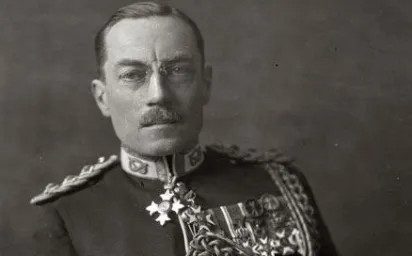
Portrait: Juan Pujol García, the double agent GARBO, in a photograph released by MI5. Unknown author. Wikimedia Commons, Public domain.

Juan Pujol García never set foot in Britain until MI5 brought him there, yet for most of 1941 the Abwehr believed he was running a network of informants across the country. His reports were invented in Lisbon from a tourist guide, reference books and newsreels. That improvised fraud became the most valuable channel in the British Double-Cross System and a central instrument of Operation Fortitude1,5.
From Barcelona to Lisbon
Pujol was born in Barcelona on 14 February 1912, the third child of a factory owner. He trained as a poultry farmer and was managing a chicken farm when the Spanish Civil War began4. He avoided service with the Republicans, spent time in a Nationalist signals unit, and came out of the war hostile to both communism and fascism4,5.
Working in Madrid when the Second World War began, he and his wife Araceli offered his services to the British embassy and were turned away more than once. He then approached the Germans posing as a fervent Nazi sympathizer. The Abwehr accepted him, gave him secret ink and money, and told him to go to Britain4,5. He went to Lisbon instead and wrote reports that purported to come from London4.
The National Archives' release notes stress how unusual this was: GARBO had not been a genuine German agent before he was turned, but had built his own deception and only afterward been absorbed into MI5's operation1. British codebreakers reading Abwehr traffic (the ISOS decrypts preserved in KV 2/39) could follow how the Germans valued his reports2.
GARBO and his imaginary network
After approaches to the British and to the US naval attaché in Lisbon, Pujol was brought to Britain in spring 1942 with his family4,5. He was first codenamed BOVRIL; MI5 renamed him GARBO for his acting ability3,4. His case officer was Tomás Harris, a Spanish-speaking MI5 officer, and they worked from a safe house at 35 Crespigny Road in Hendon, where the wireless transmitter was installed4.
Together Pujol and Harris "recruited" 27 sub-agents, every one of them fictitious and every one paid for by the Germans4. Messages went first by secret-ink letter, supposedly carried to Lisbon by an airline courier, and from 1943 by radio5. When a sub-agent ought to have seen something the British wanted hidden, he fell ill or died; one invented agent's "widow" drew a German pension5. MI5's own catalogue describes the files as documenting "the progressive development" of the network and the contingency plans Harris drew up when Abwehr defections after D-Day threatened it3. The channel carried deception on Operations Torch and Husky as well as an imaginary network of caves in southern England1.
D-Day
GARBO's greatest service came in 1944. From January he sent the Germans a steady flow of order-of-battle detail supporting the fiction of a large army group in southeast England poised to cross to the Pas de Calais5. To build his credibility he was allowed to warn the Germans of the Normandy landing in the early hours of 6 June, too late to be useful. On 9 June he signaled that Normandy was a diversion and that the main blow was still to fall farther north4,5.
Germany kept substantial forces, including armored divisions, in the Pas de Calais for weeks afterward4,5. The Germans awarded their agent ALARIC the Iron Cross, Second Class, in July 1944; the British appointed him MBE later that year, in secret4,5.
After the war
Fearing reprisals, Pujol left Europe. With MI5's help he was reported dead of malaria in Angola in 1949 and settled in Venezuela, where he remarried4,5. His identity was uncovered in 1984; that year he was received at Buckingham Palace and visited the Normandy beaches on the 40th anniversary of D-Day4. He died in Caracas on 10 October 19884,5.
MI5's GARBO files began to open at The National Archives in 1999 (KV 2/39), and a further run, KV 2/4190–4214, was released in 20161,2,3. The later files also document the strain the work placed on his wife, which MI5 treated as a security risk1.
Key dates
- 1941 Rebuffed by the British in Madrid, offers himself to the Abwehr and begins sending invented reports from Lisbon.
- April 1942 Brought to Britain and taken on as a double agent, first as BOVRIL, then GARBO.
- 1944 Appointed MBE by the British, in secret.
- 9 June 1944 Signals that the Normandy landing is a diversion and a larger attack on the Pas de Calais is still to come.
- July 1944 Awarded the Iron Cross, Second Class, by the Germans.
- 1949 With MI5's help, has his death from malaria reported in Angola; settles in Venezuela.
- 21 January 1999 First MI5 files on GARBO opened at The National Archives (KV 2/39 onward).
Sources
- Official history Double Agent Operations (release notes for KV 2/4190–4214, Juan Pujol-Garcia), The National Archives (UK).
- Official history KV 2/39: PUJOL GARCIA, Juan. Second World War Double Agent codenamed GARBO. Top Secret (ISOS) material, The National Archives (UK), Discovery catalogue (1999).
- Official history KV 2/4200: Juan PUJOL GARCIA, aliases GARBO, BOVRIL, IMMORTAL, The National Archives (UK), Discovery catalogue (2016).
- Other PUJOL GARCIA, Juan (1912–1988): blue plaque, 35 Crespigny Road, Hendon, English Heritage.
- Wikipedia Juan Pujol García, Wikipedia.
- Wikipedia English Wikipedia article (used for cross-checking).
Elsewhere in the files
Read next
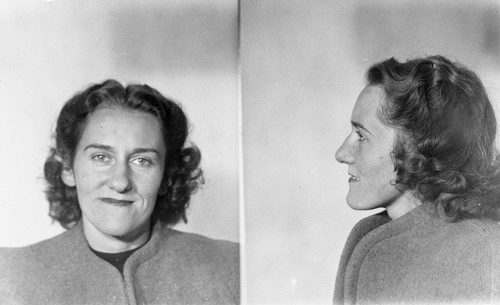 September 1939 – May 1945
The Double-Cross System
How MI5 caught or recruited Germany's wartime spies in Britain and ran them as double agents, steered by the Twenty Committee, until their reports could carry the D-Day deception.
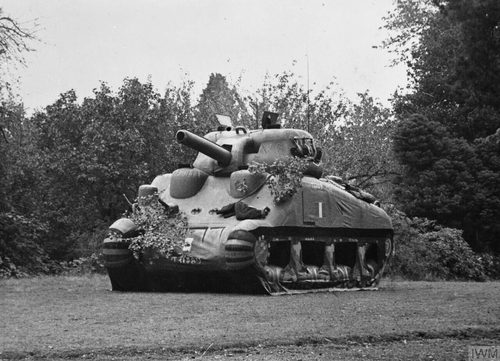 January – September 1944
Operation Fortitude
The Allied deception that invented armies in Scotland and southeast England in 1944 to make Germany expect landings in Norway and the Pas-de-Calais, and to see Normandy as a feint.
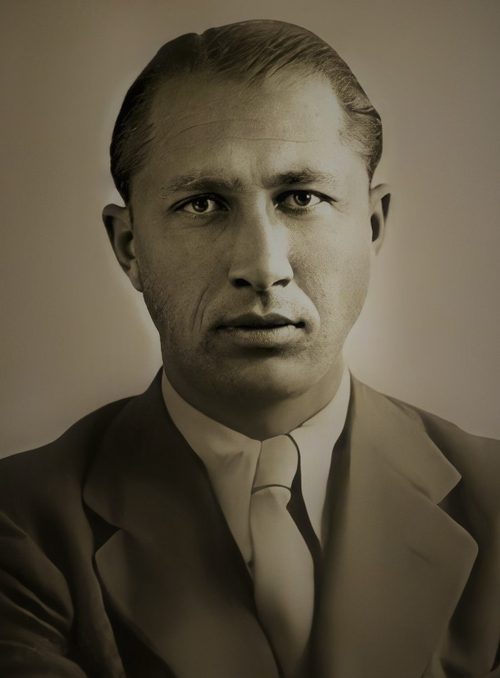 1912–1981
Duško Popov (TRICYCLE)
Yugoslav lawyer recruited by the Abwehr in 1940 who became MI5's double agent TRICYCLE, carried a German questionnaire about Pearl Harbor to the FBI, and fed D-Day deception.
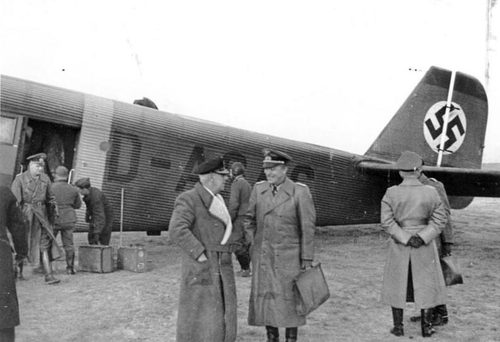 Germany · 1920–1944
Abwehr
The German armed forces' intelligence service from 1920 to 1944: spies, saboteurs and counterintelligence under Admiral Canaris, outplayed by the FBI and MI5 and finally absorbed by the SS.
 United Kingdom · 1909
Security Service (MI5)
Britain's domestic security service, founded in 1909 as the home section of the Secret Service Bureau: hunter of German spies in two world wars, runner of the Double-Cross System, and a target of Soviet penetration.
1920s–1990s
Double agents
Agents who seem to serve one service while controlled by another. From the OGPU's Trust to MI5's Double Cross system and the FBI's Duquesne case, the best of them turned an enemy network into a channel for deception.