
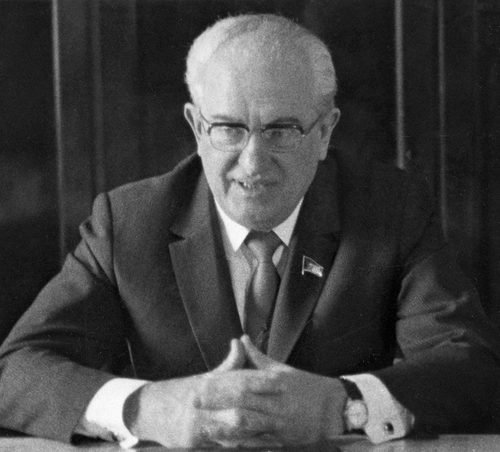
Portrait: Yuri Andropov, Soviet leader, 1982. TASS. Wikimedia Commons, Public domain.

When Yuri Andropov became Soviet leader in November 1982, major Western newspapers printed detailed profiles of him that contradicted one another and in places were simply invented; very little about the man was actually known.5 His record was clearer: ambassador in Budapest when Soviet tanks crushed the Hungarian revolution, then chairman of the KGB for fifteen years, the longest tenure in its history.5
Party official and ambassador
According to his official biography, Andropov was born on 15 June 1914 in the Cossack settlement of Nagutskaya in the Stavropol region, the son of a railway worker. Research since the Soviet collapse suggests a more complicated story, including a Moscow birth, a stepfather and a maternal family background he concealed.5 He rose through the Komsomol in Yaroslavl and Soviet Karelia, joined the party in 1939, and moved to the Central Committee apparatus in Moscow in 1951.5
In July 1954 he was appointed ambassador to Hungary, and he was in Budapest throughout the revolution of 1956.5 The historian Christopher Andrew, drawing on Vasili Mitrokhin's notes from the KGB archive, describes a lasting "Hungarian complex": having seen how fast a communist state could fall, Andropov believed armed force was the answer when regimes later wobbled in Prague, Kabul and Warsaw.5 From 1957 to 1967 he ran the Central Committee department for relations with ruling communist parties.5
Chairman of the KGB
Andropov took over the KGB in May 1967 and entered the Politburo as a candidate member, becoming a full member in 1973.5 On 3 July 1967 he proposed a new Fifth Directorate to deal with political opposition; it opened files on dissidents including Andrei Sakharov and Aleksandr Solzhenitsyn. Under his chairmanship the KGB used arrests, forced emigration and confinement in psychiatric hospitals against opponents of the regime.5 He pressed for hard measures against the Prague Spring in 1968 and was among the leaders who decided on the invasion of Afghanistan in December 1979.5 (On the American response in Afghanistan, see Operation Cyclone.)
His most consequential intelligence decision came in May 1981. At a closed session of senior KGB officers, Leonid Brezhnev spoke first; Andropov then said bluntly that the United States was preparing a surprise nuclear attack and that the KGB and the military intelligence service, the GRU, would combine in a collection effort codenamed RYAN.1 The former Soviet ambassador in Washington, Anatoly Dobrynin, observed in his memoirs that Andropov was the first Soviet leader since Stalin who seemed to believe the United States might launch a surprise attack.1 (See Operation RYAN.)
Fifteen months in power
Andropov left the KGB in May 1982 for the party Secretariat and, two days after Brezhnev's death, was elected General Secretary on 12 November 1982.5 On 15 November he received Vice President George Bush and Secretary of State George Shultz in the Kremlin after the funeral; the American record of the meeting opens with his thanks for the high rank of the US delegation.2
At home he campaigned against absenteeism and corruption and promoted younger officials, among them Mikhail Gorbachev.5 Abroad, relations with Washington worsened through 1983: President Reagan's "evil empire" speech and Strategic Defense Initiative in March, the shooting down of the Korean airliner KAL 007 on 1 September, and the Soviet walkout from arms talks in November.5,1
His kidneys failed in February 1983, and from August he was in hospital.5 When the US President's Foreign Intelligence Advisory Board later reconstructed the Soviet reaction to NATO's Able Archer 83 exercise that November, it noted that Andropov, "probably the only man in the Soviet Union who could authorize the use of nuclear weapons at a moment's notice," was seriously ill and "may have been incapacitated."3
He died at 4:50 p.m. Moscow time on 9 February 1984; the official announcement came the next afternoon, and the US embassy reported Moscow reacting "with outward calm."4 He was succeeded by Konstantin Chernenko.5
Key dates
- July 1954 Appointed Soviet ambassador to Hungary.
- November 1956 In Budapest during the Soviet suppression of the Hungarian revolution.
- May 1967 Appointed chairman of the KGB.
- 3 July 1967 Proposes the KGB Fifth Directorate to combat political dissent.
- May 1981 With Brezhnev, tells senior KGB officers the US is preparing a surprise nuclear attack; launches RYAN.
- May 1982 Leaves the KGB for the Central Committee Secretariat.
- 12 November 1982 Elected General Secretary two days after Brezhnev's death.
- November 1983 Seriously ill during the Able Archer war scare.
- 9 February 1984 Dies in Moscow.
Sources
- CIA A Cold War Conundrum: The 1983 Soviet War Scare, by Benjamin B. Fischer, Central Intelligence Agency, Center for the Study of Intelligence (1997).
- FRUS Foreign Relations of the United States, 1981–1988, Volume III, Soviet Union, January 1981–January 1983, Document 234: Memorandum of Conversation, Bush–Andropov meeting, 15 November 1982, US Department of State, Office of the Historian (1982-11-15).
- FRUS Foreign Relations of the United States, 1981–1988, Volume IV, Document 135 (Editorial Note), US Department of State, Office of the Historian (2021).
- FRUS Foreign Relations of the United States, 1981–1988, Volume IV, Document 170 (Editorial Note on Andropov's death), US Department of State, Office of the Historian (2021).
- Wikipedia Yuri Andropov, Wikipedia.
- Wikipedia English Wikipedia article (used for cross-checking).
Elsewhere in the files
Read next
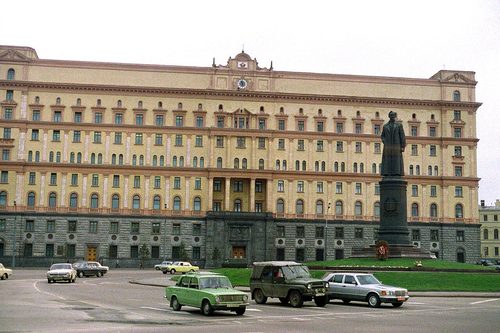 Soviet Union · 1954–1991
KGB
The Soviet Committee for State Security, 1954–1991: foreign intelligence, counter-intelligence, border troops and political police under one roof, from Khrushchev's reforms to the failed coup of August 1991.
 May 1981 – April 1989
Operation RYAN
The KGB–GRU intelligence alert launched in May 1981 to detect a feared American nuclear first strike, its indicator lists, and the long argument over whether Moscow's fear was real.
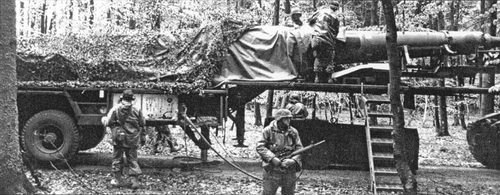 2–11 November 1983
Able Archer 83 and the war scare
A routine NATO nuclear-release exercise in November 1983 met an unusual Soviet military alert. What the declassified record shows about the reaction, and why historians still disagree on the danger.
1922–2004
Vasili Mitrokhin
KGB archivist who spent twelve years secretly copying foreign-intelligence files by hand, defected to Britain in 1992, and left the Mitrokhin Archive: hugely valuable to investigators, still debated by historians.
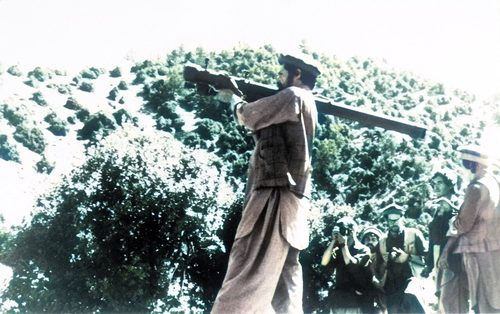 3 July 1979 – 1992
Operation Cyclone
The CIA's covert program to arm the Afghan resistance, from a $695,000 non-lethal finding in July 1979 through Soviet-made rifles via Pakistan to Stinger missiles, and what the record says about bin Laden.