
Vasili Mitrokhin's weapon was a pencil. For twelve years, while he supervised the move of the KGB's foreign-intelligence archive to a new headquarters outside Moscow, he copied files by hand onto scraps of paper, carried them out in his shoes and later his jacket pockets, and hid them at his family's dacha. The result, smuggled to Britain in 1992, became the Mitrokhin Archive, which the FBI has been quoted as calling "the most complete and extensive intelligence ever received from any source."1
A career in the archives
Mitrokhin was born on 3 March 1922 in Yurasovo, in the Ryazan region, studied history and law, and entered Soviet foreign intelligence in 1948.5 After postings abroad in the 1950s he was moved, around 1956, from operational work to the archives of the First Chief Directorate, the KGB's foreign-intelligence arm. He later dated his disillusionment to Khrushchev's denunciation of Stalin that year and to what he read in the files.5,6
From 1972 he was in charge of transferring the directorate's archive from the Lubyanka in central Moscow to the new headquarters at Yasenevo, a task that took years and gave him access to hundreds of thousands of files. That was when he began copying.1,6 He retired in 1984 and, at home, organized his notes geographically and typed them into ten volumes of studies of KGB operations around the world.1 (Accounts differ in detail: Wikipedia dates the move to 1972–1984 and his retirement to 1985, while the Cambridge announcement says he was in charge of the transfer until 1982.)1,5
Defection
After the Soviet Union collapsed, Mitrokhin took samples of his material to the Baltic states in 1992. American officers at the US embassy in Riga did not find him credible. He then approached the British embassy in Vilnius, and after further meetings the Secret Intelligence Service brought him, his family and his archive to Britain.5,6 A US congressman later summed up the episode on the House floor: "His first trip was to a U.S. embassy, and we turned him down."4
In Britain Mitrokhin produced a further 26 typed volumes from his notes, which became the basis for two books written with the Cambridge historian Christopher Andrew.1 The first, published in September 1999, made his defection public and named, among others, Melita Norwood, who for four decades had passed classified information to the KGB from the British Non-Ferrous Metals Research Association, where nuclear research was done. She was not prosecuted.1,5
The inquiry
The disclosures raised the question of why such agents had not been charged. On 13 September 1999 the Prime Minister and Home Secretary asked Parliament's Intelligence and Security Committee to examine how the agencies had handled Mitrokhin's material. The committee took evidence from 32 witnesses, reported on 20 April 2000, and published its report on 13 June 2000.2 It found mistakes by the Security Service, including in consulting the Law Officers on prosecutions, while describing the operation as "an outstanding intelligence achievement."2,3
Mitrokhin died on 23 January 2004.5 In July 2014 the Churchill Archives Centre in Cambridge opened his edited Russian-language typescripts to researchers; under the deposit agreement, the original handwritten notes remain closed.1
Key dates
- 1948 Joins Soviet foreign intelligence (then part of the MGB).
- 1972 Begins supervising the move of the First Chief Directorate archive to Yasenevo, copying files by hand.
- 1984 Retires; types up his notes into ten volumes of studies.
- 1992 Rejected at the US embassy in Riga; exfiltrated with his family and archive by Britain's Secret Intelligence Service.
- September 1999 The Mitrokhin Archive, written with Christopher Andrew, is published; Melita Norwood is exposed.
- 13 June 2000 Parliament's Intelligence and Security Committee publishes its Mitrokhin Inquiry Report.
- 23 January 2004 Dies in Britain.
- 7 July 2014 His typescript notes open to researchers at the Churchill Archives Centre, Cambridge.
Sources
- Other Mitrokhin's KGB archive opens to public, University of Cambridge (2014-07-07).
- Other Intelligence and Security Committee, Annual Report 1999–2000 (Cm 4897), UK Parliament, Intelligence and Security Committee (2000).
- Other The Mitrokhin Inquiry Report (Cm 4764), UK Parliament, Intelligence and Security Committee (2000-06).
- Congress Congressional Record, House, 18 October 1999, p. H10168 (remarks on the Mitrokhin Archive), US Government Publishing Office (1999-10-18).
- Wikipedia Vasili Mitrokhin, Wikipedia.
- Wikipedia Mitrokhin Archive, Wikipedia.
- Wikipedia English Wikipedia article (used for cross-checking).
Elsewhere in the files
Read next
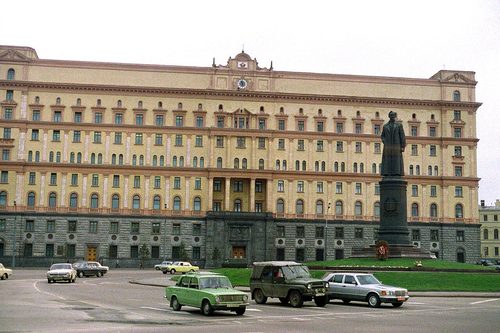 Soviet Union · 1954–1991
KGB
The Soviet Committee for State Security, 1954–1991: foreign intelligence, counter-intelligence, border troops and political police under one roof, from Khrushchev's reforms to the failed coup of August 1991.
1912–2005
Melita Norwood
Secretary at a London metals research association who passed atomic-project papers to Soviet intelligence for decades, was exposed by the Mitrokhin archive in 1999 at the age of 87, and was never prosecuted.
17 July 1983 – 1989
Operation INFEKTION
The 1980s KGB and Stasi campaign to persuade the world that the US military had created AIDS at Fort Detrick: how the story was planted, spread and disowned, and what its codename really was.
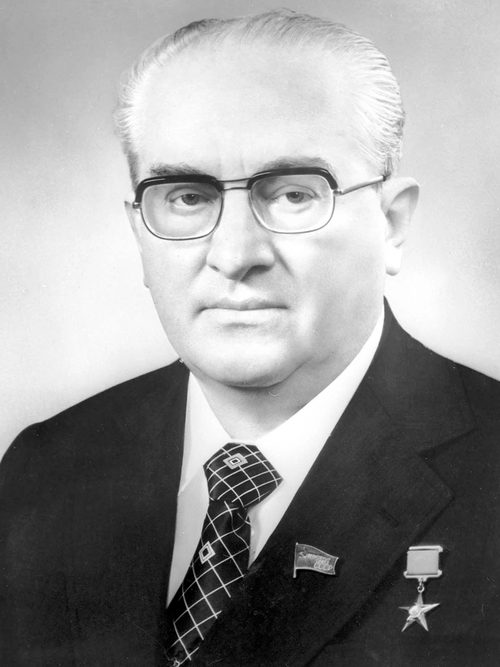 1914–1984
Yuri Andropov
Soviet ambassador in Budapest in 1956, KGB chairman for fifteen years and Soviet leader for fifteen months; the man who launched the RYAN war-scare alert and died in February 1984.
1934 – 23 January 1963
The Cambridge Five
Five Cambridge graduates recruited by Soviet intelligence in the 1930s reached MI6, MI5, the Foreign Office and Bletchley Park, and were exposed one by one between 1951 and 1990.
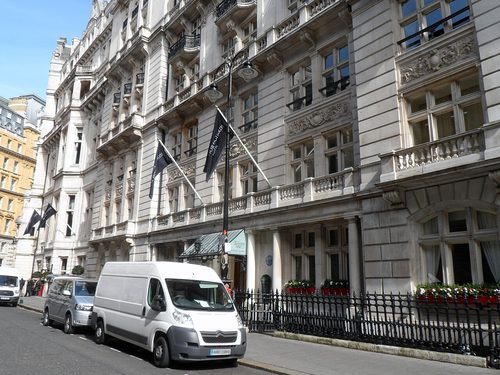 United Kingdom · 1909
Secret Intelligence Service (MI6)
Britain's foreign intelligence service, founded in 1909 as the foreign section of the Secret Service Bureau, run by a chief known as 'C', and not placed on a statutory footing until the Intelligence Services Act 1994.