
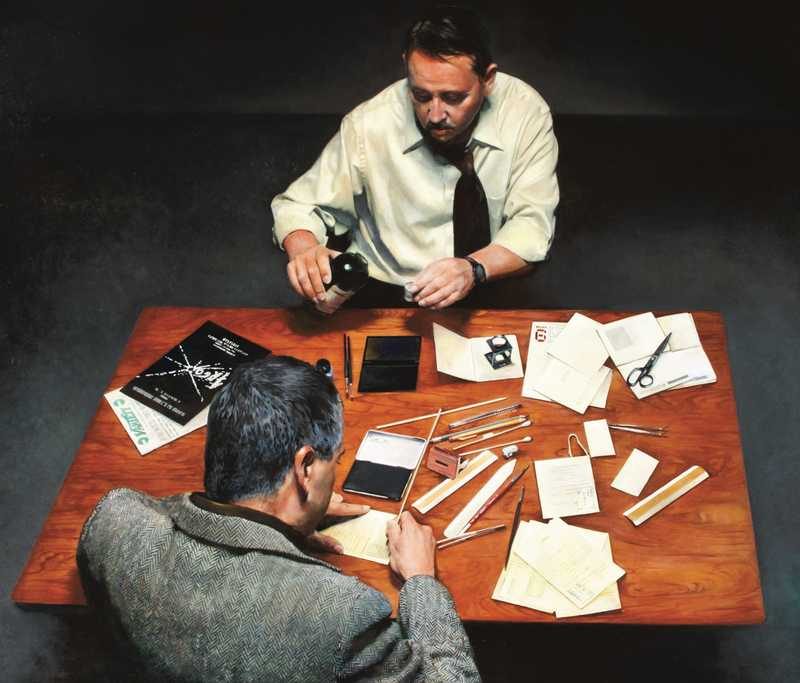
The six were working in the consulate, a separate building at the edge of the American embassy compound in Tehran, when militants came over the wall on 4 November 1979. While the main chancery was overrun and its staff taken hostage, the consular officers slipped out by a back door into the street. They took refuge in an apartment, and four days later one of them, the head of the consular section, Robert Anders, telephoned John Sheardown, the Canadian embassy's chief immigration officer1,3.
Houseguests
Canada's ambassador, Ken Taylor, did not hesitate. He decided to split the Americans between Sheardown's house and his own residence, telling local staff they were visiting Canadian tourists. Ottawa agreed: the Under-Secretary, Allan Gotlieb, wrote that there was "in all conscience ... no alternative," and Foreign Minister Flora MacDonald pulled Prime Minister Joe Clark out of Question Period to get his approval. Joseph and Kathleen Stafford went to Taylor's residence; Anders and Mark and Cora Lijek to Sheardown's. On 21 November the Swedish ambassador asked Taylor to take a sixth American, the agricultural attaché Lee Schatz, who had been hiding with a Swedish diplomat3.
The secret began to fray in December. Jean Pelletier, the Washington correspondent of the Montreal paper La Presse, noticed that American officials gave different numbers of hostages and deduced that some had escaped and that Canada was hiding them. He agreed to hold the story until they were out. On 10 December MacDonald, at a NATO meeting in Brussels, told Secretary of State Cyrus Vance that the time had come; on 30 December they agreed that the two countries would plan the escape together3.
A film nobody would make
At the CIA the problem went to Antonio Mendez, who on 11 December 1979 had become chief of the Office of Technical Service's Authentication Branch, responsible for disguise and false documents. His team weighed three things: whose passports to use, what cover story to give six people with no intelligence training, and whether to move them together or singly. The Agency preferred Canadian passports, and in Ottawa Mendez learned that the Canadian government had already approved issuing passports to non-citizens for humanitarian purposes1,3.
For cover he reversed the usual rule. A good legend, he wrote, follows the user's real background and is dull enough not to interest anyone. Here he wanted something "so exotic that no one would imagine it was being used for operational purposes": a Hollywood crew scouting locations. A makeup artist who had long advised the CIA's disguise section told him that such a scouting party would number about eight people1,4.
In mid-January 1980 the CIA set up "Studio Six Productions" in offices on the old Columbia lot in Hollywood in four days, took full-page advertisements in Variety and The Hollywood Reporter, and dressed up a real but unproduced science-fiction script under the title Argo. The State Department and the Canadians had their own cover ideas, unemployed teachers and food economists among them, and the six would be offered all three1.
Tehran, January 1980
The forged Iranian visas went to Tehran in a Canadian diplomatic pouch "the size of a pillowcase." When they arrived, a Farsi-speaking Canadian diplomat, Roger Lucy, noticed that the visa dates had been written in the Persian calendar wrongly and fell in the future. On 19 January someone telephoned Taylor's residence and asked for one of the Staffords by name. Two days later MacDonald ordered the escape to begin1,3.
Mendez received his visa in Bonn on 23 January. Before he could leave he was told to wait: President Carter was being briefed. Half an hour later the message came, "President has just approved the Finding. You may proceed on your mission to Tehran." Mendez and a second technical officer, known in CIA accounts as "Julio," landed at Mehrabad on 25 January. That evening at Sheardown's house they briefed the six, who chose the film cover. The two officers spent the next day correcting the visas and stamping entry cachets that matched a real flight from Hong Kong1.
In the early morning the eight went to Mehrabad for the 7:30 Swissair flight to Zurich, which the CIA chose for its reliability and because the Revolutionary Guards would still be in bed. The controls passed without trouble, but the flight was announced as delayed by a mechanical problem and left about an hour late1,3.
Credit
The Canadian embassy closed the same day and its last staff left Iran. On 29 January La Presse published Pelletier's story, and Canada received the world's thanks. Taylor was awarded the Congressional Gold Medal and made an Officer of the Order of Canada; Sheardown, Lucy and other embassy staff also received the Order of Canada3.
The CIA said nothing. In May 1980 Mendez and "Julio" received the Intelligence Star in a secret ceremony. The Agency revealed its part in 1997, when it named Mendez one of 50 "Trailblazers" at its fiftieth anniversary, and his account appeared in the unclassified Studies in Intelligence in the winter of 1999–20001,2.
The documents
Declassified records of this operation, with the scans and their full text hosted here.

Checking the record
Dates and outcome compared in two independent sources: they agree.
- Official history
- Embassy seized 4 November 1979; escape on Swissair on Sunday 27 January 1980; La Presse story 29 January 1980. All six escaped; Canadian embassy closed; Taylor awarded the Congressional Gold Medal.
- Wikipedia
- Swissair flight on the morning of Sunday 27 January 1980. Six diplomats and two CIA officers escaped to Zurich.
Canada's history and Wikipedia agree on 27 January. The CIA sources (Mendez's 1999 article and Robarge's 2013 review) both say Monday 28 January 1980; this page gives the Canadian date in the front matter's crosscheck, the CIA date as the end date because the CIA account is the participant's record, and flags the discrepancy as contested.
Sources
- CIA A Classic Case of Deception: CIA Goes Hollywood (Antonio J. Mendez), Studies in Intelligence, Winter 1999–2000, Central Intelligence Agency, Center for the Study of Intelligence (1999).
- CIA Operation Argo in Book and Film (review by David Robarge), Studies in Intelligence 57, no. 1, Central Intelligence Agency, Center for the Study of Intelligence (2013-03).
- Official history Ken Taylor and the Canadian Caper, Global Affairs Canada, History of the Department (2019-06-21).
- Wikipedia Canadian Caper, Wikipedia.
- Wikipedia English Wikipedia article (used for cross-checking).
Elsewhere in the files
Read next
 United States · 1947
Central Intelligence Agency (CIA)
The US civilian intelligence service, created by the National Security Act of 1947 to coordinate foreign intelligence, which within a year also became Washington's instrument for covert action.
 October 1984 – 25 November 1986
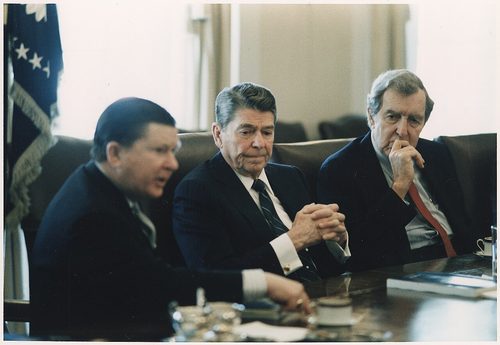
The Iran–Contra affair
In 1985–86 Reagan administration officials secretly sold missiles to Iran to free American hostages and ran a private supply line to the Nicaraguan contras despite a congressional ban, then tried to cover both up.
 4 February – 14 May 1943
Operation Mincemeat
In 1943 British intelligence floated a dead man dressed as a Royal Marines officer ashore in Spain with forged letters pointing at Greece and Sardinia, to hide the coming invasion of Sicily.
 March – 19 August 1953
Operation Ajax (TPAJAX)
The 1953 Anglo-American covert operation that removed Iran's prime minister Mohammad Mosaddeq, as reconstructed from the CIA and State Department records published in 2017.