
Portrait: Erich Mielke, Minister for State Security of East Germany. Unknown. Wikimedia Commons, CC BY 3.0.

On 13 November 1989, four days after the Berlin Wall opened, the minister who had run East Germany's secret police for thirty-two years stood before the Volkskammer for the only time in his career. Deputies laughed and shouted as he lost his thread, and he ended by crying out: "I love, I do love all people!" Four days later the chamber stripped him of his seat4,1.
Red Wedding
Erich Mielke was born on 28 December 1907 in Wedding, a working-class district of Berlin known for its communist vote. His father was a wheelwright. A bright pupil, he won a free place at the classical Köllnisches Gymnasium but left after the tenth grade and trained as a freight clerk. He joined the communist youth league in 1921 and the Communist Party (KPD) in 19271,2.
In 1931, unemployed, he joined the party's armed "self-defense" formation. On 9 August 1931 two police captains, Paul Anlauf and Franz Lenck, were shot from behind outside the Babylon cinema on the Bülowplatz, near the KPD headquarters. Witnesses named Mielke and Erich Ziemer as the men involved. The party had both out of the country with false papers within days, and they went to the Soviet Union2,1.
Moscow, Spain and France
In Moscow Mielke studied and then taught at the International Lenin School, a training ground for foreign communist cadres. From November 1936 to February 1939 he served in the Spanish Civil War under the name Leissner, as an adjutant to Wilhelm Zaisser and as a rear-area officer whose duties included action against anarchist volunteers1,2.
After the Republic's defeat he was interned in France, escaped, and worked as a lumberjack. In 1944, under a false identity, he was taken into the Organisation Todt, the Nazi construction service, and returned to Germany with it in 19451,2.
Builder of the Stasi
He reported to the KPD in Berlin in June 1945 and rose quickly through the new police apparatus in the Soviet zone, becoming vice-president of the German Administration of the Interior in 1946. A warrant issued in Berlin in February 1947 for the 1931 murders was never executed: the Soviet authorities blocked it and took the court files, which he later kept in his own safe1,2,6.
In 1949 he set up the security directorate that on 8 February 1950 became the Ministry for State Security, and served as its second-in-command under Zaisser and then Ernst Wollweber. In the purges of 1950–53 he personally interrogated imprisoned communists accused of links to the West1,2.
Walter Ulbricht made him minister on 1 November 1957. Over the next three decades he expanded the internal surveillance apparatus, took over passport control and special military units, and pressed for a hard line in the reform debates of the 1960s. He was on the staff that prepared the building of the Berlin Wall in August 1961, became a full member of the Politburo in 1976, and in 1980 received the rank of army general1,2. By 1989 the ministry had about 91,000 full-time staff3,4.
Fall and trial
In October 1989 Mielke supported Egon Krenz in removing Erich Honecker. He resigned as minister on 7 November and from the Politburo the next day. The party expelled him on 3 December, and on 7 December the East German military prosecutor arrested him1.
After unification the Berlin Regional Court tried him not for the Stasi's crimes but for the Bülowplatz killings, using evidence that included the 1931 files from his safe. In October 1993 it convicted him and sentenced him to six years. A separate prosecution over the killings at the inner-German border was halted because he was judged unfit to stand trial. He was released early from Moabit prison in August 19951,6.
He died in a Berlin nursing home on 21 May 2000. His ashes were buried in an unmarked grave in the Friedrichsfelde cemetery; within hours of the funeral the wreaths had been torn apart1,5.
Key dates
- 9 August 1931 Takes part in the murder of police captains Paul Anlauf and Franz Lenck on Berlin's Bülowplatz, then flees to the Soviet Union.
- November 1936 Serves in the Spanish Civil War under the name Leissner, until February 1939.
- 8 February 1950 Becomes state secretary of the new Ministry for State Security.
- 1 November 1957 Appointed Minister for State Security.
- 1976 Becomes a full member of the SED Politburo.
- 13 November 1989 Gives his only speech to the Volkskammer: 'But I love all people.'
- 7 December 1989 Arrested by the GDR military prosecutor.
- October 1993 Convicted by the Berlin Regional Court of the 1931 murders and sentenced to six years.
- August 1995 Released early from Moabit prison.
Sources
- Other Mielke, Erich (glossary, by Jens Gieseke), Bundesarchiv, Stasi-Unterlagen-Archiv.
- Other Wer war Erich Mielke? (Klaus Bästlein), Bundeszentrale für politische Bildung (2017).
- Other What was the State Security? Introduction, Federal Archives, Stasi Records Archive.
- Other Stasi-Chef wird zur Lachnummer, Press and Information Office of the Federal Government (Bundesregierung).
- Other Stasi chief's grave vandalised, BBC News (2000-06).
- Wikipedia Erich Mielke, Wikipedia.
- Wikipedia English Wikipedia article (used for cross-checking).
Elsewhere in the files
Read next
 East Germany · 1950–1990
Stasi (Ministry for State Security)
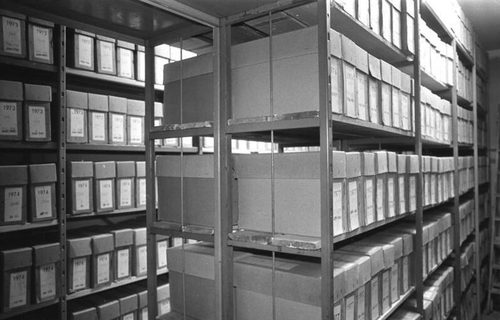
East Germany's secret police and foreign intelligence service, 1950 to 1990: by the end 91,000 staff and 189,000 informers, answerable only to the ruling party, with a spy placed beside Willy Brandt.
 1923–2006
Markus Wolf
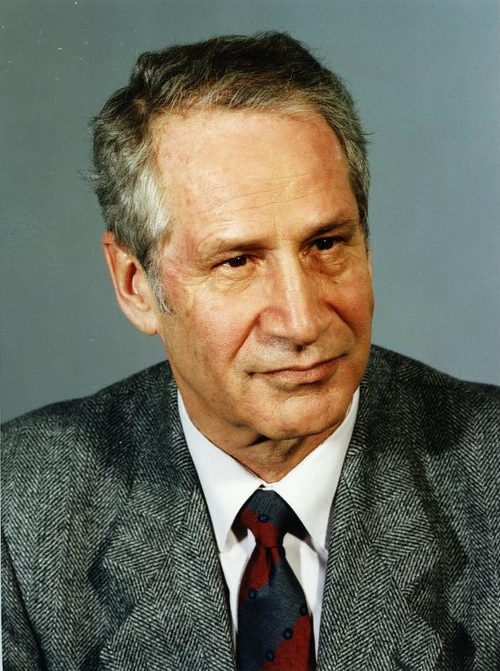
Head of East Germany's foreign intelligence service, the HV A, for more than three decades. The West had no usable photograph of him until 1978. After unification he was convicted of treason, a verdict later quashed.
 1956 – 6 May 1974
The Guillaume affair
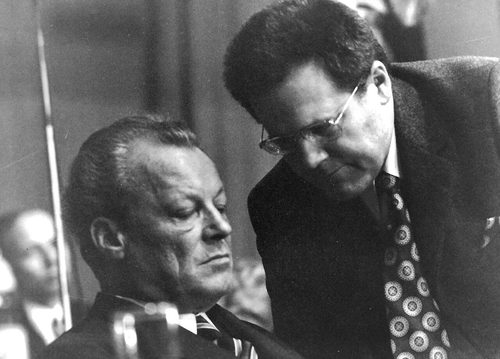
An East German intelligence officer, planted in the West in 1956, rose to become an aide to Chancellor Willy Brandt. His arrest in April 1974 was followed two weeks later by Brandt's resignation.
 Soviet Union · 1954–1991
KGB
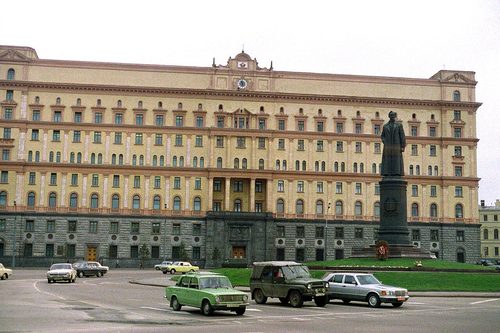
The Soviet Committee for State Security, 1954–1991: foreign intelligence, counter-intelligence, border troops and political police under one roof, from Khrushchev's reforms to the failed coup of August 1991.
 Soviet Union · 1917–1946
Cheka, OGPU and NKVD
The Soviet political police from 1917 to 1946 under its successive names: Cheka, GPU, OGPU and NKVD. It ran the Red Terror, the Trust deception, the Great Terror, Katyn and Stalin's killings abroad.