
Portrait: Noor Inayat Khan, SOE wireless operator (code name Madeleine), 1943. Unknown author. Wikimedia Commons, Public domain.

Most of what was known about Noor Inayat Khan for decades came from a single official text: the George Cross citation published in the London Gazette on 5 April 1949. It says she was the first woman operator infiltrated into occupied France, that she refused the chance to come home when her network fell apart, and that she gave her captors no information of any kind1. Her Special Operations Executive personnel file, opened in 2003, and postwar testimony have since filled in the outline2,4.
Background
She was born in Moscow on 1 January 1914, the eldest child of Inayat Khan, an Indian musician and teacher of Sufism, and his American wife2,3. The family moved to London that year and to Suresnes, outside Paris, in 1920. She studied child psychology at the Sorbonne and published children's stories3,4. When France fell in June 1940 the family escaped to England3.
Despite a pacifist upbringing, she joined the Women's Auxiliary Air Force on 19 November 1940 and was among the first WAAFs trained as wireless operators3. SOE interviewed her in November 19423. Her training reports were mixed: instructors doubted her temperament for clandestine work, while F Section's leadership valued her signaling skill and fluent French4.
Paris, 1943
On the night of 16 June 1943 she was landed by Lysander in northern France under the codename Madeleine, with papers as Jeanne-Marie Renier1,2,3. She was to be wireless operator for the Cinema sub-circuit of the large Prosper network3,4. Within weeks the Germans began mass arrests that destroyed Prosper1,4. London offered to bring her out; the citation records that she refused, because she did not want to leave her French comrades without communications and hoped to rebuild her group1. For more than three months she moved between addresses and kept transmitting, by then the only SOE wireless operator still transmitting from Paris3.
Capture
In October 1943 she was betrayed and taken to the Sicherheitsdienst headquarters on the Avenue Foch1,3. The Germans found her notebooks, in which she had kept copies of her messages, and used them to keep working her radio back to London1,4. She made two attempts to escape, including a rooftop breakout on 25 November with two other prisoners, and refused to sign an undertaking not to try again1,4. She was sent to Germany "for safe custody", which the citation describes as a first for an agent in her position, and held in chains in isolation at Pforzheim1,3.
Dachau
On 11 or 12 September 1944 she was moved to Dachau with three other SOE women, Yolande Beekman, Madeleine Damerment and Eliane Plewman. All four were shot there on the morning of 13 September3,4. The Gazette citation records simply that "on her arrival, she was taken to the crematorium and shot"1.
Recognition
France awarded her the Croix de Guerre with gold star in January 1946, and Britain the George Cross in April 19493. Her file at The National Archives (HS 9/836/5) gives the bare facts: born 1 January 1914, executed 13 September 1944 at Dachau2. A blue plaque marks 4 Taviton Street in Bloomsbury, the address she scratched on her prison bowl at Pforzheim3. Other women of SOE, such as Virginia Hall, survived; she is remembered among those who did not.
Key dates
- 19 November 1940 Enlists in the Women's Auxiliary Air Force and trains as a wireless operator.
- 16 June 1943 Landed by Lysander in northern France as wireless operator 'Madeleine'.
- October 1943 Betrayed and arrested in Paris; held at the SD headquarters on the Avenue Foch.
- 27 November 1943 Sent to Germany and held in solitary confinement at Pforzheim.
- 13 September 1944 Killed at Dachau with three other SOE women.
- 5 April 1949 Posthumous George Cross gazetted.
- 11 April 2003 Her SOE personnel file (HS 9/836/5) opened at The National Archives.
Sources
- Official history The London Gazette, Supplement 38578, 5 April 1949, p. 1703 (George Cross citation), The Gazette (1949-04-05).
- Official history HS 9/836/5: Noor Inayat KHAN, aka Jeanne Marie RENIER, The National Archives (UK), Discovery catalogue (2003).
- Other Noor Inayat Khan: blue plaque, 4 Taviton Street, Bloomsbury, English Heritage.
- Wikipedia Noor Inayat Khan, Wikipedia.
- Wikipedia English Wikipedia article (used for cross-checking).
Elsewhere in the files
Read next
 United Kingdom · 1940–1946
Special Operations Executive (SOE)
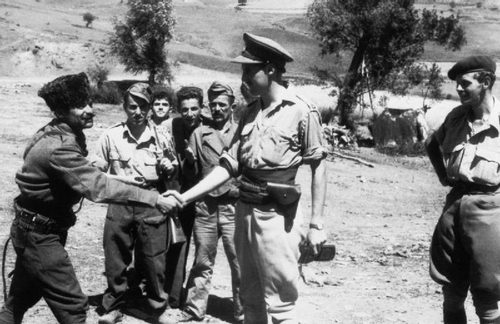
Britain's wartime sabotage and subversion service, created in July 1940 to arm resistance movements in occupied Europe and Asia. It ran Anthropoid and Gunnerside, suffered the Englandspiel, and was wound up in 1946.
 1906–1982
Virginia Hall
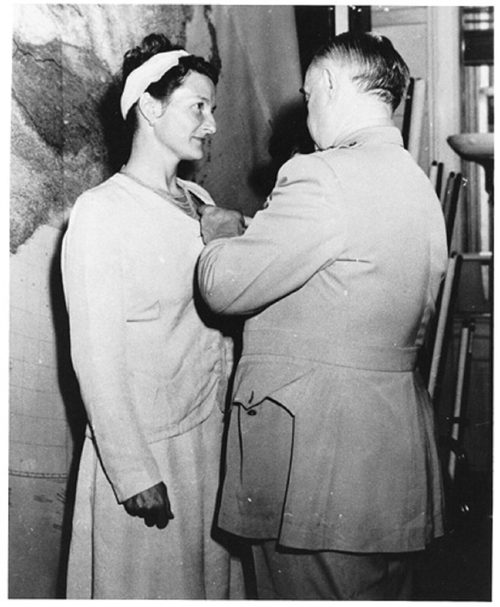
American who ran SOE's first lasting network in Vichy France, escaped over the Pyrenees, returned with the OSS in 1944, and was the only civilian woman awarded the Distinguished Service Cross in World War II.
 1914–1990s
Signals intelligence
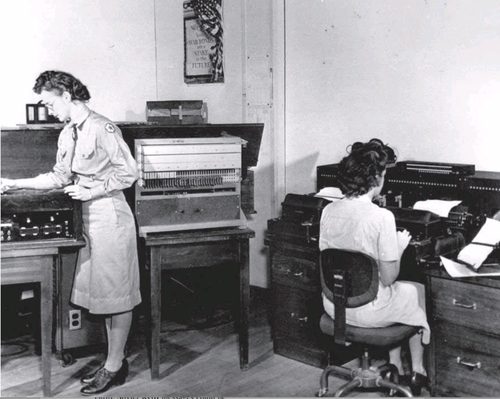
Intelligence from intercepted communications and electronic emissions, from Room 40 and the Zimmermann telegram to Ultra, Venona, the Berlin tunnel and NSA's domestic programs exposed by the Church Committee.