
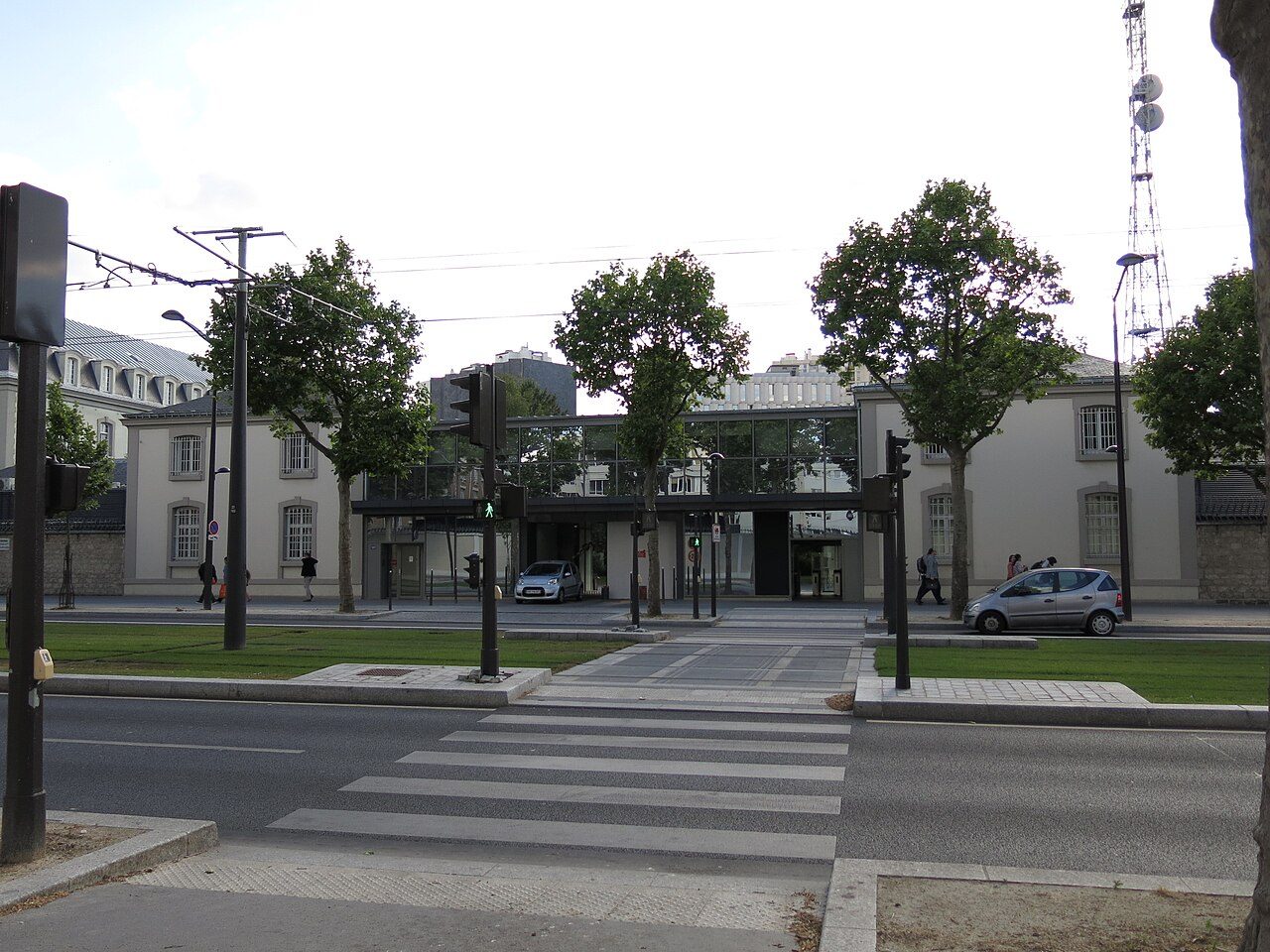

For most of the Cold War, France split its secret services the way Britain did, between a foreign service and a domestic security service, but with less coordination and more rivalry. The Service de documentation extérieure et de contre-espionnage (SDECE) worked abroad. The Direction de la surveillance du territoire (DST), a directorate of the National Police under the Interior Ministry, caught spies at home1,6,7. Their most celebrated success, the FAREWELL case, belonged to the DST, the service that was not supposed to operate abroad3.
From the Free French to the "swimming pool"
The external service traces its line to the Bureau central de renseignements et d'action (BCRA), the intelligence arm Charles de Gaulle's Free French set up in London. In November 1943 it merged with the services built under General Giraud in Algiers, and in October 1944 it became the Direction générale des études et recherches (DGER). By the DGSE's own count the DGER had more than 10,000 agents, 123 buildings and 1,400 cars1.
Colonel Passy (André Dewavrin), the BCRA's wartime chief, was charged with cutting it down. The result, in 1946, was the SDECE, with a much smaller establishment of 880 civilians, 600 military personnel and 750 contract staff. It moved to the boulevard Mortier in eastern Paris and stayed there; its neighbor, a public swimming pool, gave it the nickname la piscine1,6. Passy's design rested on two principles the DGSE still claims: one integrated service for both intelligence and clandestine action, and subordination to political leaders rather than the army. The service reported to the head of government until 1966, when de Gaulle placed it under the Ministry of Defense1.
The DST was older in spirit. A police counterespionage service, the Surveillance du territoire, had been set up in 1934 and was credited with catching many German spies during the Second World War. An order of 16 November 1944 re-created it as the DST, headed by Roger Wybot, who had run counterespionage for the BCRA; he led it until 19597.
The SDECE at war and in scandal
The SDECE fought France's colonial wars. In Indochina it ran commando and guerrilla units; in Algeria its Action Service went after the FLN's supply lines in Europe6,1.
It was also a working ally of the CIA. On 23 October 1962, during the Cuban missile crisis, Sherman Kent, the CIA's chief of national estimates, briefed the SDECE's director, General Paul Jacquier, and his senior staff on the photographs of Soviet missiles in Cuba. Kent reported "absolutely no hint of doubt with respect to the genuineness of the photographs"2. See Intelligence in the Cuban Missile Crisis.
Relations then soured. The KGB defector Anatoliy Golitsyn told the CIA that a Soviet network, which the CIA called Sapphire, reached into the SDECE's leadership. De Gaulle regarded the allegation as an American attempt to disorganize his service, and cooperation suffered6.
On 29 October 1965 Mehdi Ben Barka, a Moroccan opposition leader living in Paris, was seized on a Paris street and never seen again. French police officers and men connected to the SDECE took part in the abduction; a 1967 trial sent two Frenchmen to prison and found that the main culprit was Morocco's interior minister, General Mohamed Oufkir. The affair is what led de Gaulle to move the SDECE under the Defense Ministry8,6.
In 1970 President Pompidou appointed Count Alexandre de Marenches to clean the service up. He dismissed a large share of the staff, restored ties to the CIA and ran the SDECE until June 19816. The incoming Mitterrand government replaced him and, on 2 April 1982, reorganized the SDECE as the Direction générale de la sécurité extérieure (DGSE), at the same address1,6.
The DST and FAREWELL
The DST's Cold War work was mostly invisible: watching Soviet bloc diplomats and their French contacts. It had its own scandals. In December 1973 DST officers posing as plumbers were caught installing a microphone in the offices of the satirical weekly Le Canard enchaîné7. In June 1975 the terrorist Carlos shot dead two DST inspectors in Paris7.
Its great coup came in 1981. Vladimir Vetrov, a KGB officer evaluating Soviet technology theft, chose to approach the DST rather than the SDECE, reasoning that the KGB watched French foreign intelligence but not the police service. The DST ran him in Moscow through French civilians, gave him the English code name FAREWELL, and, with Mitterrand's approval, shared his documents with Washington3,4. The dossier identified hundreds of Soviet technology collectors, and on 5 April 1983 France expelled 47 Soviet officials5. The rivalry it stirred lasted: former French officers later claimed the case had been a CIA test of Mitterrand, and in 1985 Mitterrand, suspecting as much, dismissed the DST's director, Yves Bonnet4,5.
The DST continued until 1 July 2008, when it merged with the police intelligence service, the Renseignements généraux, to form the DCRI7.
Key dates
- 16 November 1944 An order signed by de Gaulle's government creates the DST under Roger Wybot.
- 1946 The DGER is cut down and reorganized as the SDECE, which settles on the boulevard Mortier.
- 23 October 1962 CIA's Sherman Kent briefs SDECE chief General Paul Jacquier on Soviet missiles in Cuba.
- 29 October 1965 Moroccan opposition leader Mehdi Ben Barka is abducted in Paris; an SDECE contact is implicated.
- 1966 De Gaulle moves the SDECE from the prime minister's office to the Ministry of Defense.
- 6 November 1970 Alexandre de Marenches becomes director and purges the service.
- 1981 The DST begins running KGB officer Vladimir Vetrov, code-named FAREWELL.
- 2 April 1982 The SDECE is replaced by the Direction générale de la sécurité extérieure (DGSE).
- 5 April 1983 France expels 47 Soviet officials identified by the DST's FAREWELL material.
- 1 July 2008 The DST merges with the Renseignements généraux to form the DCRI.
Operations in these files
People
Sources
- Official history Du BCRA à la DGSE, Ministère des Armées, Chemins de mémoire (author: Direction générale de la sécurité extérieure).
- FRUS Foreign Relations of the United States, 1961–1963, Volumes X/XI/XII, Microfiche Supplement, Document 352 (Memorandum for the record by Sherman Kent), US Department of State, Office of the Historian (1962-11-14).
- CIA The Intelligence Officer's Bookshelf, June 2012 (review of Kostin and Raynaud, Farewell), Central Intelligence Agency, Studies in Intelligence 56, no. 2 (Hayden Peake) (2012-06).
- CIA Duping the Soviets: The Farewell Dossier (Studies in Intelligence, 1996), Central Intelligence Agency, Center for the Study of Intelligence (Gus W. Weiss) (1996).
- Other How the Cold War was won by the French, The Independent (John Lichfield) (2009-09-17).
- Wikipedia Service de documentation extérieure et de contre-espionnage, Wikipedia.
- Wikipedia Direction de la surveillance du territoire, Wikipedia.
- Wikipedia Ben Barka affair, Wikipedia.
- Wikipedia English Wikipedia article (used for cross-checking).